
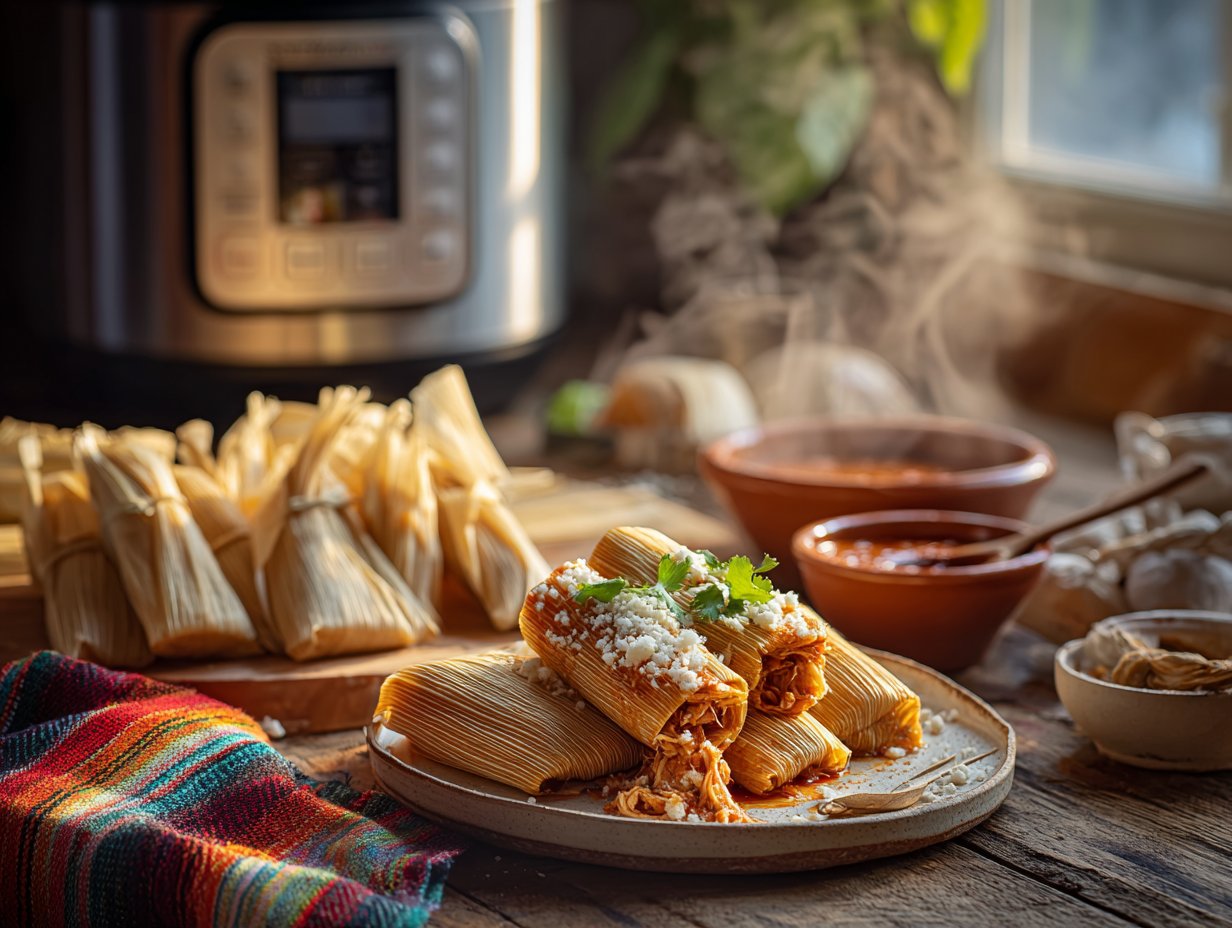
These mini chicken tamales come together in 35 minutes using rotisserie chicken, masa harina, and either an Instant Pot or a stovetop steamer. The smaller size isn’t a gimmick — it cuts steam time significantly and makes them easier to serve to a table of mixed appetites. If tamales have always felt like a weekend-only project, this recipe changes that.
What makes this version work
Two things actually drive this recipe. First, the mini format: less masa per tamale means steam penetrates faster, so you get fully cooked, tender masa in 20 minutes instead of the 60-plus that full-size tamales need. Second, baking powder in the masa. It’s not traditional, but it creates a lighter, less dense texture that holds up well under the shorter cook time — without it, the masa can turn out heavy and gluey. Everything else — the rotisserie chicken, the canned red chile sauce — is just smart use of what’s already in your kitchen on a Tuesday.
Shopping notes
- Masa harina: Look for Maseca or Bob’s Red Mill in the Latin foods aisle or near the cornmeal. Regular cornmeal is not a substitute — the texture will be completely wrong.
- Dried corn husks: Usually sold in a bag near the masa harina. Soak them in just-boiled water for at least 15 minutes; cold water won’t soften them enough to fold without cracking.
- Lard: Found near the shortening or in the Latin foods section. If you’re using refined coconut oil as a swap, make sure it’s refined (not virgin) — virgin coconut oil adds a noticeable coconut flavor that doesn’t work here.
- Red enchilada sauce: Any canned brand works. Green enchilada sauce is a legitimate swap if that’s what you have — the filling will taste different but still good.
- Queso fresco: Optional for serving. Skip the garnish if you’re feeding kids who won’t eat it anyway — not worth the extra dish.
Leftovers and make-ahead
Cooked tamales keep in an airtight container in the fridge for up to 4 days. To reheat, wrap them in a damp paper towel and microwave for 60–90 seconds — they come out nearly as good as fresh. For longer storage, freeze them in a single layer on a baking sheet first, then transfer to a zip-top bag; they’ll keep for up to 3 months. Reheat from frozen in the microwave for 2–3 minutes, flipping once halfway through, or steam them for about 10 minutes. You can also assemble the tamales up to 24 hours ahead and refrigerate them uncooked, tightly wrapped in plastic — steam them straight from the fridge, adding 3–4 minutes to the cook time.
Troubleshooting
- Masa sticks to the husk and won’t peel off after cooking: The tamales needed more time. If the masa is still wet and sticky, re-fold the husks and steam for another 5 minutes. Properly cooked masa releases cleanly from the husk.
- Tamales are dense and gummy in the center: Either the masa was spread too thick or the steam wasn’t hot enough before you added them. Make sure the water is actively boiling and producing steam before the tamales go in, and keep the lid on throughout cooking.
- Husks split during folding: They weren’t soaked long enough. Put them back in hot water for another 5–10 minutes. Thinner husks are more flexible — if you have a choice, pick those for the outer wrap.
- Filling leaks out during steaming: Too much filling, or the masa wasn’t spread close enough to the edges to seal properly. Use about 1 tablespoon of filling per tamale and make sure the masa layer overlaps the filling on all sides before folding.
- Uneven cooking — some done, some underdone: The tamales at the bottom of the steamer cook faster. Stand them upright with the open end up rather than laying them flat, and make sure they’re packed snugly so they don’t tip over and lose their shape.
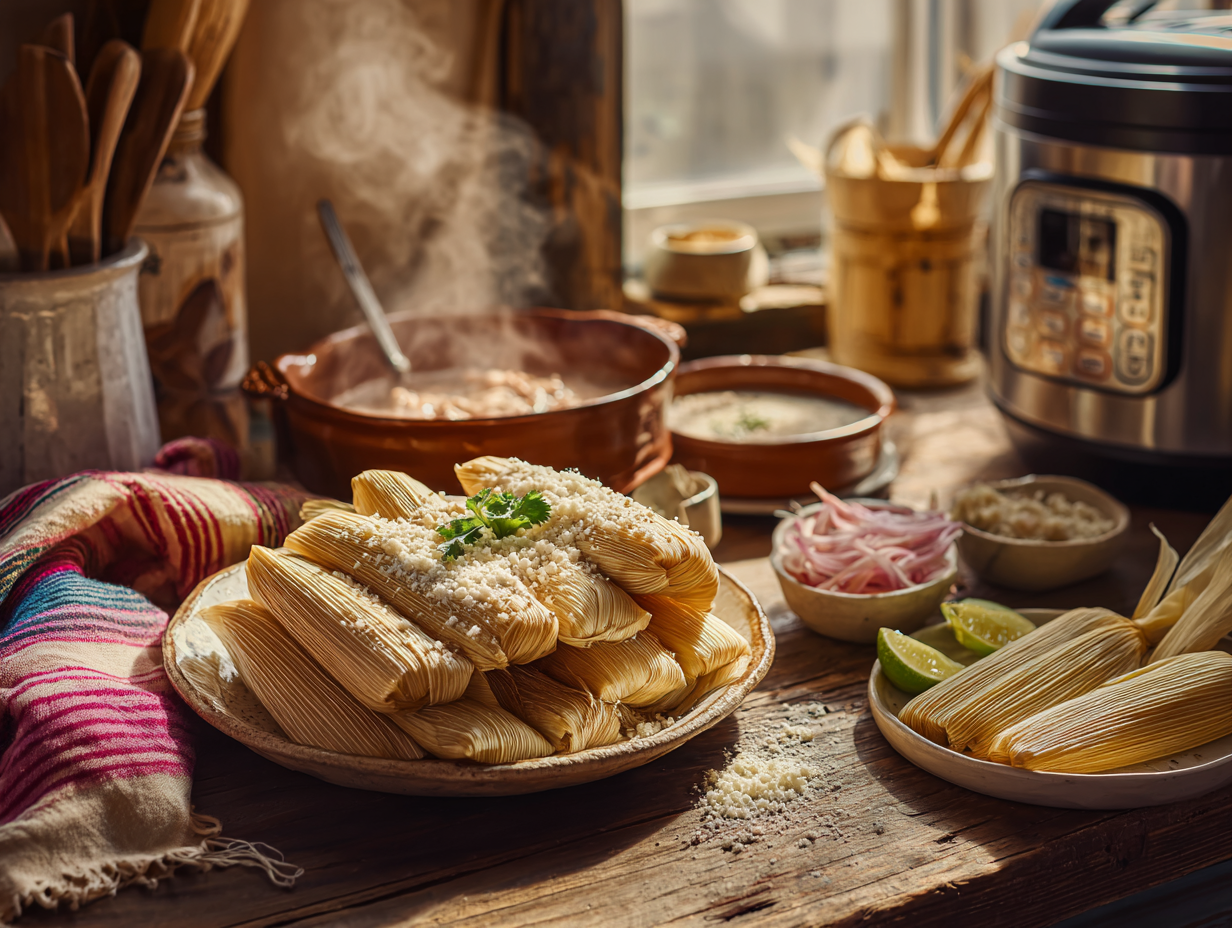
Weeknight Mini Chicken Tamales (Instant Pot or Stovetop)

Equipment
- Instant Pot or electric pressure cooker (with steam rack)
- Stovetop steamer or large pot with steamer insert (alternative)
- Large heatproof bowl (for soaking husks)
- Kettle or pot (to heat water to just-boiling)
- Tongs
- Small skillet
- Mixing bowls
- Hand mixer or stand mixer (paddle) or sturdy whisk
- Measuring cups and spoons
- Silicone spatula or small offset spatula
- Cutting board and knife
Ingredients
For Husks
- As needed Hot water (for soaking husks, about 205°F/96°C) Use enough to fully submerge husks
- 20 pieces Dried corn husks Choose broad, unbroken husks for easier spreading
Chicken–Chile Filling
- 1 tbsp Neutral oil Avocado or canola
- ¼ cup White onion, finely diced About 1/4 small onion
- 2 cloves Garlic, minced Freshly minced for best aroma
- 2 cups Shredded rotisserie chicken Skin removed; mix light and dark meat for juiciness
- 1 cup Red enchilada sauce or New Mexico red chile sauce Smooth style; look for Hatch or Las Palmas
- ½ tsp Ground cumin Briefly bloom in oil for best flavor
- ½ tsp Dried Mexican oregano, crushed Rub between fingers to release aroma
- ¼ tsp Kosher salt To taste, depending on sauce saltiness
- ¼ tsp Freshly ground black pepper
- ½ cup Queso fresco, crumbled Optional, for a creamy finish
Quick Masa Dough
- ½ cup Rendered lard, room temperature Or refined coconut oil for a dairy-free option
- 2 cups Masa harina Maseca or Bob’s Red Mill
- 1 tsp Baking powder Ensures lift for quick steaming
- 1 tsp Kosher salt
- 1 ½ cups Low-sodium chicken broth, warmed About 120°F/49°C for easier emulsification
For Assembly & Steaming
- 1 cup Water (for pressure cooker steaming) Use 2 cups for larger cookers if recommended by manufacturer
- As needed Corn husk strips or kitchen twine Optional, for tying pairs of tamales
- ⅓ cup Mexican crema For serving
- ¼ cup Fresh cilantro, chopped For garnish
- 1 large Lime, cut into wedges For serving
- ¼ cup Pickled red onions Optional, brightens richness
Instructions
- Soak the husks (10 minutes, overlaps with prep): Place dried corn husks in a large heatproof bowl. Pour over just-boiling water, about 205°F/96°C, and weigh down with a plate so they’re submerged. Soak 10 minutes until pliable, then drain and pat dry. While husks soak, proceed with steps 2 and 3.
- Cook the quick filling (4–5 minutes): Heat a small skillet over medium heat (surface ~350°F/175°C). Add oil, then onion; sauté 2–3 minutes until translucent and sweet. Stir in garlic for 30 seconds until fragrant. Add shredded chicken, red chile sauce, cumin, oregano, salt, and pepper. Simmer 1–2 minutes until thick and saucy. Remove from heat; fold in queso fresco if using.
- Make the quick masa (4–5 minutes): In a mixing bowl, beat the lard with a hand or stand mixer 1–2 minutes until pale and fluffy. In another bowl, whisk masa harina, baking powder, and salt. With the mixer on low, add dry mix to the lard, then stream in warm broth (about 120°F/49°C) until a thick, spreadable dough forms—like soft peanut butter. Beat 1 minute more to aerate. If too stiff, add 1–2 tbsp broth; if too loose, sprinkle in a bit more masa. Optional float test: a pea of dough should float in cold water when properly aerated.
- Assemble mini tamales (5–7 minutes): Lay a husk smooth-side up, wide end at top. Spread about 2 tbsp masa into a 3-by-3-inch square, ~1/8-inch thick, leaving a 1/2-inch border at sides and 1 inch at the top. Spoon ~1 tbsp filling down the center. Fold the sides over to meet and lightly press to seal; fold the narrow tail up. Tie two tamales together with a husk strip if desired—it speeds loading and unloading. Repeat to make about 12 mini tamales.
- Steam—Instant Pot (fastest): Pour 1 cup water into the cooker. Insert steam rack. Arrange tamales vertically, open ends up. Seal lid and set to High Pressure for 15 minutes. Quick release (about 5 minutes), then open and rest 5 minutes with lid ajar so the masa sets. Alternative stovetop steamer: Bring water to a lively simmer (about 212°F/100°C), load tamales upright, cover, and steam 25–30 minutes, checking water level and adding hot water as needed.
- Serve: Tamales are done when the masa looks matte, feels springy, and pulls cleanly from the husk. Rest 3 minutes, then unwrap, drizzle with crema, and finish with cilantro, lime, and pickled onions.
Notes
Lisa’s Tips
- Masa texture: Aim for thick, spreadable dough; too wet leads to gummy results. Aeration (brief beating) gives quicker lift in short cook times.
- Fat choices: Lard delivers classic flavor. Refined coconut oil works for a dairy-free alternative; add a pinch more salt to compensate.
- Sauce swap: Use green enchilada sauce and shredded pork for salsa verde tamales, or sauté mushrooms for a vegetarian version (add 1 tbsp oil and 1/2 tsp smoked paprika).
- No mixer? Use a sturdy whisk or wooden spoon; beat vigorously to incorporate air. Texture will be slightly denser but still delicious.
- Keep steam steady: Whether pressure or stovetop, consistent steam ensures even cooking. Do not let the pot run dry.
Serving Suggestions
- Plate tamales still in their husks on a warm plate, then open like a gift at the table. The contrast of ivory masa, ruby-red chile, and green cilantro is festive and appetizing.
- Pair with a simple jicama-cucumber salad and a crisp Mexican lager or aguas frescas (hibiscus or lime).
Culinary Context
Tamales trace back to pre-Columbian Mesoamerica as a portable, celebratory food wrapped in corn husks or banana leaves. This streamlined, mini format honors the flavors—corn, chile, and slow-cooked meats—while adapting technique so weeknights can taste like a holiday.Optional Advanced Instructions
- Make-ahead: Soak husks up to 3 days in advance (refrigerated, covered). Filling can be made 2 days ahead. Assembled, uncooked tamales hold 24 hours in the fridge.
- Batch cooking: Double the recipe and freeze cooked tamales. Reheat in a steamer for 8–10 minutes or microwave wrapped in a damp paper towel (60–90 seconds).
- Beginners: Spread masa using a small offset spatula or the back of a spoon; a light spritz of water on the husk helps keep masa from sticking.
Timing, Course & Origin
- Prep time: 15 minutes (husks soak while you make filling and masa)
- Cook time: 20 minutes (Instant Pot: 15 minutes pressure + ~5 minutes quick release/rest)
- Course: Dinner (also great for Lunch)
- Cuisine/Origin: Mexican
Nutrition
Your questions, answered
Can I use fresh shredded chicken instead of rotisserie?
Yes, any cooked shredded chicken works fine. Poached or leftover baked chicken both work — just make sure it’s well-seasoned before you add it to the filling, since plain cooked chicken will taste flat inside the masa.
Do the corn husks need to be completely dry before I spread the masa?
No — a little moisture on the husk is fine and actually helps the masa spread more smoothly. Just shake off any excess water so the husk isn’t dripping wet, which can make the masa slide around.
Can I make these without an Instant Pot?
Absolutely — a stovetop steamer or a large pot with a steamer insert works just as well. Keep the water at a steady boil and check it halfway through to make sure it hasn’t run dry; add more boiling water if needed.
My kids don’t like spicy food — is this recipe too hot?
It depends on the enchilada sauce you choose — mild canned red enchilada sauce makes the filling very approachable. Check the label before you buy and go with a mild variety; the cumin and oregano add flavor without heat.
What to cook next
- Quick Chicken Enchiladas Rojas
- Quick Slow Cooker Chicken Tinga
- Citrus Mojo Rice and Beans
- Smoky Lime Corn Salad