
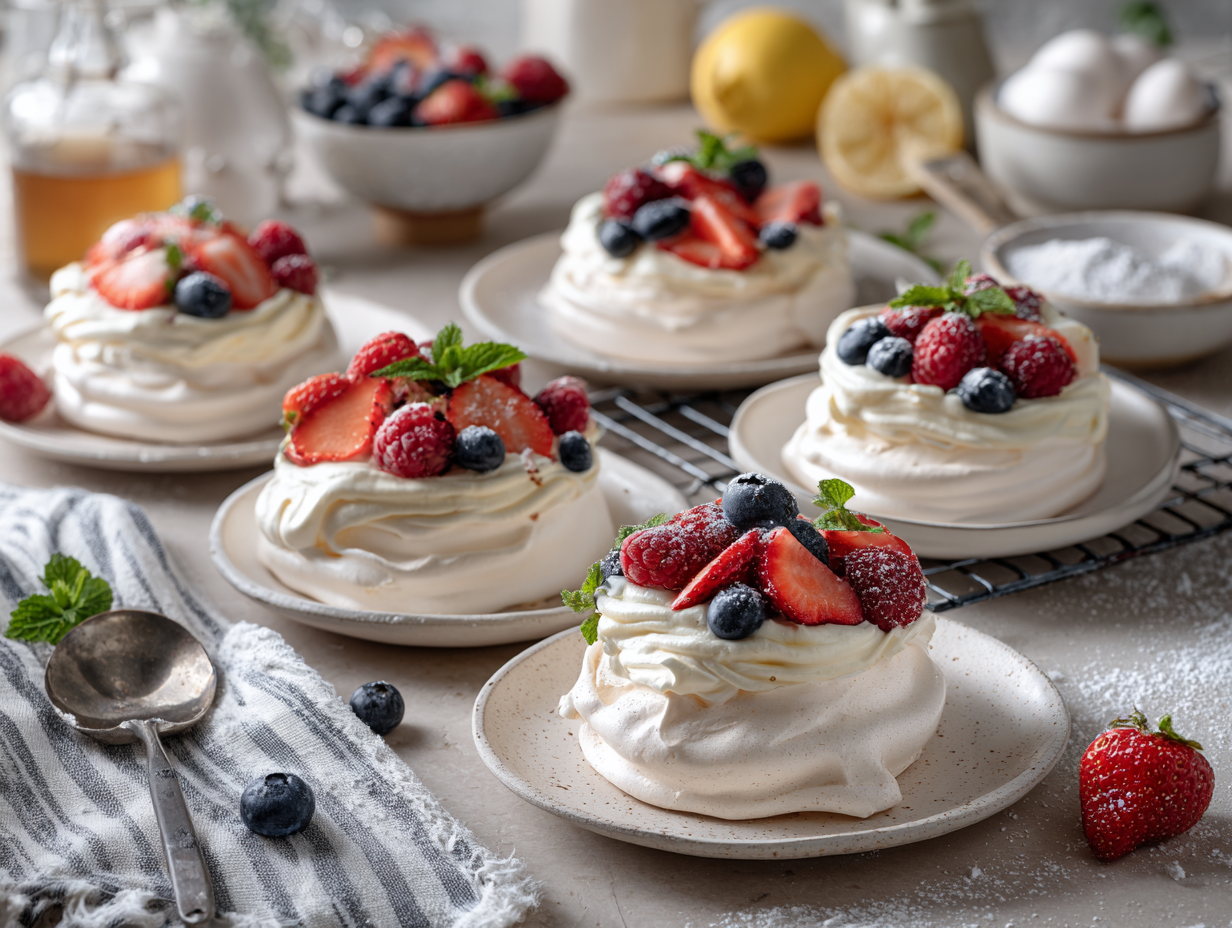
These mini pavlovas take 40 minutes start to finish — 15 to mix and shape, 25 to bake — and each one comes out with a crisp shell and a soft, marshmallowy center. You top them with vanilla whipped cream and fresh berries right before serving. The honest reason to make them tonight: the shells keep for 24 hours, so you can bake a batch now and have an impressive dessert ready to assemble in minutes tomorrow too.
Why this recipe works
Two ingredients do the real work here: cornstarch and vinegar. The cornstarch slows moisture loss in the center of each shell while it bakes, which is what gives you that soft, chewy interior instead of a meringue that’s brittle all the way through. The vinegar stabilizes the egg white proteins so the foam holds its structure during baking and doesn’t weep or collapse. Neither ingredient is detectable in the finished pavlova — they’re purely functional. The mini format cuts baking time dramatically compared to a full-size shell, which means you’re not waiting around for an hour-plus of low-and-slow baking on a weeknight.
About the ingredients
- Egg whites: Pull them from the fridge about 30 minutes before you start. Cold whites whip, but room-temperature whites whip to a larger, more stable volume.
- Cornstarch: Regular cornstarch from any grocery store. Don’t substitute arrowroot — it behaves differently at these temperatures and can make the center gummy rather than marshmallowy.
- White vinegar: Plain distilled white vinegar works. Cream of tartar is a common substitute (use ¼ teaspoon per egg white), but skip apple cider vinegar — the flavor comes through.
- Fresh berries: Frozen berries release too much liquid and will make the shells soggy within minutes of topping. Stick with fresh, and pat them dry before using.
Common problems and fixes
- Shells crack badly while baking: The oven is too hot or the temperature spiked. Use an oven thermometer — many home ovens run 25°F hot. If cracks appear, don’t open the oven door; let them finish and the whipped cream will cover minor cracks anyway.
- Meringue won’t stiffen past soft peaks: There’s fat in the bowl or on the beaters. Even a trace of egg yolk will do it. Wipe everything down with a paper towel dampened with white vinegar, then start over with new whites.
- Shells weep or turn sticky after cooling: Humidity is the culprit. Don’t make the shells on a rainy or very humid day if you can help it. If you’re in a humid climate, store the cooled shells in an airtight container with a silica packet or a few grains of dry rice to absorb moisture.
- Flat shells with no height: Sugar was added too fast. Dumping it in all at once deflates the foam before it has a chance to stabilize. Add it one tablespoon at a time with the mixer running.
- Shells stick to the parchment: They weren’t fully cooled before you tried to lift them. Let them cool completely on the pan — rushing this step tears the base.
Leftovers and make-ahead
Baked, unfilled shells keep well at room temperature in an airtight container for up to 24 hours — this is the move if you want to bake a full batch of six and use them across two nights. Once topped with cream and berries, the shells start softening within an hour, so assemble only what you’re serving immediately. Leftover whipped cream keeps in the fridge for up to 48 hours in a covered bowl; give it a quick stir before using. Skip freezing the shells — the moisture from thawing turns them sticky and soft, and there’s no good way to bring them back. If you have extra egg yolks from separating the whites, they keep refrigerated for two days and work well in scrambled eggs or a quick custard sauce.
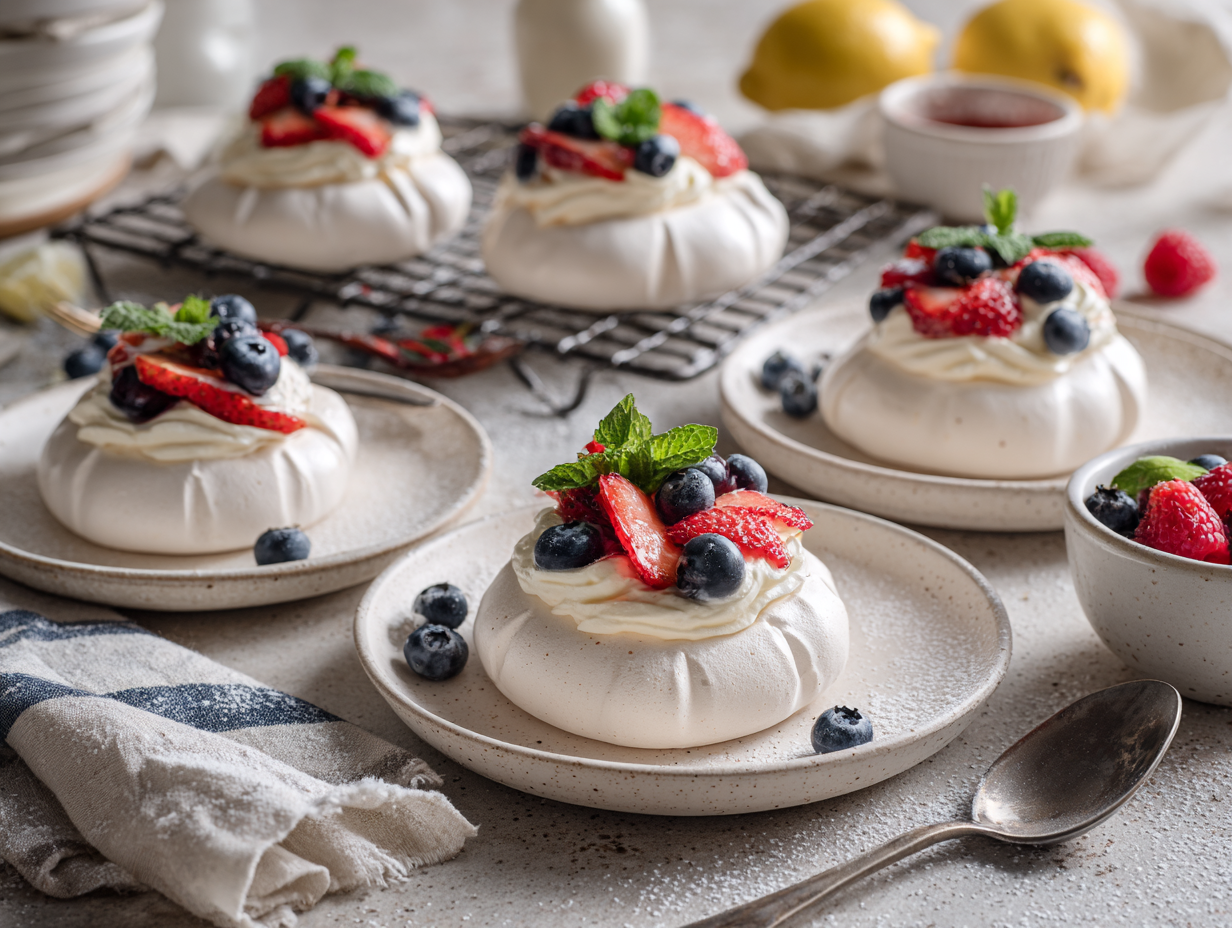
Pavlova Recipe: Quick Mini Pavlovas with Berries

Equipment
- Stand mixer or hand mixer
- Large clean, dry mixing bowl (metal or glass)
- Rubber spatula
- Baking sheet
- Parchment paper
- Piping bag with large round or star tip (optional)
- Offset spatula or spoon
- Measuring cups and spoons
- Instant-read thermometer (optional)
- Cooling rack
Ingredients
For the Mini Pavlovas
- 3 large egg whites Room temperature for best volume (from about 3 large eggs)
- ¾ cup superfine sugar (caster sugar) About 5.3 oz; use superfine or pulse granulated sugar 10–15 sec in a food processor
- 1 teaspoon cornstarch Helps keep the center marshmallowy
- ½ teaspoon distilled white vinegar Stabilizes the meringue
- ½ teaspoon pure vanilla extract
- 1 pinch fine sea salt Enhances sweetness
For the Vanilla Cream
- ¾ cup heavy whipping cream Cold; 36%+ fat
- 2 tablespoons powdered sugar Also called confectioners’ sugar
- ½ teaspoon pure vanilla extract
- 1 teaspoon lemon zest Optional, brightens the cream
For the Topping
- 1 cup mixed fresh berries Strawberries (hulled and sliced), blueberries, raspberries; as seasonal as possible
- 1 tablespoon berry jam Optional; warmed for glazing fruit
- 1 teaspoon water Optional; to loosen jam for glazing
- 6 leaves fresh mint Optional, small leaves for garnish
Instructions
- Preheat and prepare pans: Heat oven to 300°F (150°C). Line a baking sheet with parchment. For even sizing, draw six 3-inch circles on the underside of the parchment as a guide. Ensure your mixing bowl and beaters are impeccably clean and dry—wipe with a little vinegar to remove any grease.
- Start the meringue: In a large bowl, add 3 room-temperature egg whites and a pinch of fine sea salt. Beat on medium speed until foamy and opaque, about 1 minute. Increase to medium-high to reach soft peaks—when the whisk leaves gentle trails and the peaks droop.
- Add sugar gradually: With the mixer running on medium-high, add the superfine sugar 1 tablespoon at a time, waiting 15–20 seconds between additions so it dissolves. Continue beating until the meringue is glossy, billowy, and forms stiff peaks, 4–6 minutes total. Rub a little between your fingers; it should feel smooth with no grit.
- Stabilize and flavor: Sprinkle the cornstarch over the top, then add the vinegar and vanilla. Fold gently with a rubber spatula just until incorporated (about 6–8 folds). Avoid deflating the mixture.
- Shape the minis: Spoon the meringue into six mounds on the parchment (or pipe using a large tip), each about 3 inches wide and 1 inch tall. Use the back of a spoon to make a shallow well in the center of each—this cradles the cream and fruit later.
- Bake: Place on the center rack and bake at 300°F (150°C) for 23–25 minutes, until the outsides are set and crisp, the color is pale ivory, and they lift easily from the parchment. Turn the oven off, crack the door, and let them sit for 5 minutes to minimize cracking. Transfer the tray to a cooling rack and cool 10 minutes while you prepare the cream and fruit.
- Whip the vanilla cream: In a chilled bowl, whisk heavy cream, powdered sugar, vanilla, and lemon zest to soft-medium peaks, 1–2 minutes. The cream should hold gentle swoops and look silky, not grainy.
- Prep the fruit: If glazing, warm the jam 10–15 seconds in the microwave and loosen with 1 teaspoon water. Gently toss the berries with a little glaze or leave them fresh for contrast.
- Assemble and serve: Lift pavlovas carefully onto plates. Spoon a cloud of vanilla cream into each well. Top with berries, drizzle any remaining glaze, and garnish with mint. Serve immediately while the shells are crisp and the centers tender.
Notes
Lisa’s Tips
- No superfine sugar? Pulse granulated sugar in a food processor 10–15 seconds until it looks sandy. Finer crystals dissolve faster for a smoother meringue.
- Humidity hack: If shells soften, return to a 250°F (120°C) oven for 5–7 minutes to re-crisp. Cool before filling.
- Dairy-free: Use chilled coconut cream instead of heavy cream; whisk with a little powdered sugar and vanilla.
- Flavor twists: Swirl 1 ounce melted dark chocolate into the meringue before baking for a stracciatella effect, or fold in 1 teaspoon finely ground freeze-dried berries.
- Sparkling edges: For a subtle crunch, dust shells with a tiny sprinkle of extra-fine sugar before baking.
Serving Suggestions
- Plate on a brush of berry coulis or a spoon of lemon curd for color contrast.
- Dust lightly with powdered sugar and add edible flowers or citrus zest threads for fragrance and visual pop.
- Pair with a glass of Prosecco, Moscato, or a pot of Earl Grey—bergamot loves berries.
Culinary Context
Pavlova is a proud icon of both Australia and New Zealand, honoring Russian ballerina Anna Pavlova. The hallmark is the textural duet: a crisp shell and marshmallow-soft interior. This mini format preserves the spirit of the classic while trimming the baking time—ideal for home cooks on a schedule.Optional Advanced Instructions
- Make-ahead shells: Bake up to 24 hours in advance; store airtight with a packet of desiccant or uncooked rice. Fill just before serving.
- Swiss meringue option (extra-stable): Whisk egg whites and sugar over a simmering water bath until the mixture reaches 160°F (71°C) and the sugar dissolves, then whip to stiff peaks. Bake as directed.
- Double-batch tip: Bake one tray at a time on the middle rack for even drying.
Timing, Course, and Origin
- Prep Time: 15 minutes (0:15)
- Cook Time: 25 minutes (0:25)
- Total Time: 40 minutes (0:40)
- Course: Dessert
- Origin/Cuisine: Australian & New Zealand
Nutrition
Frequently asked questions
Can I make these without a stand mixer?
Yes — a hand mixer works fine. It will take a few minutes longer to reach stiff peaks, usually 8 to 10 minutes on high speed instead of 5 to 7.
How do I know when the shells are actually done baking?
The outside should feel dry and set when you lightly tap it, and the shells should lift cleanly off the parchment with no wet or sticky spots on the bottom. If they’re still tacky, give them another 3 to 5 minutes and check again.
My sugar isn’t fully dissolving — the meringue feels gritty. What do I do?
Keep beating. Undissolved sugar is almost always a sign the mixer needs more time, not that something went wrong. Rub a small amount of meringue between your fingers — when you can’t feel any grit, it’s ready.
Can I use carton egg whites instead of cracking whole eggs?
No — pasteurized carton whites don’t whip reliably to stiff peaks and will likely give you flat, dense shells. Use fresh whole eggs and separate them yourself.
If you liked this one
- Quick Lemon Meringue Pie
- Quick French Cream Puffs
- Quick Double Chocolate Cookies
- Bright Lemon Bar Bliss