
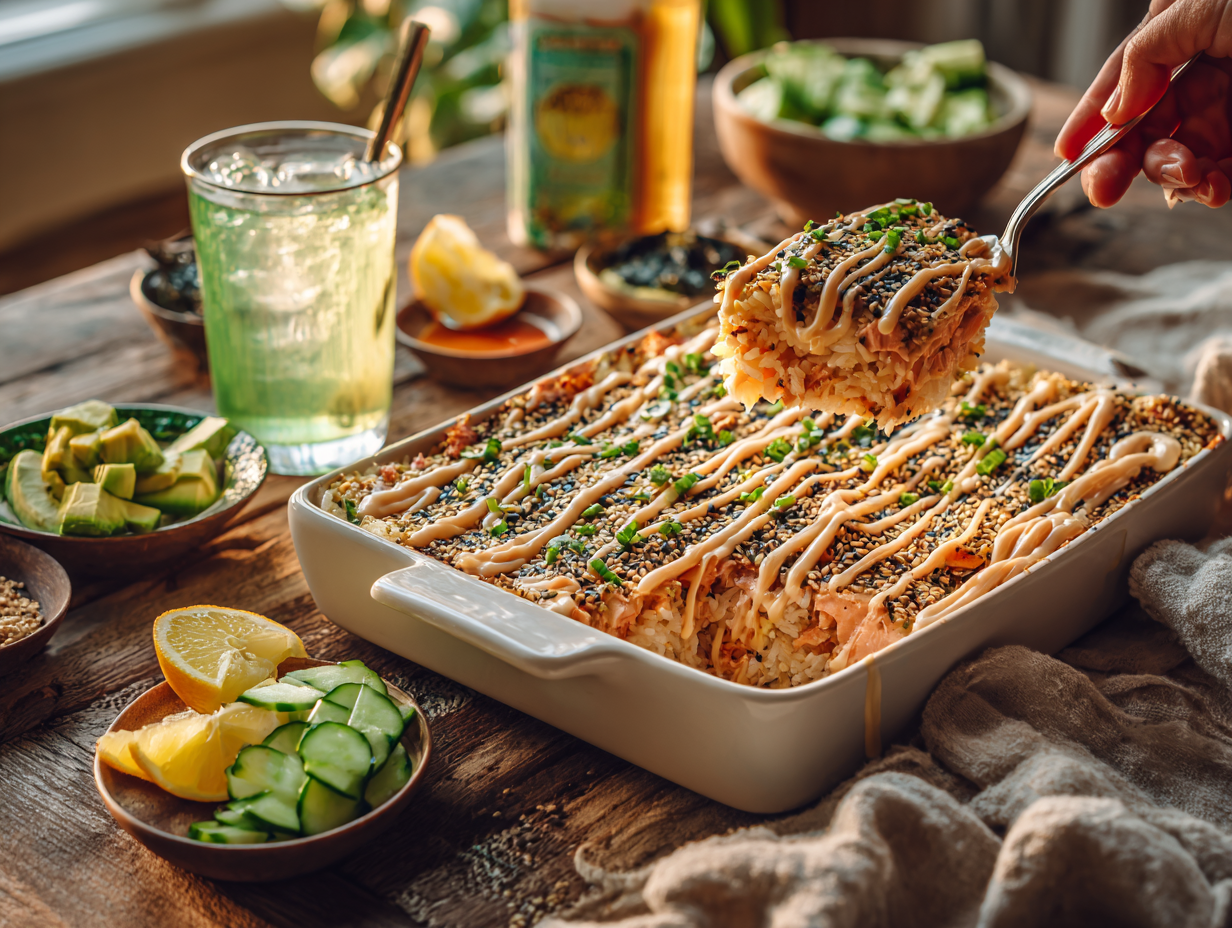
Sushi bake is seasoned rice topped with a creamy, spicy seafood mixture, finished under the broiler, and scooped onto nori sheets at the table. The whole thing is done in 30 minutes and feeds four people without any rolling, slicing, or special equipment. If you have a sushi craving on a Tuesday, this is the honest answer to it.
The short version of why this works
Two things carry this recipe. First, the broiler does real work — it browns the mayo-cream cheese topping quickly and creates slightly crispy edges that contrast with the soft rice underneath. Pull it too early and the topping is just warm; give it the full time until you see golden spots and it changes the dish entirely. Second, the rice seasoning has to go on while the rice is still hot. Warm rice absorbs the vinegar mixture and stays distinct and slightly sticky, which is exactly what you need for clean scooping. Let the rice cool first and it turns dense and clumpy instead.
Common problems and fixes
- Topping slides off the nori when scooping: The filling is probably too warm and loose. Let the bake rest for 2 minutes out of the oven before serving — it firms up just enough to hold together on the sheet.
- Rice layer is soggy at the bottom: This usually means the baking dish was too deep or the rice was packed too tightly. Spread it in an even layer no more than an inch thick so heat can move through it.
- Broiler burns the top before the center heats through: Move the rack down one position. The topping only needs to brown, not cook through, so a slightly lower rack gives you more control without losing the char.
- Canned salmon tastes flat: Drain it very well and pat it dry before mixing. Excess liquid dilutes the Kewpie and sriracha and makes the topping watery under the broiler.
- Nori sheets go limp immediately: Keep them in the bag until the moment you serve. Even a few minutes of exposure to steam from the hot dish softens them fast.
Substitutions that actually work
- Kewpie mayonnaise: Regular mayo works in a pinch, but Kewpie is richer and less sweet — worth grabbing at most grocery stores now. If you use regular mayo, add a small squeeze of lemon juice to get closer to the flavor.
- Furikake: If you can’t find it, a mix of toasted sesame seeds and a small sheet of crumbled nori gets you most of the way there. It won’t be identical, but it won’t be missing either.
- Imitation crab: A legitimate swap for salmon — it shreds easily, needs no draining, and browns well under the broiler. Skip the garnish of extra scallions on top of the crab version; the flavor is mild enough that it just disappears and isn’t worth the extra dish.
- Sriracha: Sambal oelek or gochujang (use slightly less) both work. Gochujang adds a faint sweetness that pairs well with crab in particular.
Leftovers and make-ahead
Store leftovers in an airtight container in the fridge for up to 2 days — keep the rice and topping together, but store any fresh garnishes like cucumber and avocado separately or skip them entirely on the leftover portion. Reheat in a 350°F oven for about 10 minutes, or in a toaster oven if you have one; the microwave works but softens the top and makes the rice gummy. The assembled bake does not freeze well — the rice texture suffers badly. If you want to get ahead on a weeknight, you can mix the seafood topping up to 24 hours in advance and refrigerate it covered, then just cook the rice and assemble when you’re ready.
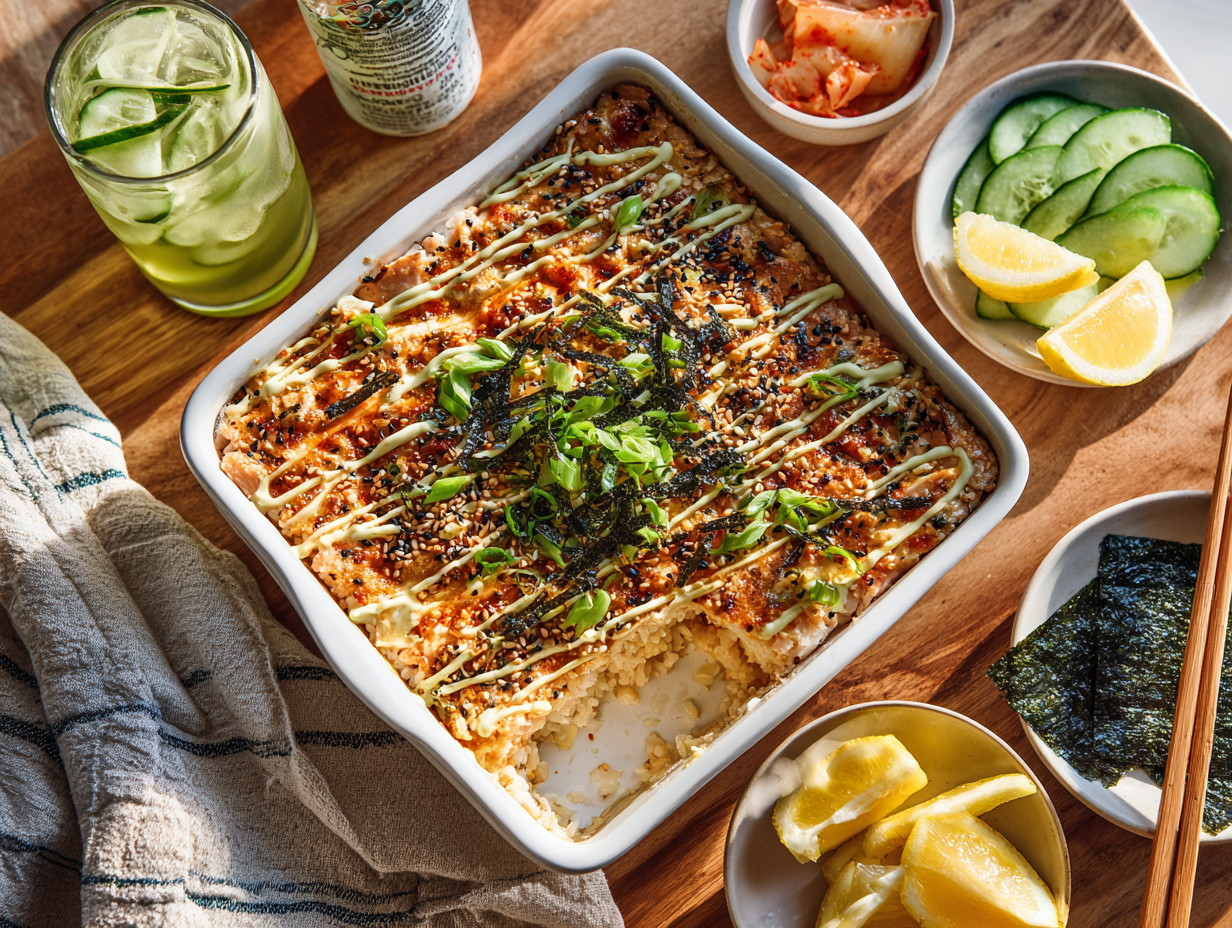
Weeknight Salmon (or Crab) Sushi Bake

Equipment
- 8x8-inch baking dish (ceramic or metal)
- Oven with broiler function
- Mixing bowls (2 medium)
- Measuring cups and spoons
- Rice paddle or silicone spatula
- Small saucepan (for rice seasoning)
- Offset spatula or spoon for spreading
- Kitchen torch (optional for extra char)
Ingredients
For the Rice Layer:
- ¼ cup unseasoned rice vinegar quality matters—look for Marukan or Mizkan
- 2 tbsp granulated sugar balances tang and umami
- 1 tsp kosher salt use Diamond Crystal; reduce to 3/4 tsp if using Morton
- 4 cups warm cooked sushi rice short-grain; use day-of or high-quality microwave pouches for speed
For the Seafood Topping:
- 12 oz cooked salmon, flaked (or imitation crab, shredded) canned wild salmon works beautifully for speed
- ⅓ cup Kewpie mayonnaise Japanese mayo for silky richness
- 1 tbsp Sriracha adjust to heat preference
- 2 oz cream cheese, softened adds body and browns nicely
- 1 tsp soy sauce use tamari for gluten-free
- 1 tsp toasted sesame oil just enough for aroma, not overpowering
- 2 whole scallions, thinly sliced white and green parts, divided
- 2 tbsp furikake, divided nori-sesame blend; look for one with bonito for extra umami
To Finish & Serve:
- 1 whole ripe avocado, diced hass preferred for texture
- 1 whole Persian cucumber, cut into matchsticks or 1/2 English cucumber, seeded
- 24 sheets nori snack sheets for scooping; full-size sheets cut into quarters also work
- ¼ cup pickled ginger optional but refreshing
- 2 tbsp additional Kewpie mayo, for drizzling load into a squeeze bottle for neat lines
- 1 tbsp additional Sriracha, for drizzling
- 1 tsp toasted sesame seeds for a final nutty pop
- 4 wedges lemon optional, to brighten at the table
Instructions
- Heat the Oven: Preheat to 425°F (220°C). Set an oven rack in the upper third for easy broiling later. Lightly grease an 8x8-inch baking dish.
- Make Sushi Rice Seasoning: In a small saucepan over low heat, combine 1/4 cup rice vinegar, 2 tbsp sugar, and 1 tsp kosher salt. Warm, stirring, just until the sugar dissolves (about 1–2 minutes). Do not boil—the goal is clarity and a gentle tang. You should smell a clean, slightly sweet aroma.
- Season the Rice: Place 4 cups warm cooked sushi rice in a wide bowl. Pour the warm vinegar mixture over the rice. Using a rice paddle, fold with quick slicing motions to distribute without mashing—fan the rice or let a cool draft pass over it for a glossy sheen. Rice should taste delicately sweet-sour with individual grains intact.Tip: If using cold leftover rice, microwave covered until steamy and pliable before seasoning.
- Mix the Seafood Topping: In a bowl, combine 12 oz flaked cooked salmon (or shredded imitation crab), 1/3 cup Kewpie mayo, 1 tbsp Sriracha, 2 oz softened cream cheese, 1 tsp soy sauce, and 1 tsp toasted sesame oil. Fold in most of the sliced scallions (reserve some greens for garnish). The mixture should be creamy, spreadable, and lightly spicy with a savory aroma.No mixer? A fork works. If cream cheese resists, microwave 10–15 seconds to soften.
- Assemble the Layers: Spread the seasoned rice evenly in the prepared dish, pressing gently with damp fingers or a spatula to create an even bed about 3/4 inch thick. Sprinkle 1 tbsp furikake over the rice. Spoon the seafood mixture on top and spread to the edges with an offset spatula. Finish with the remaining 1 tbsp furikake.
- Bake, then Broil: Bake at 425°F (220°C) for 8–10 minutes until the edges are bubbling and the top looks slightly set. Switch to broil on high (~500°F/260°C) for 1–2 minutes to achieve light golden spots and a toasty aroma. Watch closely—broilers vary.Alternative: Use a kitchen torch to gently kiss the surface for added char instead of broiling.
- Finish and Garnish: Rest 2 minutes. Drizzle with additional Kewpie mayo and Sriracha in zigzags. Top with reserved scallion greens, toasted sesame seeds, and scatter avocado and cucumber over or serve them on the side. Arrange nori sheets and pickled ginger at the table. Serve with lemon wedges if you like brightness.
Notes
Jen’s Tips:
- Rice Speed Hack: High-quality microwave sushi rice pouches cut prep dramatically. Season while warm for best absorption.
- Texture Balance: Keep the rice layer slightly thinner than the topping for a luscious, scoopable bite.
- Flavor Swaps: Try a 1 tsp miso paste whisked into the mayo for deeper umami; swap Sriracha for chili crisp.
- Dietary Tweaks: Gluten-free: use tamari. Dairy-free: skip cream cheese and add 1 extra tbsp mayo. Pescatarian/Vegan: use shredded baked tofu or hearts of palm with vegan mayo and a dash of nori flakes.
- Crispier Top: After broiling, rest 3–4 minutes to set; the surface will hold neater scoops.
- If using raw salmon, cook or air-fry it first (season lightly with salt and pepper) until just done; cool slightly before flaking.
- For extra umami, add a sprinkle of bonito-flake furikake between layers.
Nutrition
FAQ
Can I use leftover rice instead of cooking fresh?
Yes, but you need to warm it before seasoning. Cold leftover rice won’t absorb the vinegar mixture properly, so microwave it until hot, then stir in the seasoning immediately.
Do I need a kitchen torch, or is the broiler enough?
The broiler is completely sufficient. A torch gives you more targeted char, but the broiler produces the same golden, bubbly top without any extra equipment.
How spicy is this dish?
Mildly spicy as written. The sriracha is blended into a large amount of mayo and cream cheese, which softens the heat significantly — most people who are sensitive to spice find it very manageable.
Can I make this with shrimp instead of salmon or crab?
Yes — use cooked shrimp, chop it roughly, and pat it dry before mixing. It holds up well under the broiler and has a slightly firmer texture than crab or canned salmon.
What size baking dish should I use if I’m doubling the recipe?
Use a 9×13-inch dish rather than two 8×8 pans. Keep the rice layer at roughly the same thickness — about one inch — so it heats evenly, and add 2 to 3 minutes to the broil time.
Where do I find nori sheets for serving?
Most regular grocery stores carry them in the snack or international aisle — look for pre-cut snack-size nori sheets, which are the right size for scooping without any cutting. Asian grocery stores have them in bulk for much less money if you have one nearby.
What to cook next
- Sesame Crusted Ahi Tuna
- Quick Ginger Scallion Wontons
- Spicy Korean Rice Cakes
- Quick Korean Bibimbap Bowls