
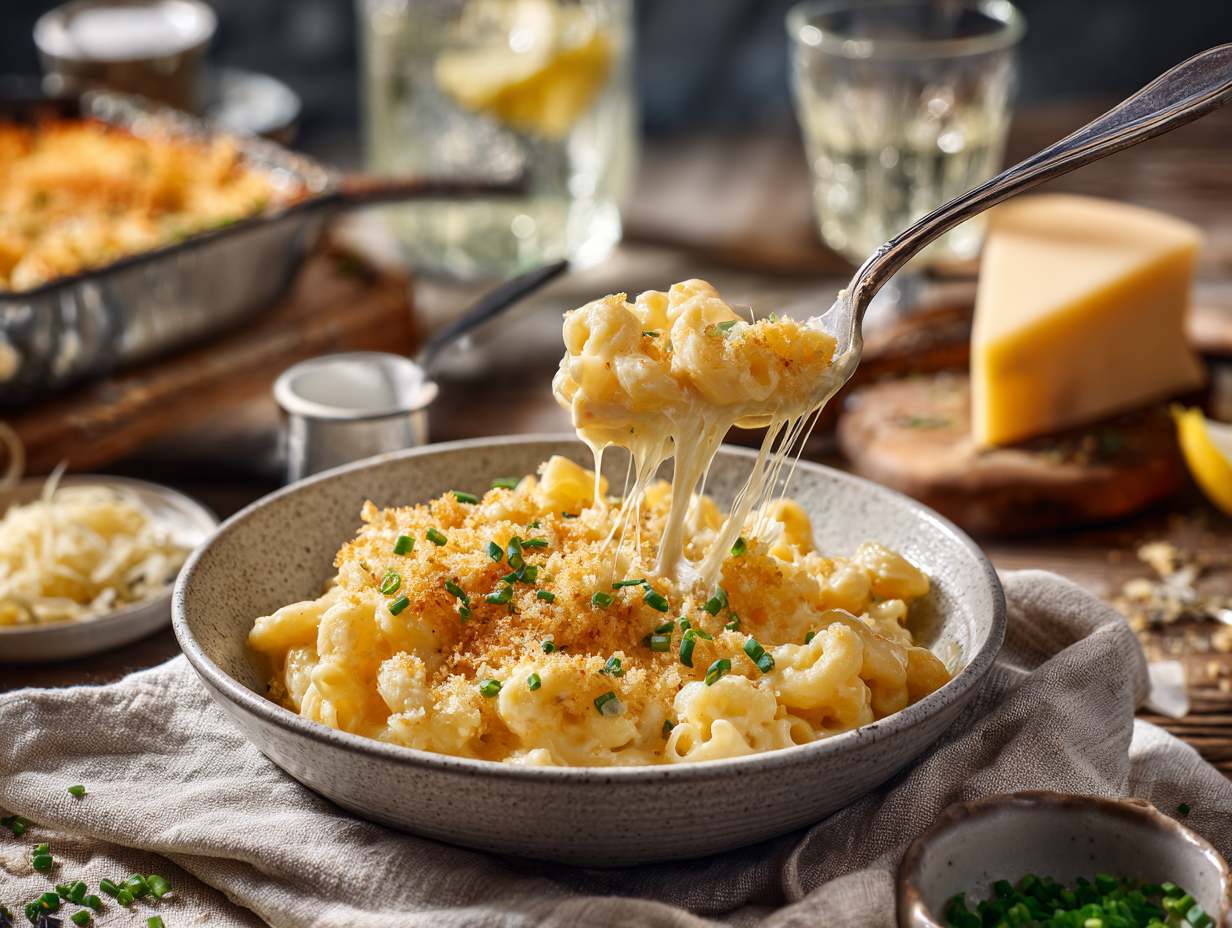
This is a stovetop mac and cheese built on a quick béchamel — butter, flour, milk — with sharp cheddar, a melt-friendly second cheese, and a small hit of Dijon that keeps the sauce from tasting flat. It comes together in 30 minutes and uses one pot for the pasta and one pan for the sauce. If you need dinner on the table fast with no complaints from the table, this is a reliable choice.
Ingredient notes
- Sharp cheddar: Buy a block and grate it yourself. Pre-shredded cheddar is coated in starch to prevent clumping, which makes the sauce grainy instead of smooth.
- Gruyère or Monterey Jack: Either works as the second cheese. Gruyère has more flavor; Monterey Jack melts more quietly and is the better pick if you’re feeding anyone who objects to strong cheese.
- Dijon mustard: One teaspoon. It doesn’t taste like mustard in the finished dish — it just sharpens the cheese flavor. Don’t skip it.
- Panko breadcrumbs: Completely optional. A quick toast in olive oil adds crunch if you want it, but skip the garnish — not worth the extra dish on a weeknight.
- Gluten-free swap: A 1-to-1 gluten-free flour blend works in the roux without changing the technique.
The technique that matters
The sauce breaks — turns greasy and grainy — when cheese hits heat that’s too high. After your béchamel is done and thickened, pull the pan off the burner entirely before you add the cheese. The residual heat is enough to melt it. Stir steadily and add the cheese in two or three additions rather than all at once. The other thing worth knowing: the pasta is intentionally undercooked by a minute before it goes into the sauce. It finishes cooking there and absorbs some of the sauce, which means the final dish holds together instead of sitting in a puddle.
Mistakes to avoid
- Using cold milk in the roux: Cold milk added all at once causes lumps. Warm your milk first, or add it gradually while whisking constantly from the start.
- Covering the pot after draining: If you let the drained pasta sit covered and steaming, it overcooks before it even reaches the sauce. Drain it, then move it immediately.
- Tasting only at the end: The sauce needs salt adjusted after the cheese goes in, since different cheeses vary in saltiness. Taste it before you add the pasta.
- Walking away from the sauce: Béchamel scorches on the bottom if you leave it unattended. Keep stirring, especially once the milk is in.
- Reheating leftovers without added liquid: The sauce tightens up in the fridge. Add a splash of milk before reheating or it will be dry and clumped — see storage notes below.
Storage and reheating
Leftovers keep in an airtight container in the fridge for up to 3 days. The sauce will firm up as it cools, which is normal. To reheat on the stovetop, add 2 to 3 tablespoons of milk per serving and warm over low heat, stirring until smooth. The microwave works too — add the same splash of milk, cover loosely, and heat in 60-second intervals, stirring between each. Mac and cheese does not freeze well; the sauce separates on thawing and the pasta turns soft. Make only what you’ll eat within a few days.
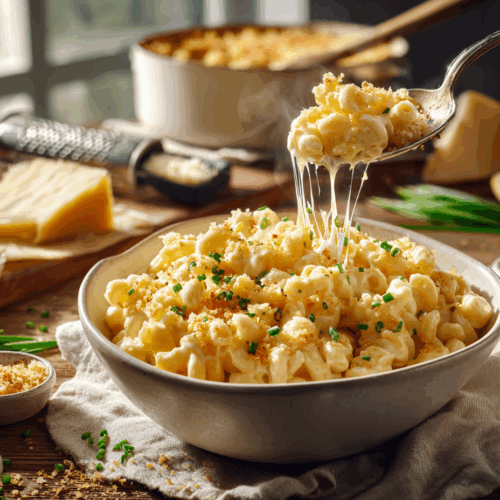
30-Minute Homemade Mac and Cheese

Equipment
- 4–5 qt large pot with lid (for boiling pasta)
- Colander
- 3 qt saucepan or sauté pan (for sauce)
- Whisk
- Wooden spoon or silicone spatula
- Measuring cups and spoons
- Box grater or microplane (for cheeses)
- Instant-read thermometer (optional, for sauce temp)
- 12-inch skillet (optional, to toast panko)
- Broiler-safe baking dish (optional, for quick crust)
Ingredients
- 4 qt water enough to comfortably submerge pasta; keep pot covered to boil faster
- 1 tbsp Kosher salt for seasoning the pasta water (I prefer Diamond Crystal)
- 12 oz elbow macaroni choose a high-quality brand with good gluten structure (De Cecco, Barilla)
- 4 tbsp unsalted butter good-quality butter yields a silkier sauce
- 3 tbsp all-purpose flour for the roux; measure level for accuracy
- 2 cups whole milk room temperature helps prevent lumps
- 1 cup heavy cream adds body and a luxurious mouthfeel
- 1 tsp Dijon mustard brightens the cheese; I like Maille or Edmond Fallot
- ½ tsp garlic powder subtle savoriness without overpowering
- ¼ tsp sweet paprika for color and warmth; not smoky
- ¼ tsp ground white pepper gentle heat and aroma without black specks
- ½ tsp hot sauce optional; just enough to lift flavors (Crystal or Frank’s)
- 1 tsp Worcestershire sauce optional; adds depth and umami
- 10 oz sharp cheddar cheese, freshly grated avoid pre-shredded; I like Tillamook or Cabot
- 4 oz Gruyère or Monterey Jack, freshly grated Gruyère for nuttiness; Jack for extra melt
- 1 oz Parmesan cheese, finely grated adds salty-savory finish; microplane works best
- ½ cup pasta cooking water reserved before draining to adjust sauce consistency
- ½ cup panko breadcrumbs optional topping for crunch
- 1 tbsp extra-virgin olive oil for toasting panko; butter also works
- 2 tbsp fresh chives, thinly sliced optional garnish for color and freshness
Instructions
- Bring Water to a Boil (6–8 minutes): Fill a 4–5 qt pot with 4 qt water, cover, and bring to a rolling boil over high heat.Tip: Keeping the lid on speeds the boil. While water heats, move to Step 2 to start the sauce.
- Start the Roux (about 1 minute): In a 3 qt saucepan over medium heat, melt 4 tbsp butter. Sprinkle in 3 tbsp flour and whisk constantly until the mixture turns blond, foamy, and nutty—avoid browning for a pale, creamy sauce.
- Build the Béchamel (4–6 minutes): Gradually whisk in 2 cups whole milk and 1 cup heavy cream, about 1/2 cup at a time. Maintain gentle steam and small edge bubbles; do not vigorously boil. Cook, whisking, until the sauce coats the back of a spoon. For precision, aim for 180–190°F (82–88°C).
- Salt and Cook the Pasta (7–8 minutes): When the pot boils, add 1 tbsp kosher salt and 12 oz elbow macaroni. Stir, then cook until just shy of al dente (the center should still have a slight bite). Reserve 1/2 cup pasta water, then drain in a colander.
- Season the Sauce (30 seconds): Whisk in 1 tsp Dijon, 1/2 tsp garlic powder, 1/4 tsp sweet paprika, 1/4 tsp white pepper, plus 1/2 tsp hot sauce and 1 tsp Worcestershire if using. Taste; the sauce should be savory, lightly tangy, and not overly salty yet (cheese will add salt).
- Emulsify the Cheeses (1–2 minutes off heat): Remove the pan from heat. Stir in 10 oz sharp cheddar, 4 oz Gruyère or Monterey Jack, and 1 oz Parmesan in small handfuls, whisking until fully melted and glossy. If too thick, whisk in a splash of the reserved pasta water. Keep the sauce around 160–170°F (71–77°C) while adding cheese for a smooth melt.
- Combine Pasta and Sauce (1–2 minutes): Return the drained pasta to the dry pot. Pour the cheese sauce over and fold gently with a spatula until every elbow is luxuriously coated. Adjust consistency with more pasta water as needed—the sauce should flow slowly and cling, not pool.
- Optional Crunchy Topping (2–3 minutes): In a skillet over medium heat, toast 1/2 cup panko with 1 tbsp olive oil and a pinch of salt until golden and crisp, 2–3 minutes. Sprinkle over the mac before serving. For a quick gratin, transfer to a broiler-safe dish, top with panko and an extra handful of cheddar, and broil on High at about 500°F (260°C) for 1–2 minutes until spotty brown. Watch closely.
- Finish and Serve: Scatter with chives. The aroma should be buttery, cheesy, and gently garlicky, and the texture silky with tender pasta.
Notes
Lisa’s Tips:
- Grate your Own Cheese: Pre-shredded cheese contains anti-caking agents that can make sauce grainy. Blocks melt smoother.
- Temperature Control: Keep the béchamel below a boil and add cheese off heat to prevent splitting.
- Flavor Boosters: A pinch of nutmeg in the béchamel or a dash of ground mustard can add depth.
- Dietary Swaps: Use gluten-free macaroni and a 1:1 gluten-free flour blend for the roux. For lighter dairy, swap the cream for evaporated milk (1 cup) for body without heaviness.
- Cheese Variations: Try 50/50 cheddar and fontina for extra melt, or fold in 2 oz cream cheese for extra silkiness.
- Make-Ahead: Grate cheeses up to 2 days ahead and refrigerate in airtight bags. Measure dry spices in a small prep cup.
Serving Suggestions:
Spoon into warm shallow bowls so the sauce stays fluid. Finish with a fine rain of Parmesan, a sprinkle of chives, and a quick crack of black pepper for contrast. Pair with a crisp green salad (lemon vinaigrette) and a chilled glass of lightly oaked Chardonnay or sparkling water with lemon. Perfect mac and cheese appears glossy, creamy, and gently mounding—not stiff, not soupy.Culinary Context:
Macaroni and cheese traces back to early European pasta-and-cheese casseroles, later embraced and reimagined in the American South. This version borrows French technique (béchamel) with American cheddar personality—weeknight-fast but chef-level in texture and balance.Optional Advanced Instructions:
- Broiler Finish: For a restaurant-style crust, broil at 500°F (260°C) for 1–2 minutes. Keep the sauce slightly looser before broiling to avoid drying.
- Parallel Workflow: Start the roux while water heats; your sauce will thicken just as pasta reaches al dente, keeping the total cook to ~20 minutes.
Nutrition
FAQ
Can I use only cheddar and skip the second cheese?
You can, but the sauce will be slightly less smooth. Cheddar alone has a tendency to get a little stringy; the second cheese helps it melt more evenly and keeps the texture creamy.
What pasta shape works if I don’t have elbow macaroni?
Any small, sturdy shape works — cavatappi, shells, rotini, or penne all hold the sauce well. Avoid long thin pasta like spaghetti; it doesn’t mix into a thick cheese sauce easily.
My sauce looks lumpy. Can I fix it?
Yes, if you catch it early. Keep the heat low and whisk vigorously — most small lumps will smooth out. If the sauce is seriously lumpy, strain it through a fine mesh sieve before adding the cheese.
Is there a way to make this without the Dijon for picky eaters?
Leave it out and the dish is still good. You might add a small pinch of dry mustard powder instead, which gives a similar background sharpness with even less detectable flavor.
Can I make the sauce ahead of time?
The béchamel base (before cheese is added) can be made up to a day ahead and refrigerated. Reheat it gently over low heat with a splash of milk, then proceed with adding the cheese and pasta.
How do I keep the mac and cheese from drying out if dinner gets delayed?
Keep it on the lowest possible heat with a lid on, and stir in a splash of milk every few minutes. Mac and cheese does not hold well for more than about 15 minutes off the stove before the sauce starts to tighten.
Try these next
- Creamy Stovetop Mac Perfection
- Quick Chicken Noodle Soup
- Speedy Twice-Baked Potato Casserole
- Southern Stovetop Creamed Corn