
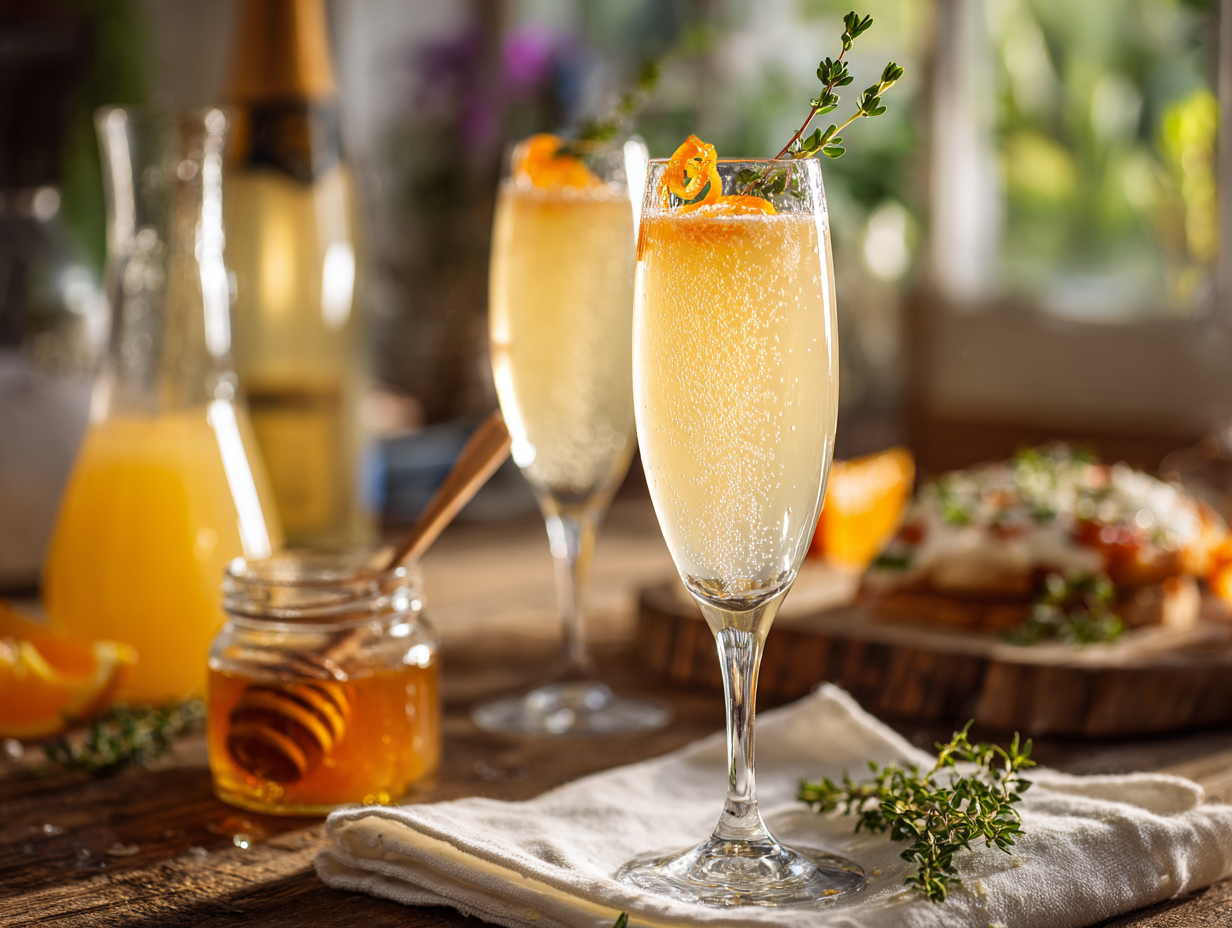
This is a classic mimosa — two parts sparkling wine, one part fresh orange juice — with a quick citrus-honey thyme syrup stirred in for a little extra flavor. The syrup takes 10 minutes on the stove and can be made days ahead, so the actual pouring takes under 5 minutes. If you’ve never made a mimosa before, this recipe is a good place to start because it explains the small decisions that actually matter.
What makes this version work
Two things matter here. First, the syrup uses honey instead of plain sugar, which dissolves more smoothly into cold liquid and adds a rounder sweetness without making the drink taste like candy. Second, the 2-to-1 ratio of sparkling wine to orange juice keeps the bubbles alive — more juice than that and the drink goes flat and heavy fast. Everything else is optional, but get those two right and the mimosa holds together.
What can go wrong
- Flat bubbles before the first sip: This happens when you stir the drink to mix it. Pour the juice in first, then pour the sparkling wine gently down the side of the glass — the carbonation does the mixing for you.
- Syrup seizes or crystallizes: If the heat is too high when making the syrup, the honey can scorch or the mixture can get grainy. Keep it at a low simmer and pull it off the heat as soon as the honey dissolves, usually 3 to 4 minutes.
- Drink tastes too sweet: Store-bought orange juice is already sweeter than fresh-squeezed, so if that’s what you’re using, cut the syrup to half the amount called for in the recipe card.
- Syrup flavor doesn’t come through: Thyme is subtle. If you taste the finished syrup and the herb flavor is faint, let the thyme steep in the warm syrup off the heat for an extra 5 minutes before straining.
- Glasses fog up instead of frost: If your freezer is packed or runs warm, 10 minutes won’t be enough. Thirty minutes gives you a proper chill without the glass getting so cold it makes the wine go flat on contact.
Make-ahead notes
The citrus-honey thyme syrup keeps well in a sealed jar in the refrigerator for up to two weeks — make a double batch and you’re set for several brunches. Fresh-squeezed orange juice is best the day it’s made, but it holds in the fridge for up to 24 hours with only minor flavor loss; squeeze it the night before if that saves you time in the morning. Skip the garnish — not worth the extra dish. The sparkling wine should stay sealed until you’re ready to pour; once open, it goes flat within a couple of hours even with a stopper.
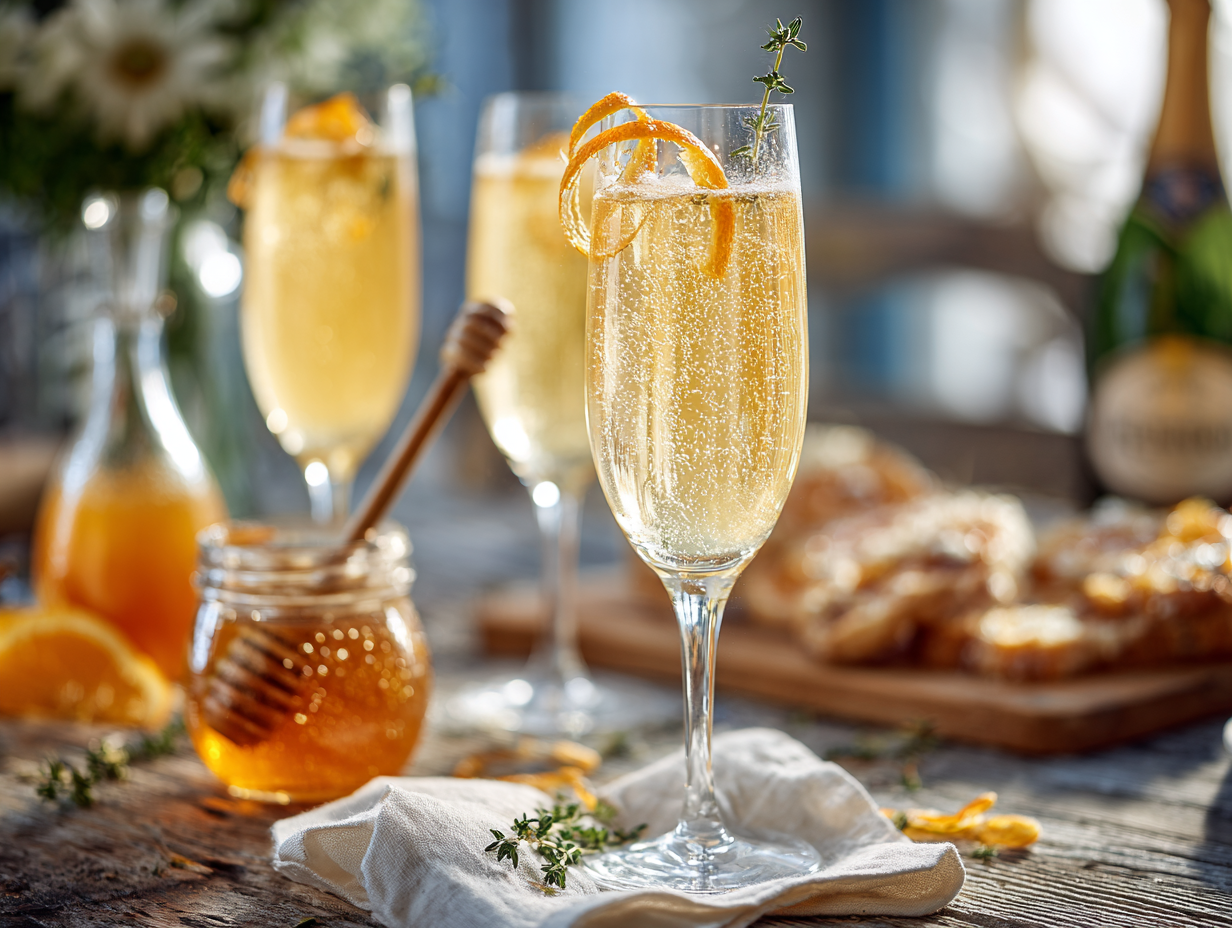
Classic Mimosa with Quick Citrus-Honey Thyme Syrup

Equipment
- Small saucepan
- Citrus juicer (manual or electric)
- Fine mesh strainer
- Measuring cups and spoons
- Microplane or vegetable peeler
- Heatproof bowl (for ice bath)
- Bar spoon (or long spoon)
- Jigger or small liquid measuring cup
- Champagne flutes (6)
- Paring knife
Ingredients
Citrus-Honey Thyme Syrup (optional but recommended)
- ½ cup water Filtered for best flavor
- ⅓ cup orange blossom honey Or good-quality clover honey
- 1 large orange, peel only (wide strips) Use a peeler to avoid bitter white pith
- 2 sprigs fresh thyme Tender tips are most aromatic
- 1 pinch fine sea salt Heightens citrus and honey notes
Mimosas
- 25.4 fl oz dry sparkling wine (Brut Champagne, Cava, or Prosecco), well-chilled 1 standard bottle; aim for 43–48°F (6–9°C)
- 1 ½ cups freshly squeezed orange juice, strained Chilled to about 40°F (4°C) for best fizz
- 2 fl oz orange liqueur (Cointreau or Grand Marnier), optional Adds orange-peel complexity
- 4 dashes Angostura bitters, optional Aromatic lift; 1 dash per flute if using
- 1 medium navel orange, for twists Firm, brightly colored skin
- 6 sprigs fresh thyme, for garnish Optional but lovely
Instructions
- Chill glassware and wine (10 minutes): Place Champagne flutes in the freezer for 10 minutes at about 0°F (−18°C) for a frosty finish. Ensure your sparkling wine is well-chilled—ideally 43–48°F (6–9°C) to keep bubbles lively and the profile crisp.
- Make the quick citrus-honey thyme syrup (10 minutes cook + 5 minutes steep): In a small saucepan over medium heat, combine 1/2 cup water, 1/3 cup honey, orange peel strips, thyme, and a pinch of sea salt. Bring to a gentle simmer—you should see small, steady bubbles around the edges—about 185–200°F (85–93°C). Stir to dissolve honey, then reduce heat and keep at a soft simmer for 3–4 minutes. Remove from heat and let steep 5 minutes for aromatic depth. Strain through a fine-mesh strainer into a heatproof cup. Cool quickly by setting the cup in an ice bath and stirring 2–3 minutes until room temp (about 75°F/24°C).
- Prepare the orange juice (5 minutes, can be done while syrup steeps): Roll oranges on the countertop to release juices. Juice, then strain for a refined texture or leave some pulp for a rustic feel. Chill to about 40°F (4°C) for the best mousse (bubble) retention.
- Prep garnishes (2 minutes): Use a peeler to remove a wide strip of orange peel for each flute. Twist around a spoon handle to set a gentle curl. Trim ends for clean lines. Rinse and dry thyme sprigs.
- Build each mimosa (8 minutes total for 6 flutes): Add 1–2 teaspoons of the citrus-honey syrup to each chilled flute (optional; start with 1 teaspoon and adjust to taste). If using liqueur, add about 1/4 fl oz (1/2 tablespoon) to each flute now. Tilt each flute at a slight angle and pour in 4 fl oz sparkling wine to minimize foam. Top gently with 2 fl oz orange juice, pouring down the inside of the glass. If desired, finish with 1 dash Angostura bitters per flute for an aromatic accent.
- Garnish and serve: Express the orange twist over the glass by gently bending it to release oils—look for a faint mist and citrus perfume—then place it in the flute. Add a petite thyme sprig. Serve immediately while the bubbles are lively and the color gleams like sunrise.
Notes
Lisa’s Tips
- Wine choice: Brut Champagne is classic, Cava is budget-friendly and crisp, and Prosecco offers a fruitier profile. Always choose dry (Brut) to balance orange sweetness.
- Non-alcoholic option: Use a quality non-alcoholic sparkling wine or a 50/50 mix of sparkling water and non-alcoholic sparkling juice. Keep the syrup light to avoid excess sweetness.
- Citrus variations: Blood orange yields a ruby hue; Cara Cara is low-acid and sweet; Mandarin adds perfume. Keep the 2:1 sparkling-to-juice ratio.
- Speed-chill the syrup: Spread it in a thin layer in a metal bowl over an ice bath and stir—cools in 2–3 minutes.
- Bitters boost: A dash of orange or aromatic bitters adds structure and length to each sip.
- Syrup storage: Refrigerate up to 1 week in a sealed jar.
Serving Suggestions
- Present in frosty flutes on a tray lined with a crisp napkin. The perfect mimosa is pale golden with a soft orange halo, fine streams of bubbles, and a bright citrus aroma.
- Garnish with a tidy orange twist and a tiny thyme tip. Pair with buttery pastries, smoked salmon toasts, or an herbed omelet.
- For a tasting flight, offer three mini flutes: classic; blood orange; grapefruit with a pinch of salt (a spritzy nod to a Paloma).
Culinary Context
The mimosa likely took its name from the golden mimosa flower, mirroring its sunny color. Paris popularized the drink in the 1920s; a close cousin, the British Buck’s Fizz (circa 1921), uses more orange juice. My version honors the classic while the thyme-laced syrup adds a modern, aromatic whisper.Optional Advanced Instructions
- Make-ahead: Prepare the syrup up to 3 days ahead; chill thoroughly. Pre-chill flutes and keep the wine in an ice bucket at 43–48°F (6–9°C).
- Batch service: For a pitcher, gently combine 3 cups sparkling wine with 1 1/2 cups orange juice and 2 tablespoons syrup. Pour into flutes just before serving to preserve fizz.
- No peeler? Use a paring knife to shave peel; avoid the white pith for a clean, non-bitter twist.
Timing
- Prep Time: 20 minutes (0:20 h) including chilling flutes and juicing
- Cook Time: 10 minutes (0:10 h) for syrup simmer and steep
Course & Origin
- Course: Breakfast / Brunch cocktail
- Origin (Cuisine): French
Nutrition
FAQ
Can I use prosecco instead of Champagne?
Yes, prosecco works well here. It’s fruitier and slightly less dry than Champagne, which pairs naturally with orange juice — just make sure you’re buying a Brut-style prosecco, not an Extra Dry, which is actually sweeter and can make the drink cloying.
Do I really need to squeeze fresh oranges, or can I use carton juice?
Carton juice will work in a pinch, but the flavor difference is noticeable. Pasteurized juice is flatter and sweeter, so if you use it, reduce the syrup slightly and expect a less bright-tasting drink.
How do I scale this up for a group without standing at the bar all morning?
Batch the orange juice and syrup together in a pitcher ahead of time and keep it cold. Pour the juice mixture into each glass first, then top with sparkling wine to order — adding the wine to the pitcher in advance will make it flat before anyone takes a sip.
More quick recipes to try
- Silky White Russian Recipe
- Spicy Jalapeño Margarita Recipe
- Copycat Orange Julius Recipe
- Easy Classic French Crêpes