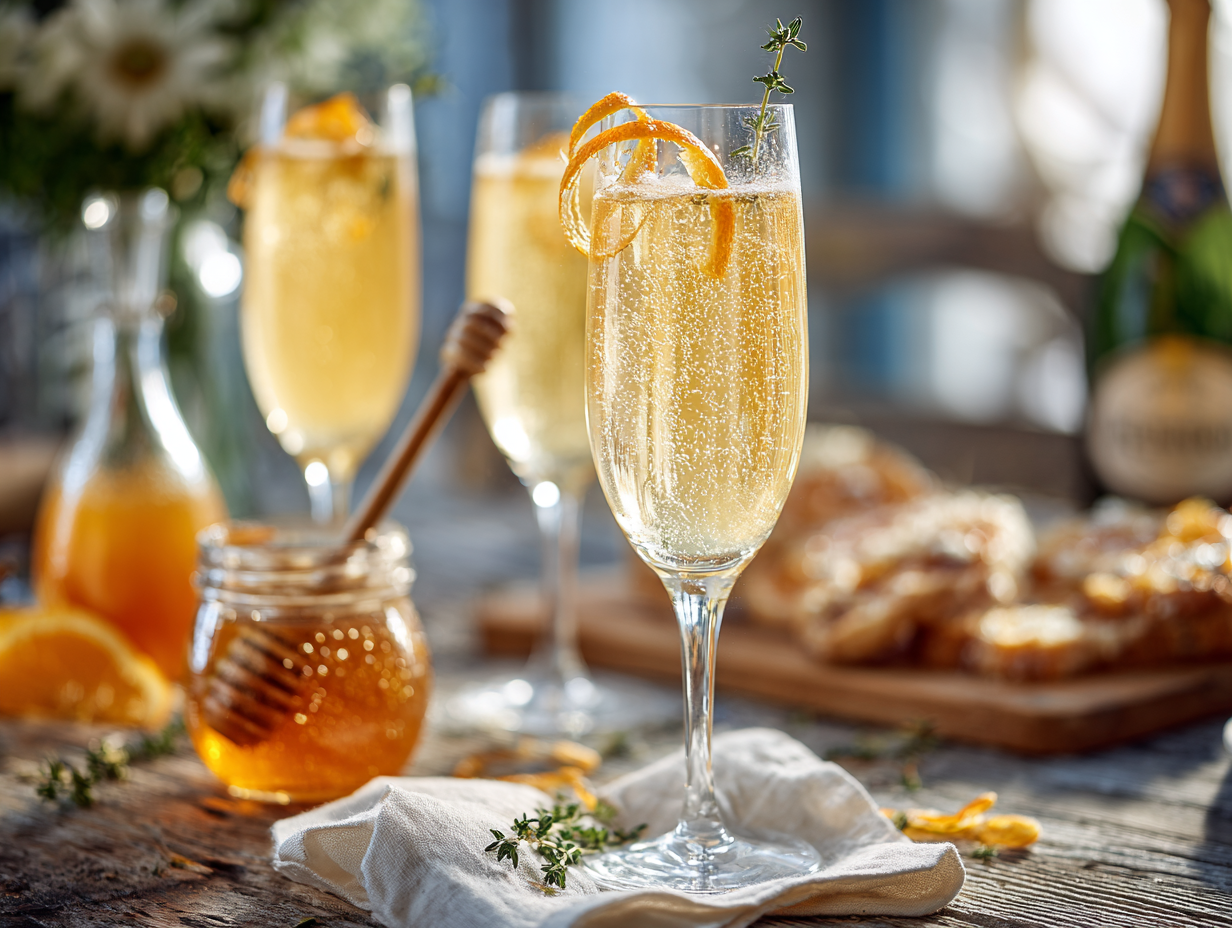
Classic Mimosa with Quick Citrus-Honey Thyme Syrup

This classic mimosa keeps the standard 2-to-1 ratio of sparkling wine to orange juice, then adds a 10-minute citrus-honey thyme syrup for a touch of fragrance and natural sweetness. The syrup takes just a few pantry ingredients and a small saucepan, and it can be made ahead. Altogether, the drink is ready in about 15 minutes and works equally well for a casual brunch or a larger gathering.
Equipment
- Small saucepan
- Citrus juicer (manual or electric)
- Fine mesh strainer
- Measuring cups and spoons
- Microplane or vegetable peeler
- Heatproof bowl (for ice bath)
- Bar spoon (or long spoon)
- Jigger or small liquid measuring cup
- Champagne flutes (6)
- Paring knife
Ingredients
Citrus-Honey Thyme Syrup (optional but recommended)
- ½ cup water Filtered for best flavor
- ⅓ cup orange blossom honey Or good-quality clover honey
- 1 large orange, peel only (wide strips) Use a peeler to avoid bitter white pith
- 2 sprigs fresh thyme Tender tips are most aromatic
- 1 pinch fine sea salt Heightens citrus and honey notes
Mimosas
- 25.4 fl oz dry sparkling wine (Brut Champagne, Cava, or Prosecco), well-chilled 1 standard bottle; aim for 43–48°F (6–9°C)
- 1 ½ cups freshly squeezed orange juice, strained Chilled to about 40°F (4°C) for best fizz
- 2 fl oz orange liqueur (Cointreau or Grand Marnier), optional Adds orange-peel complexity
- 4 dashes Angostura bitters, optional Aromatic lift; 1 dash per flute if using
- 1 medium navel orange, for twists Firm, brightly colored skin
- 6 sprigs fresh thyme, for garnish Optional but lovely
Instructions
- Chill glassware and wine (10 minutes): Place Champagne flutes in the freezer for 10 minutes at about 0°F (−18°C) for a frosty finish. Ensure your sparkling wine is well-chilled—ideally 43–48°F (6–9°C) to keep bubbles lively and the profile crisp.
- Make the quick citrus-honey thyme syrup (10 minutes cook + 5 minutes steep): In a small saucepan over medium heat, combine 1/2 cup water, 1/3 cup honey, orange peel strips, thyme, and a pinch of sea salt. Bring to a gentle simmer—you should see small, steady bubbles around the edges—about 185–200°F (85–93°C). Stir to dissolve honey, then reduce heat and keep at a soft simmer for 3–4 minutes. Remove from heat and let steep 5 minutes for aromatic depth. Strain through a fine-mesh strainer into a heatproof cup. Cool quickly by setting the cup in an ice bath and stirring 2–3 minutes until room temp (about 75°F/24°C).
- Prepare the orange juice (5 minutes, can be done while syrup steeps): Roll oranges on the countertop to release juices. Juice, then strain for a refined texture or leave some pulp for a rustic feel. Chill to about 40°F (4°C) for the best mousse (bubble) retention.
- Prep garnishes (2 minutes): Use a peeler to remove a wide strip of orange peel for each flute. Twist around a spoon handle to set a gentle curl. Trim ends for clean lines. Rinse and dry thyme sprigs.
- Build each mimosa (8 minutes total for 6 flutes): Add 1–2 teaspoons of the citrus-honey syrup to each chilled flute (optional; start with 1 teaspoon and adjust to taste). If using liqueur, add about 1/4 fl oz (1/2 tablespoon) to each flute now. Tilt each flute at a slight angle and pour in 4 fl oz sparkling wine to minimize foam. Top gently with 2 fl oz orange juice, pouring down the inside of the glass. If desired, finish with 1 dash Angostura bitters per flute for an aromatic accent.
- Garnish and serve: Express the orange twist over the glass by gently bending it to release oils—look for a faint mist and citrus perfume—then place it in the flute. Add a petite thyme sprig. Serve immediately while the bubbles are lively and the color gleams like sunrise.
Notes
Lisa’s Tips
- Wine choice: Brut Champagne is classic, Cava is budget-friendly and crisp, and Prosecco offers a fruitier profile. Always choose dry (Brut) to balance orange sweetness.
- Non-alcoholic option: Use a quality non-alcoholic sparkling wine or a 50/50 mix of sparkling water and non-alcoholic sparkling juice. Keep the syrup light to avoid excess sweetness.
- Citrus variations: Blood orange yields a ruby hue; Cara Cara is low-acid and sweet; Mandarin adds perfume. Keep the 2:1 sparkling-to-juice ratio.
- Speed-chill the syrup: Spread it in a thin layer in a metal bowl over an ice bath and stir—cools in 2–3 minutes.
- Bitters boost: A dash of orange or aromatic bitters adds structure and length to each sip.
- Syrup storage: Refrigerate up to 1 week in a sealed jar.
Serving Suggestions
- Present in frosty flutes on a tray lined with a crisp napkin. The perfect mimosa is pale golden with a soft orange halo, fine streams of bubbles, and a bright citrus aroma.
- Garnish with a tidy orange twist and a tiny thyme tip. Pair with buttery pastries, smoked salmon toasts, or an herbed omelet.
- For a tasting flight, offer three mini flutes: classic; blood orange; grapefruit with a pinch of salt (a spritzy nod to a Paloma).
Culinary Context
The mimosa likely took its name from the golden mimosa flower, mirroring its sunny color. Paris popularized the drink in the 1920s; a close cousin, the British Buck’s Fizz (circa 1921), uses more orange juice. My version honors the classic while the thyme-laced syrup adds a modern, aromatic whisper.Optional Advanced Instructions
- Make-ahead: Prepare the syrup up to 3 days ahead; chill thoroughly. Pre-chill flutes and keep the wine in an ice bucket at 43–48°F (6–9°C).
- Batch service: For a pitcher, gently combine 3 cups sparkling wine with 1 1/2 cups orange juice and 2 tablespoons syrup. Pour into flutes just before serving to preserve fizz.
- No peeler? Use a paring knife to shave peel; avoid the white pith for a clean, non-bitter twist.
Timing
- Prep Time: 20 minutes (0:20 h) including chilling flutes and juicing
- Cook Time: 10 minutes (0:10 h) for syrup simmer and steep
Course & Origin
- Course: Breakfast / Brunch cocktail
- Origin (Cuisine): French
Nutrition
Calories: 143kcalCarbohydrates: 16gProtein: 1gFat: 0.2gSaturated Fat: 0.04gPolyunsaturated Fat: 0.1gMonounsaturated Fat: 0.03gSodium: 18mgPotassium: 288mgFiber: 1gSugar: 12gVitamin A: 253IUVitamin C: 50mgCalcium: 37mgIron: 1mg
Tried this recipe?Rate this recipe !
