
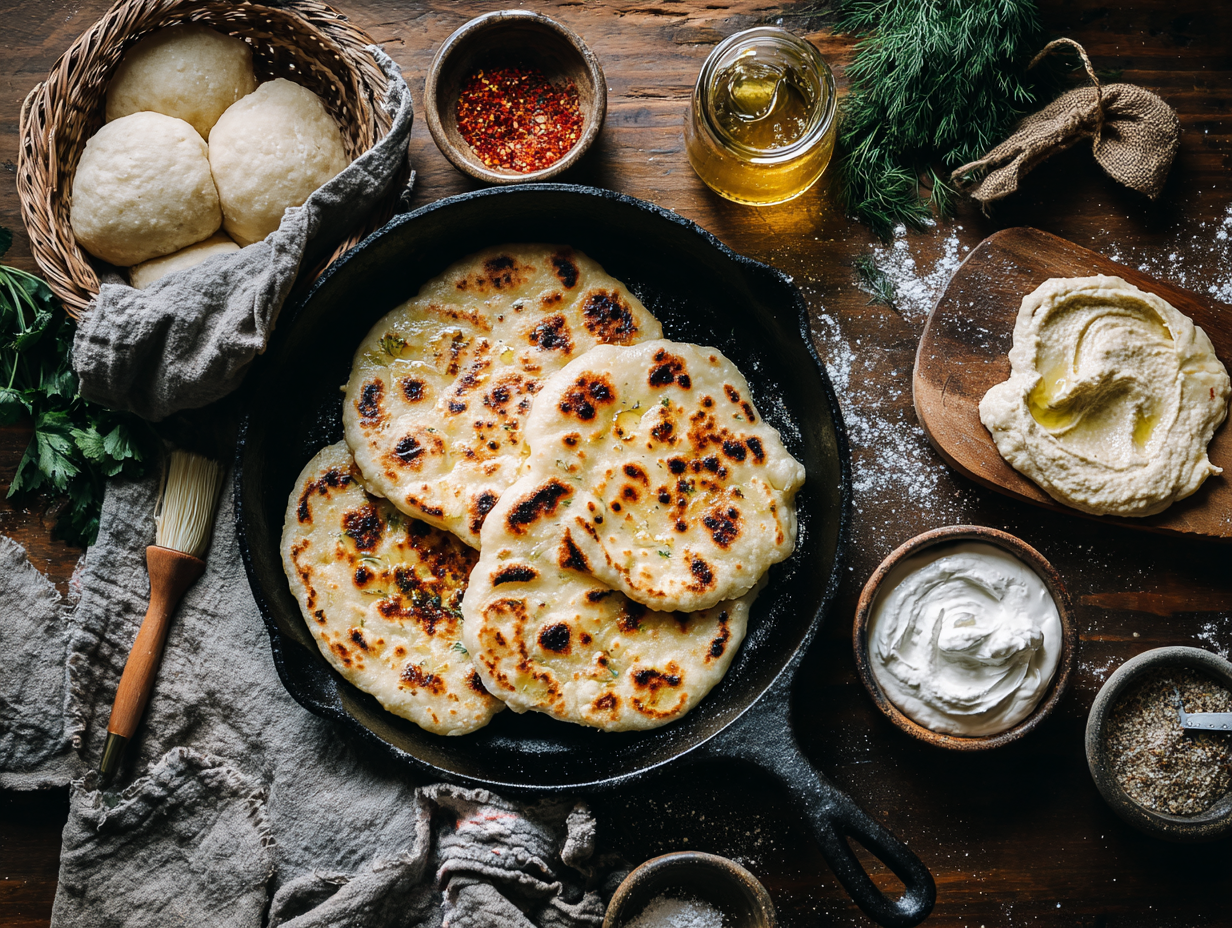
These flatbreads use sourdough starter — active or discard — plus a small amount of baking powder so you get real tangy flavor without any proofing time. The whole batch cooks in a dry skillet on the stovetop, start to finish in 30 minutes. If you have starter sitting in your fridge right now, this is the fastest useful thing you can do with it tonight.
Before you start
Two things actually matter here. First, your skillet needs to be genuinely hot before the first flatbread goes in — not warm, hot. A drop of water should skitter and evaporate immediately. A lukewarm pan produces pale, doughy flatbreads that stick; a properly preheated one gives you the blistered, slightly charred spots that make these worth making. Give it at least 3 minutes over medium-high heat before you start. Second, roll each piece thin — about ⅛ inch. Thicker flatbreads won’t cook through in the short time it takes the outside to color, and you’ll end up with a doughy center. If you don’t own a rolling pin, a smooth wine bottle or a sturdy drinking glass works fine.
Smart swaps
- Sourdough starter: Both active (recently fed) starter and unfed discard work. Active starter gives a slightly more pronounced tang; discard is milder. Either is fine — use whatever you have.
- Yogurt: Full-fat plain yogurt is ideal for tenderness. Low-fat works but the flatbreads will be a little less pliable. Greek yogurt is fine; thin it with a teaspoon of water if the dough feels stiff.
- All-purpose flour: Bread flour makes the flatbreads chewier and slightly tougher to roll thin. Stick with all-purpose if you have it.
- Butter for finishing: Olive oil brushed on right after cooking is a perfectly good swap and keeps things dairy-free.
Common problems and fixes
- Dough tears when rolling: It’s too tight. Let it rest uncovered for 3-4 minutes before trying again — the gluten just needs a moment to relax.
- Flatbread puffs into a big bubble and burns on top before the bottom cooks: Your heat is too high. Drop to medium and press the bubble gently with a spatula to redistribute it. A little puffing is normal and good; a single large balloon means the pan is too hot.
- Flatbreads come out stiff and cracker-like instead of pliable: They cooked too long. Each side needs only 1-2 minutes. Pull them when they have color but still feel soft when you press the edge. Stack finished flatbreads under a clean kitchen towel — the trapped steam keeps them soft.
- Dough is sticky and won’t hold its shape: Add flour one tablespoon at a time until it’s tacky but not wet. Starter hydration varies, so small adjustments are normal and expected.
- Flatbreads taste flat, no tang: Discard that’s been in the fridge for several weeks loses most of its flavor. Use starter that’s been fed within the last 7-10 days for noticeable tang.
Storage and reheating
Stack cooled flatbreads with a small square of parchment between each one, then seal in a zip-top bag or airtight container. They keep at room temperature for up to 2 days and in the fridge for up to 5 days — skip the garnish at this stage, not worth the extra dish. To freeze, keep them stacked with parchment separators and freeze for up to 2 months; thaw at room temperature in about 20 minutes. To reheat, 30 seconds in a dry skillet over medium heat is all they need — they come back soft and pliable. The microwave works in a pinch (15-20 seconds wrapped in a damp paper towel), but the skillet gives noticeably better texture.
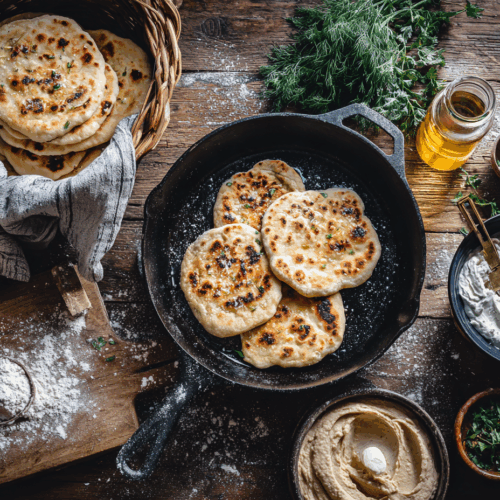
30-Minute Sourdough Skillet Flatbreads (Quick Sourdough Bread Recipe)

Equipment
- 12-inch cast-iron or heavy stainless-steel skillet
- Large mixing bowl
- Measuring cups and spoons
- Fork or silicone spatula
- Rolling pin (or wine bottle)
- Bench scraper or knife
- Pastry Brush
- Clean kitchen towel
Ingredients
For the Dough:
- 1 cup ripe sourdough starter (or well-stirred discard) room temperature; 100% hydration preferred for best tenderness
- ½ cup plain Greek yogurt, full-fat gives instant tenderness; look for thick, tangy yogurt
- 1 tbsp extra-virgin olive oil a fruity EVOO adds aroma and flexibility to the dough
- 1 ¾ cups all-purpose flour plus more for dusting; use a fresh, unbleached AP for best chew
- 1 tsp baking powder gives lift for a softer, puffed finish
- 1 tsp fine sea salt season the dough adequately for full flavor
For Cooking & Finish:
- 2 tbsp olive oil or ghee for the skillet; ghee yields beautiful browning
- 2 tbsp unsalted butter, melted optional for brushing after cooking
- 1 small garlic clove, finely grated optional; stir into melted butter for garlic finish
- 1 tbsp fresh parsley or dill, finely chopped optional herb finish
- 1 pinch flaky sea salt optional to finish
Instructions
- Preheat the Skillet (5 minutes): Set a 12-inch cast-iron skillet over medium-high heat. Let it preheat for about 5 minutes until a drop of water skitters and evaporates on contact. If using an infrared thermometer, aim for a surface temperature around 425°F (220°C). While it heats, start the dough.
- Combine Wet Ingredients (1 minute): In a large bowl, whisk together 1 cup sourdough starter, 1/2 cup Greek yogurt, and 1 tbsp olive oil until smooth and creamy. It should smell pleasantly tangy.
- Add Dry Ingredients (2 minutes): Sprinkle in 1 3/4 cups all-purpose flour, 1 tsp baking powder, and 1 tsp fine sea salt. Using a fork or spatula, fold until a shaggy dough forms. It will look slightly tacky but should pull away from the bowl with minimal sticking.
- Brief Knead (45–60 seconds): Turn the dough onto a lightly floured surface and knead just until smooth and elastic, about 45–60 seconds. You’ll feel it tighten and become supple; avoid overworking to keep the crumb tender.
- Rest (5 minutes): Cover the dough with a towel and let it relax for 5 minutes. This short rest makes rolling easier and allows the baking powder to activate.
- Divide and Roll (5 minutes): Cut the dough into 6 equal pieces. Roll each into a ball, dust lightly with flour, and roll out to 6–7-inch rounds about 1/8 inch thick. If you don’t have a rolling pin, a wine bottle works; press from the center outward, rotating for even thickness.
- Cook (about 2–3 minutes per flatbread): Lightly brush the hot skillet with olive oil or ghee. Lay in a round—bubbles should appear within 30–45 seconds. Cook 60–75 seconds until the underside has deep golden spots, then flip and cook 45–60 seconds more. Press gently with a spatula to encourage blisters. Adjust heat so they brown without smoking. Repeat, brushing the pan as needed. Total cook time for 6 is about 12–15 minutes.
- Optional Garlic Finish: Stir melted butter with grated garlic and herbs. Brush warm flatbreads and finish with a pinch of flaky sea salt.
- Oven Alternative: Preheat a pizza stone or inverted sheet pan at 500°F (260°C) for 20 minutes. Bake rolled rounds 2–4 minutes total, flipping once, until puffed and spotted. Brush and serve.
Notes
Jen’s Tips:
- If your starter is very thin, add 1–2 tbsp more flour; if very thick, splash in 1–2 tsp water. You want a soft, slightly tacky dough.
- For more chew, swap in 1/4 cup bread flour for part of the AP flour.
- Dairy-Free: Replace yogurt with 1/2 cup unsweetened thick oat yogurt or 1/2 cup lactose-free kefir; replace butter with olive oil.
- Flavor Twist: Add 1 tsp za’atar, 1 tsp toasted sesame seeds, or 1/2 tsp garlic powder to the dry mix.
- Speed Proofing Trick: That 5-minute rest is small but mighty—don’t skip it; it relaxes gluten and improves puff.
- Yields about 6 flatbreads (6–7 inches each), serving 4 people as a side or 2–3 as a main with spreads. Keep cooked breads wrapped in a towel to stay soft. Leftovers reheat well in a hot dry skillet for 30–45 seconds per side.
Serving Suggestions:
Stack flatbreads in a towel-lined basket to keep them steamy-soft. The ideal look: golden with dark freckles, softly pliant, and fragrant. Garnish with a brush of garlic-herb butter and a flick of flaky salt. Serve alongside labneh with olive oil, smoky baba ganoush, grilled chicken skewers, or a tomato-cucumber salad. For drinks, pour a crisp Sauvignon Blanc or mint tea.Culinary Context:
Across the Mediterranean and Middle East, quick breads like pita, naan’s cousins, and village flatbreads are daily fare. This version channels that spirit with a modern cook’s clock: sourdough for depth, yogurt for tenderness, and a skillet for char. I first cooked these on a tiny apartment stovetop—proof that great bread doesn’t demand an artisan oven.Optional Advanced Instructions:
- Make-Ahead: Mix the dough up to 4 hours ahead and refrigerate covered; roll and cook straight from the fridge, adding 30–60 seconds to the first side.
- Parallel Prep: While the skillet preheats, roll all rounds and stack between lightly floured parchment.
- No Cast Iron? Use a heavy nonstick skillet or a preheated grill at medium-high (about 450°F/232°C) for similar blistering.
Timing:
Prep Time: 15 minutes (mix 3 min, knead 1 min, rest 5 min, roll 6 min)Cook Time: 15 minutes (2–3 minutes per flatbread, batch-cooked)
Total: 30 minutes
Nutrition
Common questions
Can I use sourdough discard straight from the fridge, or does it need to be at room temperature?
Cold discard works, but room-temperature starter blends into the dough more evenly and produces a slightly more tender result. If yours is cold, let it sit on the counter for 20-30 minutes while you gather the other ingredients.
Do I need a cast-iron skillet, or will a regular pan work?
A regular heavy-bottomed stainless-steel or nonstick pan works fine. Cast iron holds heat more evenly and gives slightly better char, but it’s not required — the most important thing is that the pan is fully preheated before you start.
My starter hasn’t been fed in a while. Is it still okay to use?
Yes, as long as it doesn’t smell strongly of acetone or show any pink or orange streaks, it’s safe to use as discard. Flavor will be milder the older and more neglected the starter is, but the flatbreads will still cook and taste good.
Can I make the dough ahead of time?
Yes. Wrap the dough tightly in plastic wrap and refrigerate it for up to 24 hours. Let it come to room temperature for about 15 minutes before rolling — cold dough is stiff and harder to roll thin.
How do I know when to flip the flatbread?
Flip when the underside has golden-brown spots and the edges look dry and set — usually about 1-2 minutes. If you flip too early, the flatbread will stick; if you wait until it’s fully dry on top before flipping, it’s already overcooked.
More quick recipes to try
- Quick Skillet Garlic Flatbreads
- Smoky Mediterranean Bean Skillet
- Weeknight Shakshuka Recipe
- Smoky Babaganoush in 30 Minutes