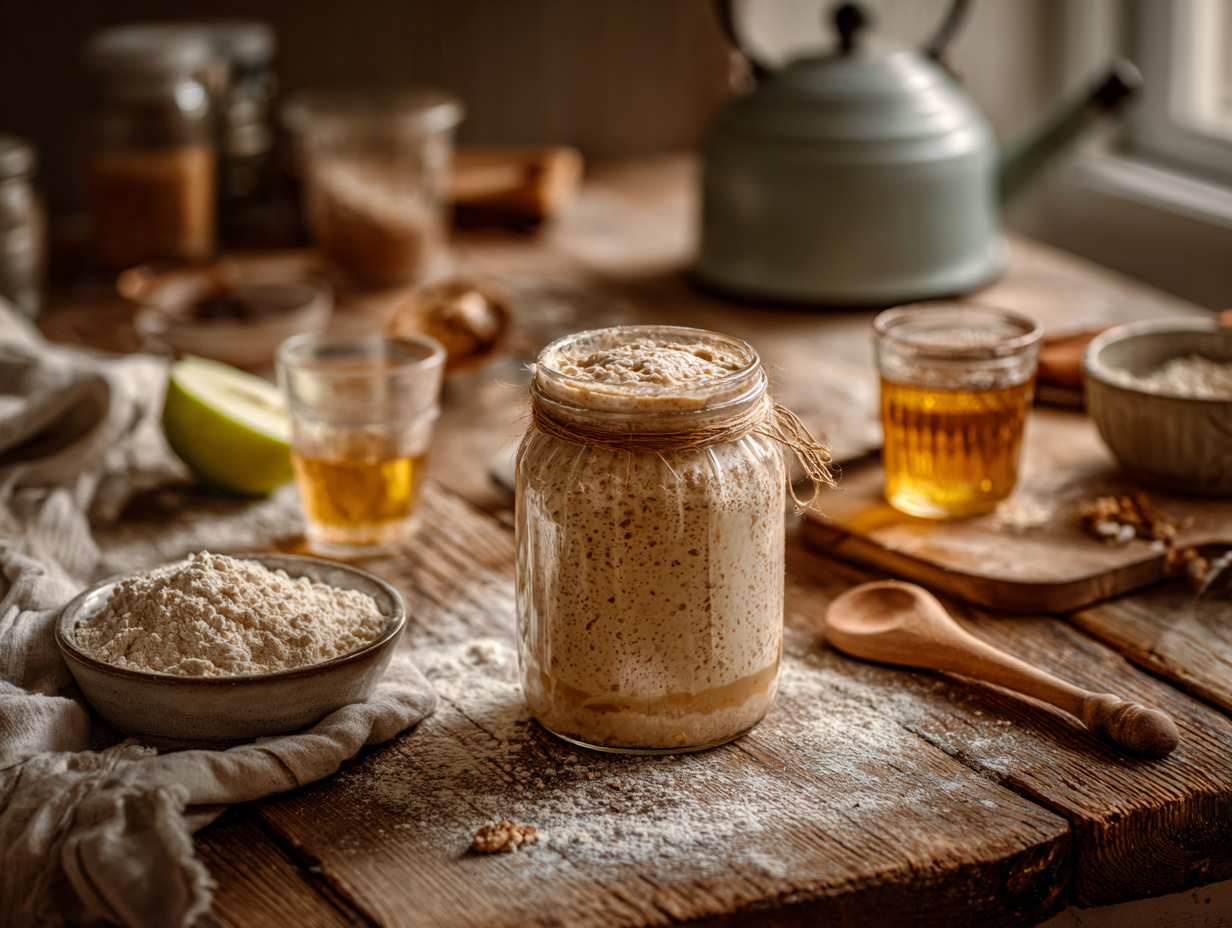
Sourdough Starter Recipe (30-Minute Active Rye & Apple Kickstart)

This sourdough starter uses a blend of whole rye flour and a small amount of fruit — whose natural acidity helps attract the right wild yeast and bacteria — to get fermentation moving quickly. Active prep each day runs about 30 minutes; the culture itself develops over several days before it's ready to leaven bread, waffles, or pancakes. Rye accelerates the process noticeably compared to all-purpose flour alone.
Equipment
- 1-quart wide-mouth glass jar (heat-safe)
- Small pot or kettle (for boiling water)
- Instant-read thermometer
- Measuring cups and spoons
- Flexible spatula or spoon
- Rubber band and permanent marker
- Clean cloth or coffee filter
Ingredients
For Sterilizing & Setup:
- 4 cups water for boiling/sterilizing jar and tools
For the Day 1 Starter Mix:
- ½ cup whole rye flour pumpernickel or stone-ground preferred for lively fermentation
- ½ cup unsweetened pineapple juice room temperature; helps create an acidic environment
- 2 tbsp filtered water room temperature; add as needed to adjust consistency
For the Daily Feeding (Days 2–5) — per feeding:
- ½ cup unbleached all-purpose flour per feeding; can substitute 50% bread flour for structure
- ¼ cup filtered water (75–80°F / 24–27°C) per feeding; lukewarm encourages activity
Instructions
- Preparation: Sterilize the Jar (Cook: 10 minutes): Place your clean, heat-safe glass jar and spoon in a small pot. Cover with the 4 cups water. Bring to a boil and gently simmer for 10 minutes at about 212°F / 100°C. This minimizes unwanted microbes. Remove carefully with tongs and let air-dry upside down on a clean towel. Allow the jar to cool to room temperature before use.
- Day 1: Mix the Starter (Prep: 10 minutes): In the cooled jar, add 1/2 cup whole rye flour and 1/2 cup pineapple juice. Stir vigorously to aerate. If too thick, add up to 2 tbsp filtered water until it resembles a thick batter—like creamy peanut butter. Aim for 75–80°F / 24–27°C mixture temperature for a head start. Scrape down the sides. Level the surface and mark the height on the glass with a rubber band or marker. Cover the jar with a breathable cloth or coffee filter secured with a band. Rest the jar in a warm spot, ideally 72–78°F / 22–26°C, away from direct sunlight.Sensory Cue: You may notice a fruity aroma and tiny pinprick bubbles within 12–24 hours—promising signs.
- Day 2: First Feeding (Prep: 5 minutes): Check aroma (mildly tangy) and look for light bubbling. Stir to assess texture. Discard roughly half the mixture (down to about 1/2 cup in the jar). Add 1/2 cup all-purpose flour and 1/4 cup lukewarm water (75–80°F / 24–27°C). Stir until smooth and tacky, then re-mark level.
- Day 3: Increase the Rhythm (Prep: 5 minutes): If the starter is rising noticeably and smells pleasantly tangy, continue with the same discard-and-feed: 1/2 cup flour + 1/4 cup water. If it doubles in under 12 hours, feed twice today—morning and evening—keeping the same per-feeding amounts.Sensory Cue: Look for a dome of bubbles and a spongy, webbed interior when stirred.
- Days 4–5: Strengthen and Test: Continue daily (or twice-daily) feedings until the starter doubles in 4–6 hours at 75°F / 24°C. Aroma should shift from fruity to clean, lactic-tangy.Readiness Checks: (a) Peak rise with a slightly domed top; (b) A spoonful floats in water at room temp; (c) Sweetly sour aroma without harsh notes.
- Maintenance: Room temp, daily bakes: keep at room temp, feed once or twice daily using the same per-feeding amounts. Weekly bakes: refrigerate after it peaks; feed 1–2 times before baking to re-energize. Hydration cue: aim for a thick but stirrable paste. If runny, add a spoon of flour; if stiff, a teaspoon or two of water.
Notes
Jen’s Tips:
- Flour Choice: Whole rye on Day 1 speeds activity; switch to all-purpose for a cleaner flavor profile. For more tang, keep 25–50% whole grain in feedings.
- Water Quality: If tap water is heavily chlorinated, use filtered or rest it uncovered 30 minutes before use.
- Temperature Control: A warm spot like the top of a refrigerator or an oven with the light on (no heat) often sits around 75–80°F / 24–27°C.
- Consistency Matters: Thicker starters rise higher; thinner ones ferment faster. Adjust to your schedule.
- Substitution: If you don’t have pineapple juice, use unsweetened apple cider or water with a squeeze of lemon (about 1 tsp per 1/2 cup water).
- For reliable results, keep notes on rise times, aroma, and temperature.
- Discard can be used in crackers, pancakes, or muffins to minimize waste.
- If you encounter pink or orange streaks or an off, rotten smell, discard and restart.
Serving Suggestions:
While the starter itself isn’t served as-is, it’s your gateway to beautiful bakes. Once reliably doubling, try: Breakfast: sourdough pancakes or waffles using discard—golden edges, tender crumb, subtle tang. Bakery classics: country loaves with blistered crusts and custardy interiors. Presentation: store your active starter in a clear jar with a tidy label and rubber band marker—creamy beige with fine bubbles indicates perfect vigor.Culinary Context:
Sourdough predates commercial yeast by millennia, with roots across Europe and the Middle East. Bakers cherished starters as family heirlooms—living cultures passed from hand to hand. This method nods to that heritage while using modern cues (temperature, acidity) to get you baking sooner.Optional Advanced Instructions:
- Build Ahead: Pre-warm flour and water to 78°F / 26°C for a quicker start.
- Stiffer Build (50–60% hydration): Knead into a doughy ball for travel; it ferments slower and is easier to transport.
- Food Processor Alternative: If mixing large builds, a few pulses incorporate air quickly, though hand mixing gives better feel.
Timing:
- Prep Time: 20 minutes total (10 minutes to mix and mark, plus brief setup steps).
- Cook Time: 10 minutes (boiling/sterilizing jar and tools at 212°F / 100°C).
- Total Active Time Today: 30 minutes.
Nutrition
Calories: 468kcalCarbohydrates: 101gProtein: 12gFat: 2gSaturated Fat: 0.2gPolyunsaturated Fat: 1gMonounsaturated Fat: 0.2gSodium: 56mgPotassium: 411mgFiber: 8gSugar: 13gVitamin A: 7IUVitamin C: 12mgCalcium: 68mgIron: 5mg
Tried this recipe?Rate this recipe !
