
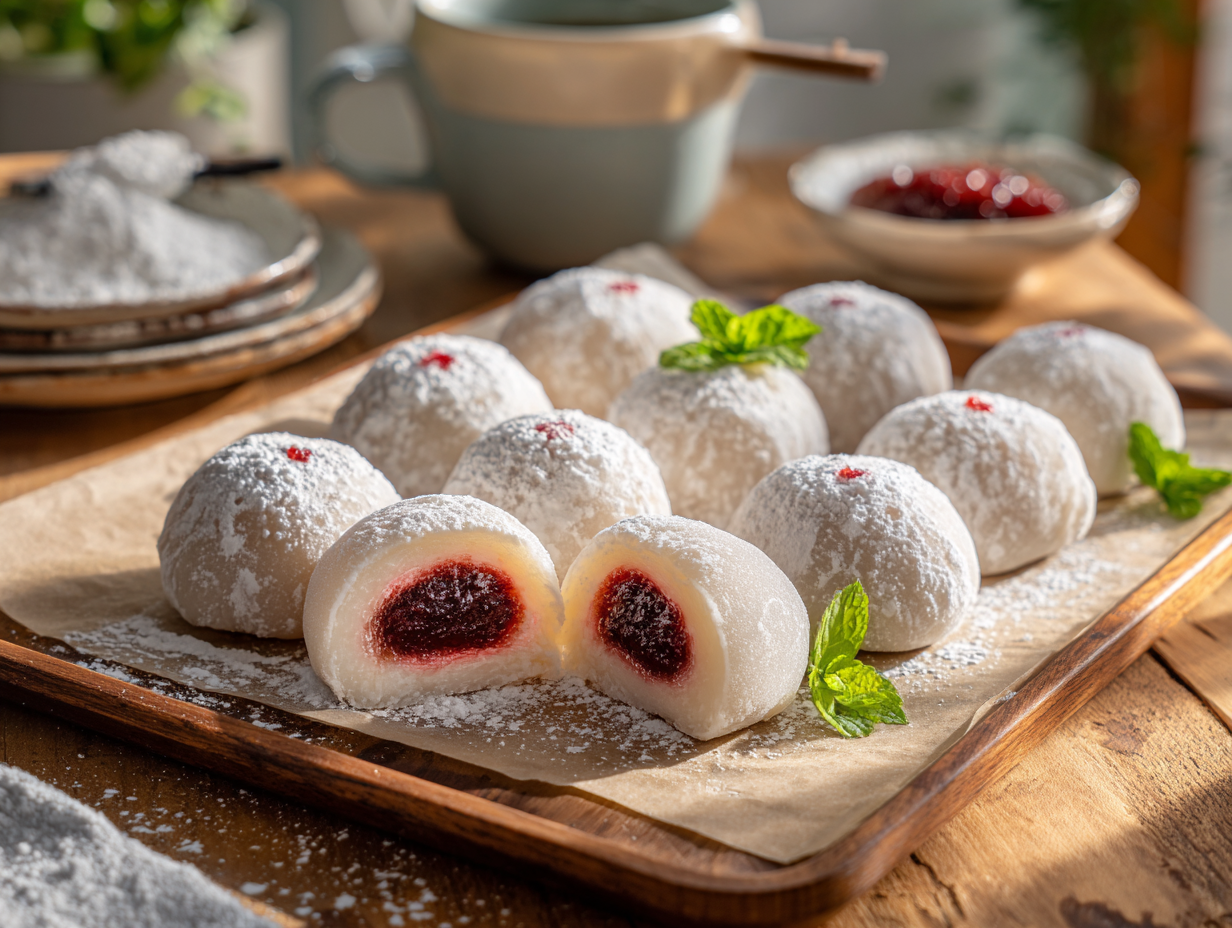
Strawberry daifuku is chewy mochi wrapped around sweet red bean paste and a whole fresh strawberry — three textures in one bite. This version uses a microwave and a single bowl, so the whole thing is done in 25 minutes with almost nothing to wash. If you have mochiko and canned anko on hand, tonight is a perfectly reasonable time to make this.
Why this recipe works
Two things make this work. First, microwaving the mochiko batter in short bursts with stirring in between builds the elastic, stretchy texture you need — the starch gelatinizes evenly instead of scorching on the bottom the way stovetop methods can. Second, the cornstarch-dusted work surface is doing real structural work here: mochi is aggressively sticky when warm, and a generous, even layer of cornstarch is the only thing that lets you handle and shape it without it tearing or gluing itself to everything it touches.
Common problems and fixes
- Mochi tears when you try to wrap the strawberry: The dough cooled too fast. Work in small batches and keep the unused dough loosely covered with plastic wrap while you assemble each piece.
- Filling leaks out after wrapping: The anko layer wasn’t sealed tightly around the strawberry before wrapping with mochi. Press the anko firmly so it fully encases the berry with no gaps — any opening becomes an exit point once the mochi stretches.
- Dough is gummy and won’t hold its shape: It’s underdone. Return it to the microwave for 20-second intervals, stirring between each, until the surface looks slightly translucent and the texture is uniformly elastic rather than wet.
- Pieces stick together on the tray: They need more cornstarch on the outside, and they shouldn’t touch. Space them at least an inch apart on the parchment-lined tray — skip the garnish on top, not worth the extra dish — and dust any tacky spots before storing.
- Mochi is too stiff to stretch after a few minutes: It set up as it cooled. Microwave the whole batch for 10 seconds and stir; it will loosen enough to finish wrapping the remaining pieces.
Leftovers and make-ahead
Daifuku is best eaten the same day, within a few hours of making it — the mochi softens and the strawberry releases juice overnight, which makes the texture noticeably worse by morning. If you need to hold them a few hours, keep them at room temperature, loosely covered, not in the fridge (cold air turns mochi hard and rubbery). For longer storage, freeze individual pieces on a parchment-lined tray until solid, then transfer to a zip bag; they keep for up to one month. Thaw at room temperature for 30 to 40 minutes before eating — do not microwave to thaw, or the mochi turns gluey and the strawberry goes soft.
Quick Strawberry Daifuku Mochi

Equipment
- Microwave-safe glass bowl (2–3 quart)
- Silicone spatula (heatproof) or sturdy wooden spoon
- Fine mesh sieve
- Measuring cups and spoons
- Plastic wrap (or microwave-safe lid)
- Baking sheet or tray
- Parchment paper
- Small rolling pin or flat-bottomed glass (optional)
- Kitchen scissors (for trimming mochi, optional)
- Steamer basket and pot with lid (optional, for steaming method)
Ingredients
Filling
- 8 pieces fresh small strawberries, hulled and well dried Drying prevents the mochi from slipping; choose ripe but firm berries.
- 0.5 cup sweetened red bean paste (anko) Divide into 8 portions; look for smooth koshi-an for easier wrapping.
Mochi dough
- 1 cup mochiko (glutinous rice flour) Koda Farms Blue Star mochiko recommended for consistent texture.
- 0.75 cup granulated sugar Adjust to 2/3 cup if you prefer a less sweet dough.
- 0.125 tsp kosher salt A pinch balances sweetness and brightens flavor.
- 1 cup water Room temperature for smoother mixing.
- 0.5 tsp vanilla extract Optional; or use 1 tsp matcha sifted with mochiko for a green tea version.
For dusting and shaping
- 0.5 cup potato starch or cornstarch For dusting hands and surface; you may not use it all.
Instructions
- Prep the tray: Line a baking sheet with parchment and generously dust with potato starch or cornstarch to prevent sticking. Keep extra starch nearby for your hands and tools.
- Portion the filling: Pat the hulled strawberries completely dry. Divide the anko into 8 portions (about 1 tablespoon each). Flatten each portion into a small disc and wrap it around a strawberry to encase most of the fruit, leaving the tip barely exposed. Refrigerate while you make the dough; cold filling is easier to wrap.
- Mix the mochi batter: In a microwave-safe glass bowl, sift together mochiko, sugar, and salt. Whisk in the water and vanilla until perfectly smooth—no lumps and a glossy batter.
- Cook (microwave method): Cover the bowl with plastic wrap, leaving a small vent. Microwave on High for 1 minute; stir with a dampened silicone spatula. Repeat microwaving in 1-minute bursts, stirring between each, until the dough is thick, glossy, and translucent—about 3–4 minutes total depending on your microwave. The dough should pull into stretchy ropes and feel very sticky.Alternative steaming method: Cover the bowl and steam over gently simmering water at 203–212°F / 95–100°C for 12–15 minutes, stirring once halfway, until translucent and elastic.
- Develop elasticity and cool slightly: Using the spatula, fold and press the hot dough against the bowl sides for about 1 minute to strengthen the stretch. Rest 2–3 minutes until the dough is still warm but safe to handle—about 105–115°F / 40–46°C. It should smell delicately sweet and feel bouncy when pressed.
- Turn out and dust: Heavily dust the prepared parchment with starch. Scrape the mochi onto the parchment and dust the top generously. Pat into a rectangle, then lightly roll to roughly 1/4 inch thickness. Keep your hands and tools lightly coated with starch at all times.
- Portion wrappers: Cut into 8 equal squares or stamp 8 circles about 3.5 inches in diameter. Slide a thin dusting under each piece so they don’t stick. Keep pieces covered with a sheet of parchment to prevent drying.
- Wrap the strawberries: Place one warm mochi wrapper in your palm and brush off excess starch from the center. Set a strawberry-anko ball tip-side down. Stretch the mochi up around the fruit in small tugs, rotating as you go, until the edges meet. Pinch to seal. If there’s excess dough, snip with kitchen scissors and pinch again. Place seam-side down on the dusted tray.
- Set and clean up: Let the mochi rest 5 minutes to set. Gently brush away extra starch from the surface. The perfect mochi feels soft and pillowy, with a delicate sheen and no wet spots.
Notes
Serving Suggestions
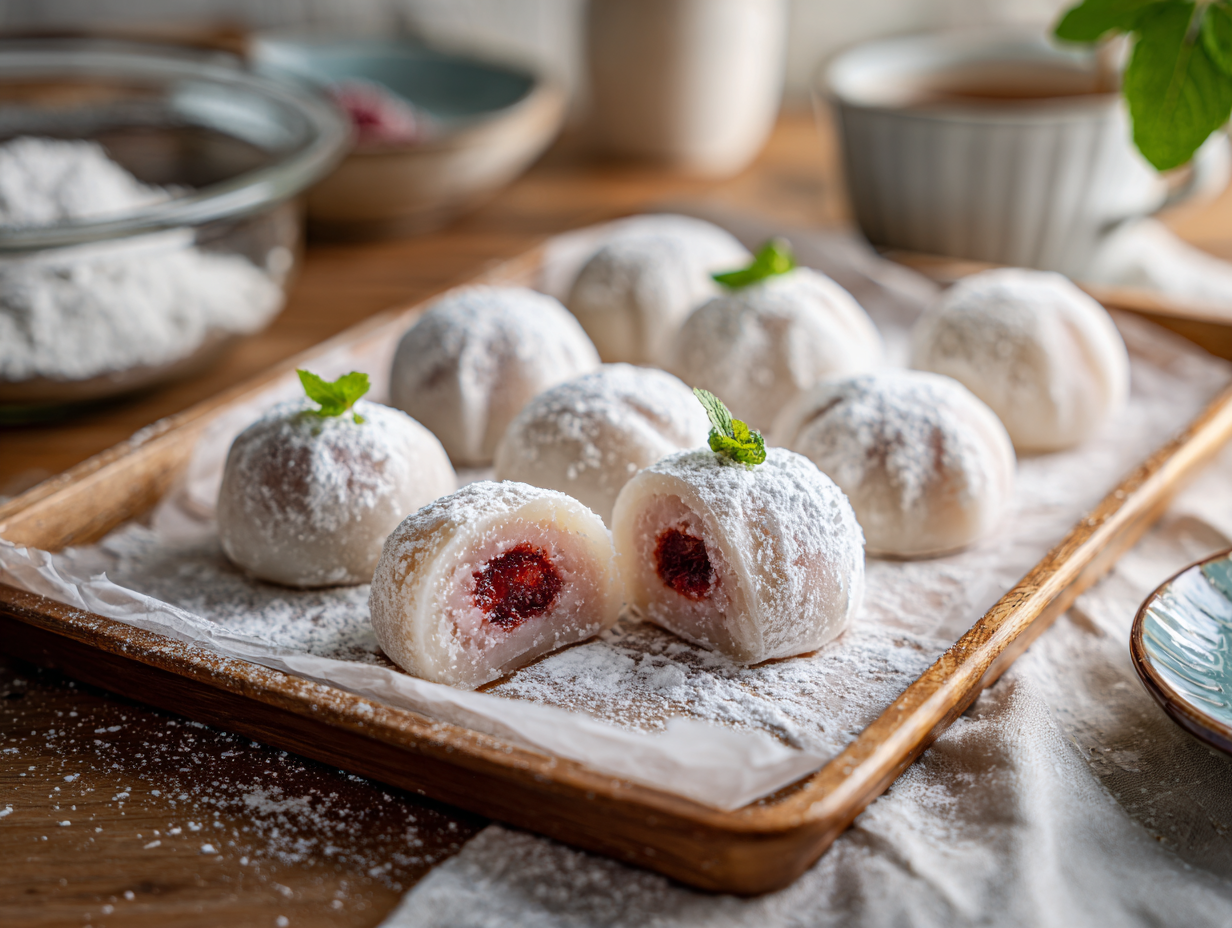
Serve at room temperature within a few hours for peak tenderness. Plate on a small ceramic dish, seam-side down, and garnish with a light snowfall of starch, a tiny mint leaf, or a whisper of matcha powder for color contrast. Pair with fragrant green tea or a chilled glass of lightly sweetened jasmine iced tea. When bitten, you should see a neat cross-section: pale mochi, a ring of anko, and the ruby heart of strawberry.Jen’s Tips
- No microwave? Use the steaming method at 203–212°F / 95–100°C for 12–15 minutes.
- Flavor twists: Sift 1–2 tsp matcha into the dry mix, or swap vanilla for 1/2 tsp almond extract. Fill with mango, banana, or chocolate-hazelnut spread instead of anko.
- Less sticking: Lightly wet your fingertips (water, not oil) if the dough clings too much, and keep dusting with starch.
- Make-ahead filling: Wrap strawberries in anko up to 1 day ahead and refrigerate in an airtight container.
- Storage: Best day-of. If needed, store covered at cool room temp up to 8 hours. Refrigeration firms the mochi; to soften, let sit at room temp 20–30 minutes.
- Smoother seals: Warm wrappers stick better; assemble while dough is still slightly warm.
Culinary Context
Daifuku is a beloved wagashi (traditional Japanese confection), often enjoyed during spring strawberry season. This quick mochi honors that heritage while leaning on a modern microwave technique that home cooks in Japan and abroad embrace for speed and consistency.Optional Advanced Instructions
- Parallel workflow: Portion anko and prep the dusted tray while the mochi cooks to save time.
- Precision shaping: Use a 3.5-inch ring cutter for uniform wrappers and a small scale (0.9–1.0 oz dough per piece) for consistent results.
- Shinier finish: Lightly brush excess starch off with a soft pastry brush just before serving.
Nutrition
Frequently asked questions
Can I use regular rice flour instead of mochiko?
No — regular rice flour won’t work here. Mochiko is made from glutinous (sweet) rice, which has a different starch structure that creates the stretchy, chewy texture; regular rice flour will give you something crumbly and dry.
Where do I find mochiko and canned anko?
Both are stocked at most Asian grocery stores and increasingly at larger supermarkets in the international aisle. You can also order them online — Koda Farms Blue Star mochiko and Shirakiku canned anko are widely available.
My strawberries are large. Do I need to adjust anything?
Trim the stem end flat so the berry sits stable, and use slightly more anko to cover it fully. You may also need to roll your mochi circles a little wider — aim for roughly a 4-inch round instead of 3.5 inches.
Can I make these without red bean paste?
Yes. White bean paste (shiro an) works well and has a milder flavor. Some people skip the paste entirely and just wrap the strawberry in mochi, which is fine, though the paste adds sweetness that balances the tartness of the fruit.
Is there a way to tell when the mochi dough is actually done in the microwave?
The dough is ready when it pulls away from the sides of the bowl cleanly, looks slightly translucent rather than chalky white, and feels uniformly elastic when you press it with a heatproof spatula. If any part still looks opaque and wet, it needs more time.
Try these next
- Spicy Korean Rice Cakes
- Chinese Candied Fruit Tanghulu
- Quick Double Chocolate Cookies
- Perfect Matcha Latte Recipe