
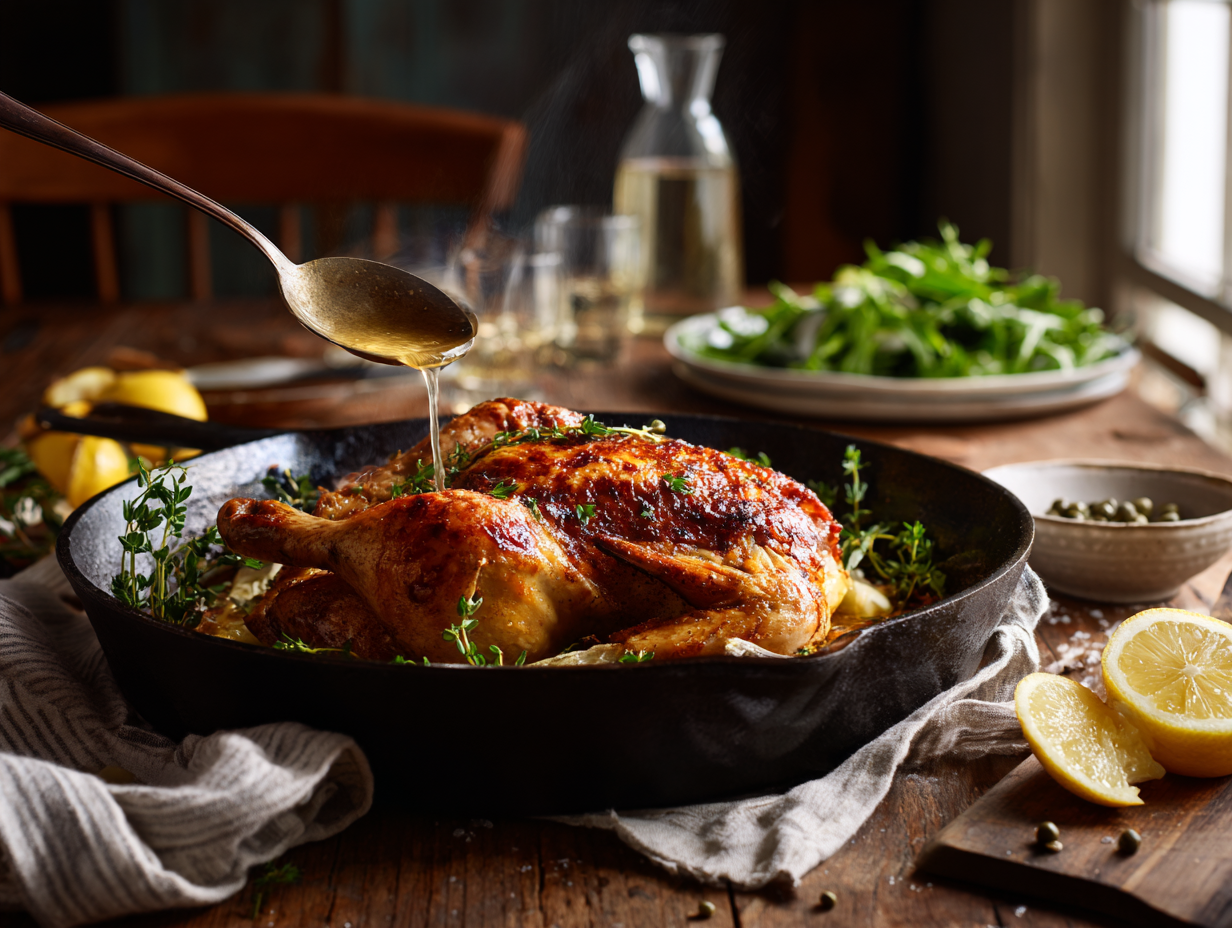
One Cornish hen, spatchcocked flat, seared on the stovetop, and finished in a hot oven — dinner for two in about 35 minutes. The bird is small enough to cook fast and forgiving enough for a weeknight. You also get a real pan sauce built from the drippings, which takes about three minutes while the hen rests.
The short version of why this works
Two things actually matter here. First, spatchcocking — cutting out the backbone so the bird lies flat — means the thick breast and the thinner legs hit the same temperature at roughly the same time. Without it, you’re choosing between dry breast meat and undercooked thighs. Second, a small amount of baking powder mixed into the seasoning draws moisture away from the skin surface, which lets it crisp faster in the oven than it otherwise would. Neither trick requires special equipment or extra time. Everything else in this recipe is just seasoning and a quick sauce.
Shopping notes
- Cornish hen: Most grocery stores carry them frozen near the whole chickens. Thaw overnight in the fridge — a 1.25 to 1.5 lb bird thaws completely in about 18 hours. Fresh is fine if your store stocks them, but frozen works just as well here.
- European-style butter: Higher fat content does produce a slightly richer glaze and sauce, but standard unsalted butter is a perfectly good substitute. Don’t buy a specialty block just for this recipe.
- Fresh thyme: Dried thyme works — use one-third the amount called for in the compound butter. Rosemary or oregano are also reasonable swaps if that’s what’s in your pantry.
- White wine for the pan sauce: A dry white is ideal, but low-sodium chicken broth with a small squeeze of lemon does the same job. Skip the garnish — not worth the extra dish.
- Microplane for garlic: A fine grater gives you a smooth paste that distributes evenly through the butter. A garlic press or very fine mincing with a knife gets you close enough.
Common problems and fixes
- Skin sticks to the pan during the initial sear: The bird isn’t ready to release yet. Don’t force it — wait another 60 to 90 seconds. Skin that releases cleanly means it’s properly seared. Forcing it tears the skin and loses the fond you need for the sauce.
- Compound butter slides off instead of staying under the skin: The butter needs to be genuinely soft — spreadable, not melted. If it’s too firm, it tears the skin as you push it through. If it melts and runs out, pat the skin very dry with paper towels before applying; moisture is usually the culprit.
- Internal temperature reads done but skin looks pale: Move the oven rack up one position and switch to broil for 2 to 3 minutes, watching closely. The meat is safe; you’re just finishing the skin. Pull it the moment it browns.
- Pan sauce breaks or looks greasy: The butter was added to liquid that was too hot. Pull the pan off the heat entirely, let it cool for 30 seconds, then whisk in cold butter one small piece at a time. The emulsion will come back together.
- Bird is done before 28 minutes: Smaller hens (closer to 1.25 lb) cook faster. Start checking internal temperature at the 20-minute mark. The thigh joint should read 165°F — that’s the target, not the time on the clock.
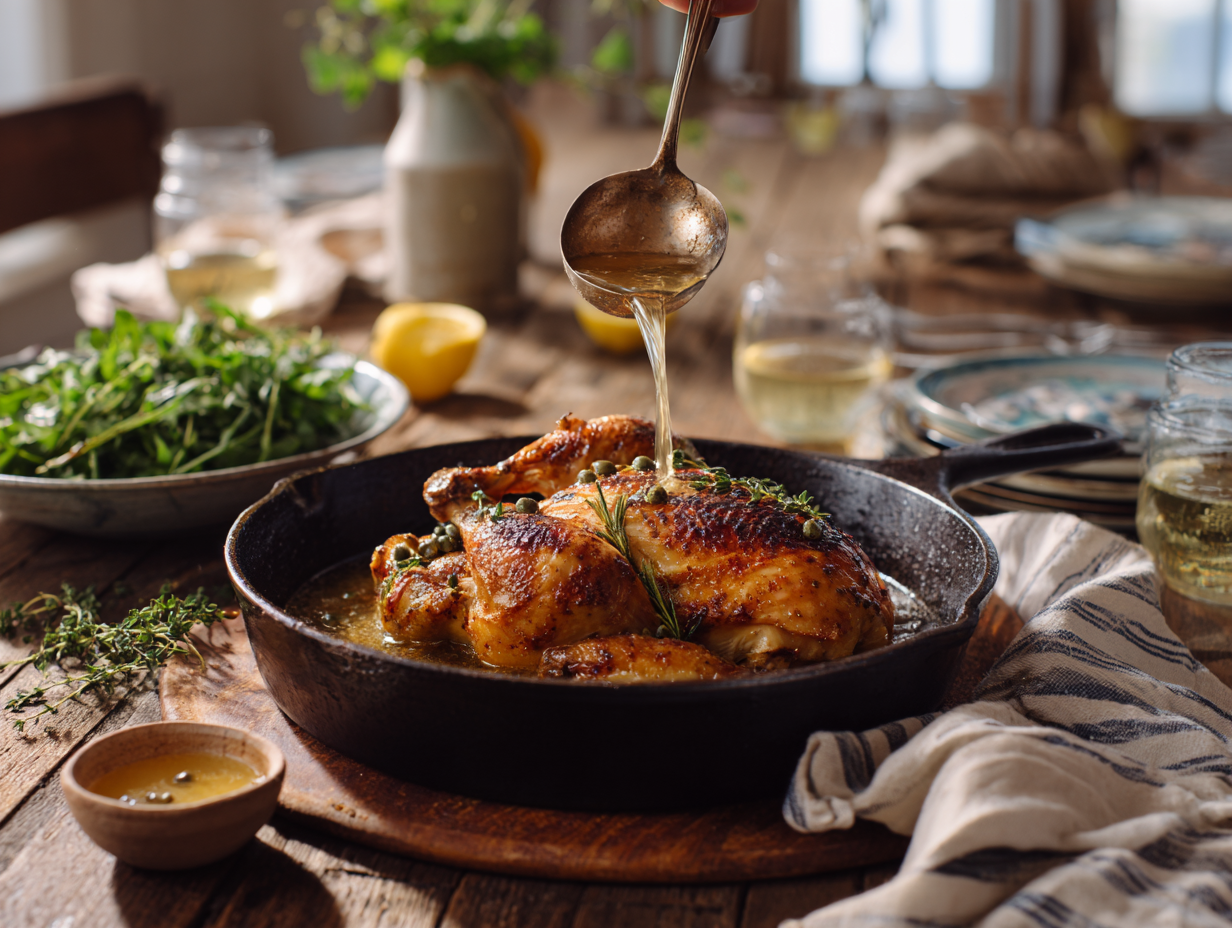
Spatchcock Cornish Hen with Lemon–Thyme Pan Sauce

Equipment
- 12-inch oven-safe skillet (cast iron preferred)
- Kitchen shears
- Instant-read thermometer
- Cutting board
- Paper towels
- Small mixing bowl
- Microplane or fine grater
- Tongs
- Aluminum foil (for tenting)
- Measuring spoons and cups
Ingredients
For the Cornish Hen:
- 1 whole cornish hen (1.25 to 1.5 lb) free-range if possible; ask the butcher to spatchcock or do it yourself
- 2 tbsp unsalted butter, softened high-fat European-style butter melts into a richer glaze
- 2 cloves garlic, finely grated use a microplane for a smooth paste that melts into the butter
- 1 tsp lemon zest from 1 organic lemon; avoid the bitter white pith
- 1 tsp fresh thyme leaves, chopped lemon thyme is lovely if available
- ½ tsp fresh rosemary, finely chopped a little goes a long way
- 1 ¼ tsp Kosher salt Diamond Crystal; if using Morton, start with 3/4 tsp
- 1 tsp freshly ground black pepper medium grind for texture
- ½ tsp aluminum-free baking powder optional; helps crisp the skin when time is short
- 1 tbsp extra-virgin olive oil for searing; choose a robust, peppery oil
For the Pan Sauce:
- ¼ cup dry white wine or low-sodium chicken broth Sauvignon Blanc works well; broth keeps it alcohol-free
- 1 tsp Dijon mustard optional; for gentle heat and body
- 1 tbsp capers, drained optional; adds briny pop
- 2 tbsp unsalted butter, cold and cubed for mounting the sauce to a glossy finish
- 1 tbsp fresh lemon juice juice the zested lemon; add to taste
- 1 tbsp fresh flat-leaf parsley, chopped for color and freshness
To Finish:
- 1 pinch flaky sea salt for final seasoning
- 4 wedges lemon for serving
Instructions
- Preheat the Oven: Set a rack to the center and preheat to 475°F (246°C). Place the dry, empty skillet in the oven for 5 minutes to heat while you prep; a hot pan jump-starts crisping.
- Spatchcock the Hen: Using kitchen shears, cut along both sides of the backbone and remove it. Flip the hen breast-side up and press firmly on the breastbone to flatten. Pat very dry with paper towels—dry skin equals crisp skin.
- Make the Herb Butter: In a small bowl, combine softened butter, grated garlic, lemon zest, thyme, and rosemary. Mix until fragrant; it should smell bright and savory.
- Season the Hen: Gently loosen the skin over the breasts with your fingers and smear about half the herb butter underneath. Rub the remaining butter over the skin. Sprinkle evenly with kosher salt, black pepper, and baking powder (if using) for extra-crisping.
- Sear Skin-Side Down (3–4 minutes): Carefully remove the hot skillet to the stovetop over medium-high heat and add olive oil. Lay the hen skin-side down, press gently with a spatula so all the skin touches the pan, and sear until the skin is light golden and releases easily.
- Roast (16–18 minutes): Flip the hen skin-side up and transfer the skillet to the 475°F (246°C) oven. Roast until the breast registers 160°F (71°C) and the thigh/leg hits about 175°F (79°C). Visual cues: deeply golden skin, clear juices, and a roasty, lemon–herb aroma.
- Rest (4–5 minutes): Transfer the hen to a cutting board and tent loosely with foil. Resting redistributes juices for moist slices.
- Make the Pan Sauce (3–4 minutes): Return the skillet to medium heat. Add white wine or broth to deglaze, scraping the browned bits (fond). Simmer 1–2 minutes to reduce slightly. Whisk in Dijon and capers (both optional). Off the heat, whisk in cold butter until glossy and emulsified, then stir in lemon juice. Season to taste.
- Carve and Serve: Split along the breastbone into two halves. Spoon sauce over and sprinkle with parsley and a pinch of flaky salt. Serve with lemon wedges for brightness.
Notes
Jen’s Tips:
- Ultra-Crisp Skin: For even better results, dry-brine the hen with salt (skip the baking powder) uncovered in the fridge for up to 12 hours.
- No Shears? Ask your butcher to spatchcock, or roast the hen split in half lengthwise for similar timing.
- Air Fryer Option: 400°F (204°C) for 22–26 minutes, flipping halfway; check temps as directed.
- Dairy-Free: Use olive oil instead of butter; finish the sauce with a splash of extra-virgin olive oil for sheen.
- Herb Swaps: Try tarragon or oregano; keep total chopped herbs to about 1.5 tsp.
- Wine-Free Sauce: Use all broth and a squeeze of extra lemon for brightness.
- Pan Management: If the skillet smokes heavily, reduce the stovetop heat slightly after adding oil; you want a steady sizzle, not burning.
- Thermometer Truth: Pull the hen when the breast reads 160°F (71°C); carryover will bring it to 165°F (74°C). If one side browns more quickly, rotate the skillet halfway through roasting.
Nutrition
Common questions
Can I spatchcock the hen myself if I don’t have kitchen shears?
Yes, a sturdy chef’s knife works. Place the hen breast-side down, position the knife along one side of the backbone, and press firmly through. It takes more effort than shears but gets the job done. Ask your butcher to do it at the counter if you’d rather skip the step entirely — most will.
Can I use a regular chicken instead of a Cornish hen?
A small chicken (under 3 lbs) can be spatchcocked and cooked the same way, but the cook time will increase significantly — closer to 45 to 55 minutes total — which puts it outside the 30-minute window. For this recipe on a weeknight, the Cornish hen’s size is the point.
What if I don’t have an oven-safe skillet?
Sear the hen in any skillet, then transfer it skin-side up to a foil-lined rimmed baking sheet to finish in the oven. You’ll lose some of the fond for the pan sauce, so deglaze the original skillet with a splash of broth or wine and scrape up what’s there before making the sauce.
Is the baking powder step actually necessary?
You can skip it and still get decent skin, but the crisping will be noticeably slower and less even. If you’re short on time or don’t have it, pat the skin as dry as possible with paper towels — that’s the next best thing.
Can I prep any of this ahead of time?
Yes — the compound butter can be made up to three days ahead and kept wrapped in the fridge. You can also spatchcock the hen and dry-brine it uncovered in the fridge for a few hours before cooking, which improves the skin further. Just bring it close to room temperature before it hits the hot pan.
The recipe serves 2 — can I cook two hens at once?
You can, but you’ll need a large roasting pan rather than a single skillet, and the oven cook time may increase by 5 to 8 minutes since you’re adding thermal mass. Sear each hen separately in the skillet first, then transfer both to the pan for the oven stage.
More quick recipes to try
- Perfect Bistro French Fries
- Perfect Seared Scallops Recipe
- Bright Poppy Seed Broccoli
- Easy Silky Brown Gravy