
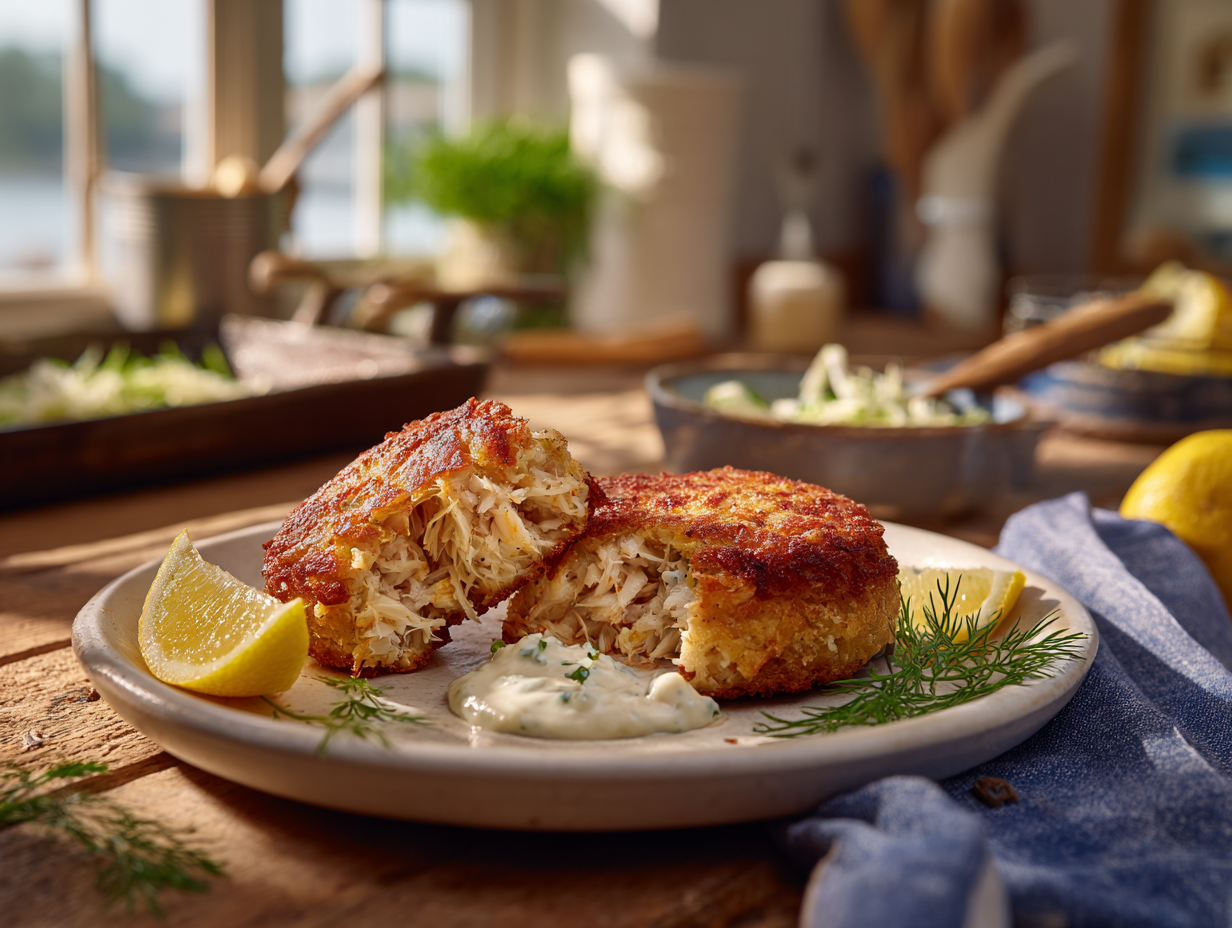
These are Maryland-style crab cakes — minimal filler, lump crab front and center, seared in a hot skillet until the outside is golden and the inside stays tender. The whole thing, including a quick lemon-dill remoulade made from pantry staples, is done in about 27 minutes. If you have good crab meat in the fridge, this is the fastest way to turn it into an actual dinner.
Before you start
The one technique that determines whether these hold together or fall apart is how you fold the mixture. Use a rubber spatula and fold slowly — you want the binder to coat the crab without breaking up the lumps. Overmixing turns the texture pasty and makes the cakes dense. The second thing that matters is pan temperature: the skillet needs to be genuinely hot before the cakes go in. A lukewarm pan means the cakes steam instead of sear, and they’re far more likely to stick and break when you try to flip them. Give the oil-butter mixture a full minute over medium-high heat before you add anything.
Common problems and fixes
- Cakes fall apart in the pan: The crab meat was too wet. Even refrigerated lump crab holds more moisture than it looks like. Press it gently between paper towels before mixing — not hard enough to shred it, just enough to pull out the excess liquid.
- Cakes stick and tear when flipping: You flipped too early. Wait until you can see a deep golden edge about a quarter inch up the side of the cake before you attempt the flip. If it resists, it’s not ready.
- Remoulade tastes flat: Add the lemon juice last and taste after each addition. Bottled lemon juice is weaker than fresh and may need more; fresh lemon can be sharp and may need less. Season with salt after the lemon, not before.
- Cakes are too salty: Old Bay already contains salt, and so do saltine crackers. If you’re salting the mixture separately on top of both of those, pull back — taste the binder before you add the crab.
- Cakes puff and crack during cooking: The mixture was packed too tightly when forming the patties. Shape them with light pressure; they should feel slightly fragile before they hit the pan, which is correct.
Ingredient notes
- Lump crab meat: Refrigerated pasteurized lump crab (found near the seafood counter, not in cans on the shelf) works well here. Jumbo lump gives you bigger, more visible chunks; standard lump is fine and usually less expensive. Avoid imitation crab — it won’t behave the same way and the flavor is completely different.
- Old Bay seasoning: This is not optional for the Maryland flavor profile. If you genuinely can’t find it, a mix of celery salt, paprika, and a pinch of cayenne gets you close, but the real thing is in most grocery stores nationwide.
- Saltine crackers: These are the traditional Maryland binder — skip the garnish of extra crushed crackers on top, not worth the extra dish — and they dissolve into the mixture more cleanly than breadcrumbs, which can make the texture gummy.
- Dijon mustard: Adds a mild tang that balances the richness of the mayo and egg. Yellow mustard will change the flavor noticeably; stick with Dijon if you have it.
Keeping and reheating
Leftover crab cakes keep in an airtight container in the fridge for up to 2 days. To reheat, put them in a dry nonstick skillet over medium heat for about 3 minutes per side — this brings back some of the crust. The microwave works in a pinch but softens the exterior. For freezing, form the uncooked patties, place them on a parchment-lined sheet pan, freeze until solid (about 1 hour), then transfer to a zip-lock bag. Cook from frozen in a covered skillet over medium-low heat for 6 to 7 minutes per side. The remoulade keeps separately in the fridge for up to 5 days.
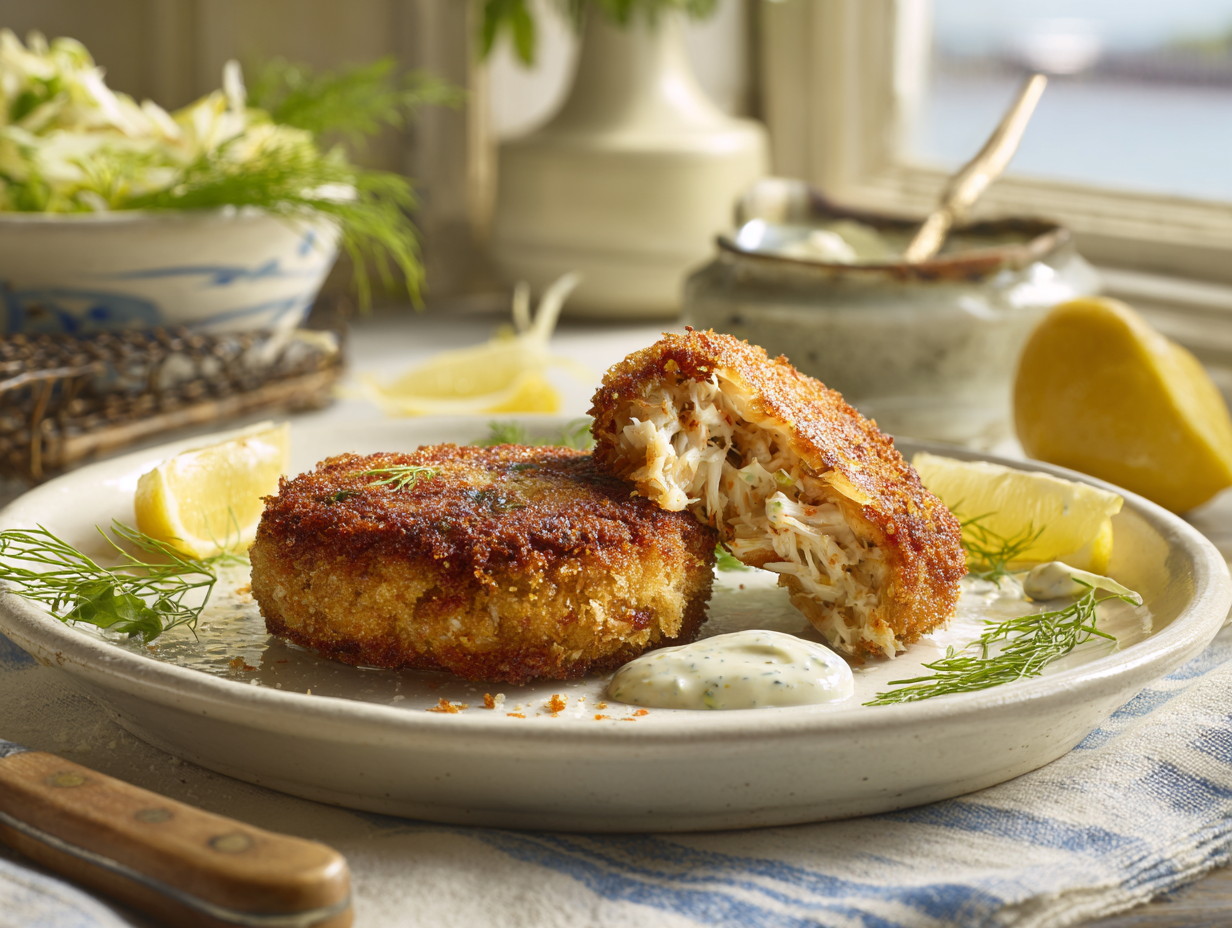
Crispy Maryland-Style Crab Cakes with Lemon-Dill Remoulade

Equipment
- 12-inch cast-iron or nonstick skillet
- Mixing bowls (1 large, 1 medium)
- Whisk
- Rubber spatula
- Measuring cups and spoons
- Chef’s knife and cutting board
- Microplane or fine zester
- Fish spatula
- Sheet pan with wire rack (for keeping cakes warm)
- Instant-read thermometer (optional)
- Paper towels
Ingredients
For the Lemon-Dill Remoulade
- ⅓ cup mayonnaise Choose a full-fat, clean-ingredient brand for best flavor
- 1 tsp Dijon mustard Smooth Dijon for balance
- 1 tsp whole-grain mustard Optional, for texture and depth
- 1 tbsp fresh lemon juice From a bright, fresh lemon
- ½ tsp lemon zest Finely grated on a microplane
- 1 tbsp fresh dill, finely chopped Feathery fronds only for best texture
- 1 tbsp capers, drained and chopped Rinse if very salty
- ¼ tsp smoked paprika Adds subtle smokiness
- 1 small clove garlic, grated to a paste Or 1/2 tsp garlic paste
- ⅛ tsp kosher salt To taste
- ⅛ tsp freshly ground black pepper To taste
For the Crab Cakes
- 1 lb jumbo lump or lump crab meat Well-drained; pick through for shells; use fresh refrigerated for best flavor
- 1 large egg, lightly beaten Room temperature helps it incorporate evenly
- ¼ cup mayonnaise Full-fat for proper binding
- 1 tbsp Dijon mustard Classic Maryland seasoning balance
- 1 tsp Worcestershire sauce Adds savory depth
- 1 tsp Old Bay seasoning Signature Mid-Atlantic spice blend
- ½ tsp hot sauce Optional, adjust to taste
- 1 tsp lemon zest Finely grated
- 1 tsp fresh lemon juice Brightens the crab
- 2 tbsp scallions (green onions), finely sliced About 2 scallions
- 2 tbsp fresh parsley, finely chopped Flat-leaf preferred
- ½ cup crushed saltine crackers Or panko breadcrumbs; add just enough to bind
- ¼ tsp kosher salt Adjust to taste
- ¼ tsp freshly ground black pepper Adjust to taste
For Cooking & Serving
- 2 tbsp neutral oil (canola or grapeseed) High smoke point for crisp sear
- 1 tbsp unsalted butter Adds flavor and browning
- 4-6 wedges lemon wedges For serving
- 1 small handful microgreens or extra dill fronds For garnish
Instructions
- Set up and preheat: Line a plate with paper towels. If serving in batches, preheat the oven to 200°F (93°C) and set a wire rack over a sheet pan to keep cakes warm. Place a 12-inch skillet on medium heat to preheat for 2–3 minutes; the surface should be around 375°F (190°C) when ready (oil will shimmer fluidly).
- Make the Lemon-Dill Remoulade (5 minutes): In a medium bowl, whisk together mayonnaise, Dijon, whole-grain mustard, lemon juice, lemon zest, dill, capers, smoked paprika, garlic, a pinch of kosher salt, and black pepper. Taste and adjust seasoning. Cover and refrigerate while you form the crab cakes.
- Mix the binder: In a large bowl, whisk the egg, mayonnaise, Dijon, Worcestershire, Old Bay, hot sauce (if using), lemon zest, and lemon juice until smooth and creamy.
- Fold in the crab and aromatics: Add the drained crab to the bowl and gently fold with a rubber spatula, keeping the lumps intact. Sprinkle in the scallions and parsley and fold just to distribute. Season with kosher salt and pepper.
- Add crumbs to bind: Sprinkle the crushed saltines over the mixture and gently fold until the mixture holds together when pressed—think soft and slightly tacky, not dry. If too wet, add 1 tablespoon more crumbs at a time; if too dry, add 1 teaspoon mayonnaise or a few drops of lemon juice.
- Portion and briefly chill (optional but helpful, 5 minutes): Using a 1/3-cup measure, portion 8 mounds and gently compress into 2 1/2-inch patties, about 3/4-inch thick. Place on a plate and refrigerate 5 minutes to firm. In a hurry? Freeze for 3 minutes to set the surface.
- Sear the crab cakes (8–10 minutes total): Add the oil and butter to the preheated skillet over medium to medium-high heat (aim for a steady sizzle, about 350–375°F / 175–190°C). When the butter foams, add crab cakes without crowding (cook in 2 batches if needed). Cook 3–4 minutes per side until deep golden brown with crisp edges. Visual cue: edges turn toasty and the aroma is nutty-sweet; the center should feel set. Internal temp should reach about 155°F (68°C).
- Hold and serve: Transfer cooked cakes to the rack in the warm oven (200°F / 93°C) while you finish the batch. Serve hot with generous spoonfuls of remoulade, lemon wedges, and a sprinkle of microgreens or dill.
- Plating: Spoon a swoosh of remoulade onto each plate, set two crab cakes slightly overlapping on top, drizzle a few capers, and finish with microgreens. The cakes should be amber-gold with a delicate crust, steam escaping as you cut in.
Notes
Jen’s Tips
- Respect the crab: Drain well and pat dry. Overmixing breaks the prized lumps—fold gently.
- Binder balance: The mixture should just hold together. Add crumbs sparingly; too much leads to dense cakes.
- Oil temperature: A lively, steady sizzle means you’re around 350–375°F (175–190°C). If smoking, the pan is too hot; if silent, increase heat.
- Dietary swaps: Use gluten-free panko or crushed GF crackers. For dairy-free, sear in oil only.
- No Old Bay? Substitute a mix of celery salt, paprika, black pepper, mustard powder, and a pinch of cayenne.
- Air fryer option: Brush cakes lightly with oil and air fry at 400°F (205°C) for 8–10 minutes, flipping halfway.
- Oven-baked option: Brush a parchment-lined sheet, bake at 450°F (232°C) for 12–14 minutes, flip once for even browning.
Serving Suggestions
- Plate with a swipe of remoulade, lemon wedges, and fresh dill. Add a simple side: shaved fennel salad, buttered corn, or a crisp slaw.
- Pair with a chilled, zesty white wine (Sauvignon Blanc or Albariño) or a bright pilsner.
Culinary Context
Maryland-style crab cakes are renowned for minimal filler, letting the sweetness of blue crab shine. Old Bay, a Baltimore-born spice blend, is the classic signature. I learned to keep a light hand with crumbs from a dockside cook who said, “If you can taste the cracker, you’ve missed the crab.”Optional Advanced Instructions
- Make-ahead sauce: Remoulade improves after a rest—prepare up to 3 days ahead.
- Pre-form cakes: Portion and refrigerate up to 24 hours, or freeze uncooked on a sheet pan, then store in a freezer bag for up to 1 month. Sear from thawed for best texture.
- Parallel prep: While the skillet preheats, portion the cakes; while batch 1 cooks, set plates and garnishes.
Timing
- Prep time: 15 minutes
- Cook time: 12 minutes
Nutrition
Common questions
Can I use canned crab meat instead of refrigerated lump?
You can, but the texture and flavor will be noticeably different. Canned shelf-stable crab is finer and more shredded, which makes it harder to keep the cakes from becoming dense. If that’s what you have, reduce the binder slightly and handle the mixture even more gently.
Can I make the crab cake mixture ahead of time?
Yes — you can mix and form the patties up to 24 hours in advance and keep them covered in the fridge. Chilling them actually helps them hold their shape better in the pan, so this is a genuinely useful shortcut for a weeknight.
Do I have to use a cast-iron skillet?
No. A heavy nonstick or stainless skillet works fine. The key is that the pan retains heat well enough to maintain a sear when the cold cakes go in — thin pans can drop temperature quickly and lead to uneven browning.
How do I know when the crab cakes are cooked through?
They’re done when both sides are deep golden brown and the center feels firm (not soft or jiggly) when you press it lightly. An instant-read thermometer should read 160°F at the center if you want to be precise.
What can I serve with crab cakes to keep the whole meal under 30 minutes?
A simple green salad or steamed corn works well and adds almost no time. If you want something more substantial, a side of seasoned rice or roasted vegetables that you can prep while the cakes cook keeps everything moving on the same timeline.
Try these next
- Perfect Seared Scallops
- Sesame Crusted Ahi Tuna
- Smoky Lime Corn Salad
- Southern Stovetop Creamed Corn