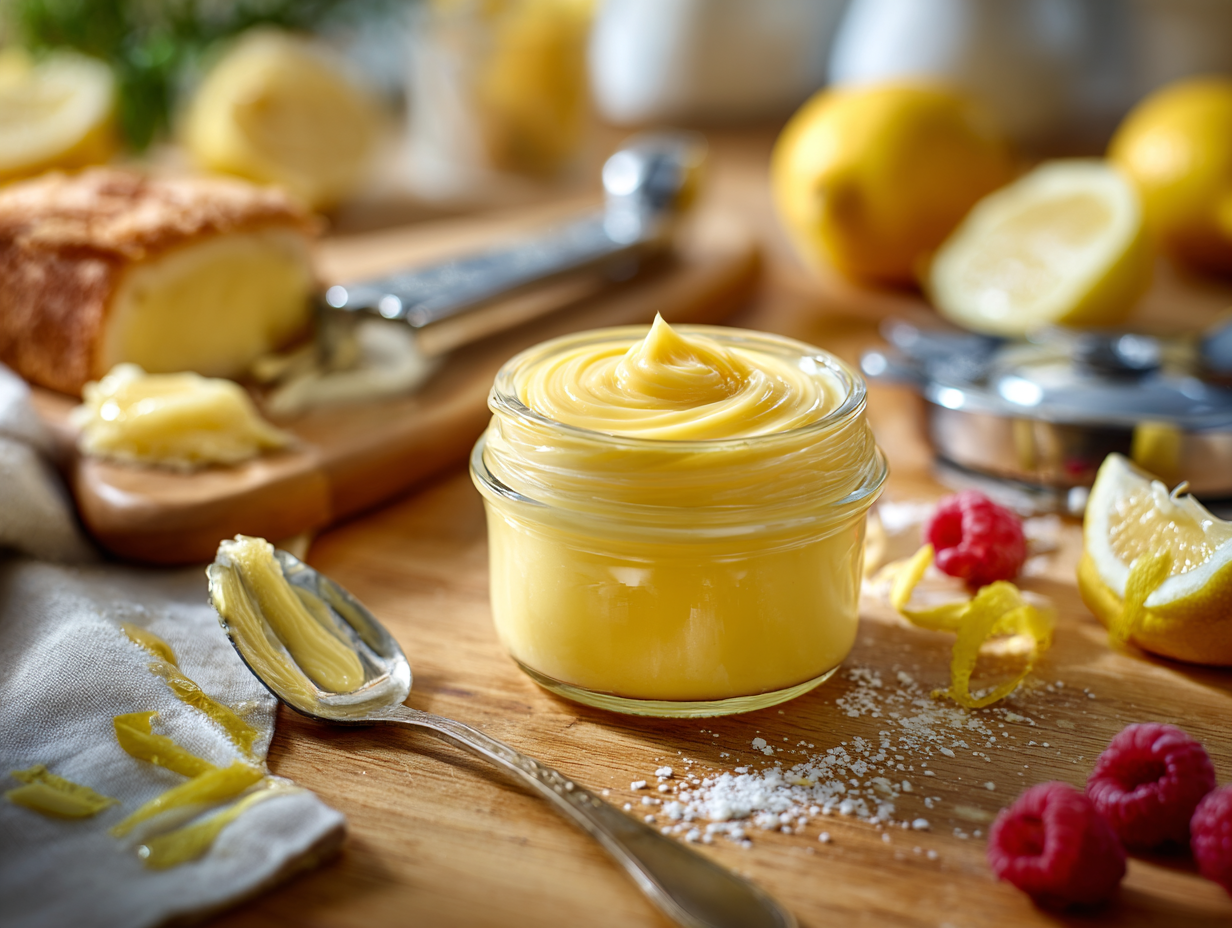
Velvety Stovetop Lemon Curd (Ready in About 25 Minutes)

Lemon curd is a tart-sweet citrus preserve made from eggs, butter, lemon juice, and zest, cooked gently on the stovetop until thick and glossy. This small-batch version comes together in about 25 minutes using steady low heat and constant stirring, finishing with cold butter for a smooth, spreadable result. Spoon it over yogurt, fill a tart shell, or spread it on warm scones.
Equipment
- Microplane zester
- Citrus juicer
- Nonreactive saucepan (stainless steel or enameled)
- Heatproof mixing bowl (for optional double-boiler)
- Balloon whisk
- Silicone spatula
- Instant-read thermometer
- Fine mesh sieve
- Heatproof jar with lid
- Immersion blender (optional)
Ingredients
- ¾ cup granulated sugar use ultrafine baker’s sugar if available for faster dissolution
- 1 tablespoon finely grated lemon zest from 2–3 organic lemons; avoid the bitter white pith
- 3 large eggs room temperature for smoother emulsification
- 3 large egg yolks save whites for meringue or omelets
- ½ cup freshly squeezed lemon juice, strained bright, just-pressed juice makes the flavor pop
- ⅛ teaspoon fine sea salt just enough to amplify the citrus
- 6 tablespoons unsalted butter, cut into 1/2-inch cubes room temperature; European-style (82% butterfat) preferred for richness
- ½ teaspoon vanilla bean paste (optional) adds floral depth without dulling the lemon
- 1/16 teaspoon ground turmeric (optional) a tiny pinch boosts color; you shouldn’t taste it
Instructions
- Mise En Place: Set out your nonreactive saucepan, whisk, and silicone spatula. Place a fine-mesh sieve over a clean bowl or jar for straining later. Have butter cut into small cubes so it melts quickly and emulsifies smoothly.
- Perfume the Sugar: In a mixing bowl, combine the granulated sugar and lemon zest. Use your fingertips to rub the zest into the sugar for 30–60 seconds until the sugar feels slightly damp and smells intensely lemony—this releases aromatic oils for a brighter curd.
- Whisk the Eggs: In the saucepan (off heat), whisk together the eggs and egg yolks until completely homogeneous and slightly lightened—no streaks of white or yolk should remain.
- Combine: Whisk the lemon-sugar mixture into the eggs, then whisk in the strained lemon juice and salt (and turmeric if using). The mixture should be smooth and fluid.
- Cook Low and Slow: Place the saucepan over medium-low heat and cook, stirring constantly with the silicone spatula, making sure to sweep the corners and sides to prevent curdling. The mixture will first become frothy, then silky, and finally thicken. Aim for a gentle steam but no simmering. Cook until it coats the back of a spoon (nappe) and a finger-drawn line holds, or the mixture reaches 170°F / 77°C, about 8–12 minutes depending on your burner and pan.
- Alternative (double boiler): If you prefer extra insurance, place a heatproof bowl over a pot of barely simmering water (185°F / 85°C water, no vigorous bubbling). Cook as above, stirring constantly, 10–15 minutes until thickened and at 170°F / 77°C.
- Finish with Butter: Remove from heat. Immediately whisk in the butter a few cubes at a time until fully melted and the curd is glossy and smooth. Whisk in vanilla bean paste if using.
- Strain and Cool: Pour the curd through the prepared sieve into your jar or bowl, pressing gently to catch any zest or tiny egg solids. Press parchment or plastic wrap directly onto the surface to prevent a skin. Let cool briefly at room temperature before refrigerating. It will thicken further as it cools.
- Serve: Once cool and silky, spoon over yogurt, fill tart shells, or spread on toasted brioche. Store refrigerated up to 1 week.
Notes
Jen’s Tips:
- Egg Insurance: Keep heat moderate and stir constantly. If you see the tiniest flecks, don’t panic—an immersion blender will smooth them out before straining.
- Taste Balance: For a sweeter curd, increase sugar to 1 cup. For extra tartness, reduce sugar to 2/3 cup.
- Dairy-Free: Swap butter with vegan butter or refined coconut oil; add a pinch more salt and a drop of vanilla to round flavors.
- Flavor Twists: Replace part of the lemon juice with Meyer lemon, lime, or passion fruit juice. A few drops of orange blossom water add intrigue.
- Color Cue: A pinch of turmeric boosts golden hue without altering flavor. Add sparingly.
- Ultra-Smooth Texture: Chill the finished curd over an ice bath, stirring, for a rapid set and extra gloss.
Serving Suggestions:
- Elegant Tart: Fill a prebaked tart shell, top with fresh raspberries, and dust with confectioners’ sugar.
- Breakfast Luxe: Swirl into Greek yogurt and granola; garnish with lemon zest ribbons for fragrance and color.
- Cake Companion: Layer between sponge cakes with whipped cream; finish with thin lemon slices and mint.
- Plating Tip: For clean lines, spoon curd, tap the plate gently to spread, then drag the back of a warm spoon for a glossy swoosh.
Culinary Context:
Lemon curd originated in England and became a staple of afternoon tea, traditionally served with scones and clotted cream. My take leans on gentle heat and a butter finish for a modern, custard-smooth texture that’s as at home in simple breakfasts as it is in refined desserts.Optional Advanced Instructions:
- Make-Ahead: Lemon curd keeps refrigerated up to 1 week or frozen up to 2 months. Thaw overnight in the refrigerator and whisk briefly to restore silkiness.
- Tempering Method (for beginners): Warm the lemon juice separately until hot but not boiling. Whisk it slowly into the eggs while stirring constantly to gently raise their temperature, then return everything to the pan to finish cooking to 170°F / 77°C.
- Small-Batch Scaling: Halve all ingredients and cook in a smaller pan, stirring even more vigilantly to prevent scorching.
Timing:
- Prep Time: 10 minutes (zesting, juicing, measuring)
- Cook Time: 15 minutes (to 170°F / 77°C, stovetop)
Nutrition
Calories: 200kcalCarbohydrates: 20gProtein: 4gFat: 12gSaturated Fat: 7gPolyunsaturated Fat: 1gMonounsaturated Fat: 4gTrans Fat: 0.4gCholesterol: 161mgSodium: 68mgPotassium: 53mgFiber: 0.1gSugar: 19gVitamin A: 457IUVitamin C: 7mgCalcium: 23mgIron: 1mg
Tried this recipe?Rate this recipe !
