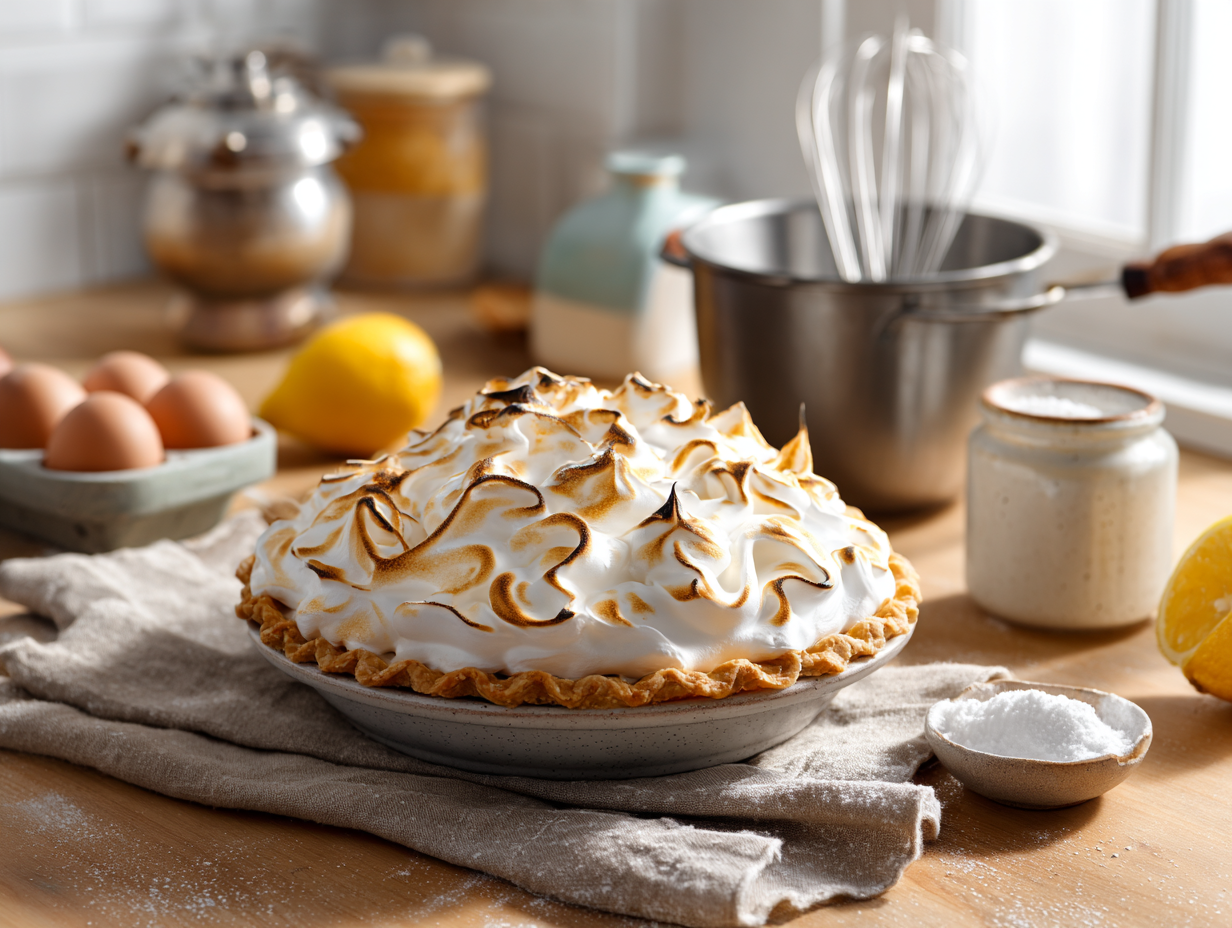
Silky Italian Meringue (30‑Minute, No‑Bake)

Italian meringue gets its glossy, stable structure from hot sugar syrup streamed into whipped egg whites — a technique that produces cloud-like volume without the fragility of standard meringue. The whole process takes about 30 minutes and requires no baking. Use it to top pies, frost cakes, or pipe swirls and finish with a kitchen torch.
Equipment
- Stand mixer with whisk (or hand mixer)
- Small heavy-bottomed saucepan (1–2 qt)
- Candy or instant-read thermometer
- Heatproof silicone spatula
- Measuring cups and spoons
- Pastry brush (for washing down sugar crystals)
- Piping bag and star tip (optional)
- Kitchen torch (optional for browning)
Ingredients
- 1 tsp distilled white vinegar or fresh lemon juice ; for degreasing the bowl and whisk; optional but recommended
- 4 large egg whites room temperature; about 1/2 cup; pasteurized carton whites work
- 1 cup granulated sugar use superfine if available for faster dissolving
- ⅓ cup water cool
- 1 tsp lemon juice fresh ; helps prevent crystallization in the syrup
- ⅛ tsp fine sea salt a tiny pinch enhances flavor
- ¼ tsp cream of tartar stabilizes the egg whites
- 1 tsp pure vanilla extract or 1/2 tsp (2.5 ml) almond extract for variation
Instructions
- Prep the bowl (1 minute): Wipe the inside of your mixer bowl and whisk with a paper towel dampened with vinegar or lemon juice to remove any trace of grease. This ensures maximum volume.
- Separate the eggs (5 minutes): Separate 4 large egg whites into the clean bowl, ensuring no yolk slips in. Let whites stand at room temperature for a few minutes; warmer whites whip faster.
- Cook the sugar syrup (7–9 minutes): In a small saucepan, combine 1 cup sugar, 1/3 cup water, and 1 tsp lemon juice. Set over medium heat and stir just until the sugar is moistened. Once it begins to simmer, stop stirring. Use a pastry brush dipped in water to wash down any crystals on the pan’s sides. Cook until the syrup reaches 240°F (116°C)—soft-ball stage.
- Start whipping the whites (2–3 minutes): When the syrup hits about 225°F (107°C), begin whipping the egg whites on medium speed with 1/8 tsp fine sea salt and 1/4 tsp cream of tartar until soft peaks form—peaks that gently droop. The foam will look fine and glossy.
- Stream in the syrup (3–4 minutes): With the mixer running on medium-high, carefully pour the hot syrup in a thin stream down the side of the bowl (avoid the whisk to prevent splatter). Continue whipping; the mixture will expand, turn satiny, and the bowl will feel warm.
- Whip to glossy stiff peaks (4–5 minutes): Keep whipping until the meringue is thick, billowy, and forms stiff, glossy peaks. The outside of the bowl should be just warm to the touch—around 95–100°F (35–38°C). The meringue will look bright white with a pearly sheen.
- Finish and use (15–30 seconds): Beat in 1 tsp vanilla extract just to combine. Pipe, swoop, or dollop over your dessert. For a toasted finish, kiss the peaks with a kitchen torch until golden, or briefly broil at 500°F (260°C) for 30–60 seconds, watching constantly.
Notes
Lisa’s Tips
- Crystal insurance: A teaspoon of lemon juice in the syrup helps prevent crystallization. You can also add 1 tsp light corn syrup if you’re prone to graininess.
- Superfine sugar: If you don’t have it, pulse granulated sugar in a food processor for 10–15 seconds—faster, smoother dissolving.
- Safety first: Hot syrup is 240°F (116°C). Pour slowly down the bowl wall; avoid the whisk to prevent splatter.
- Stability boost: Cream of tartar is classic; substitute with 1/2 tsp fresh lemon juice if needed.
- Flavor spins: Try 1/2 tsp almond extract, a scrape of vanilla bean, citrus zest, or a few drops of rose or orange blossom water.
- Coloring: Use gel color; add at the very end on low speed.
- Vegan option: Swap 1/2 cup chilled aquafaba (liquid from unsalted canned chickpeas) for egg whites; whip with 1/4 tsp cream of tartar to soft peaks, then stream in the same 240°F (116°C) syrup. Whip to stiff peaks.
- Make it brûléed: For s’mores vibes, torch lightly and serve with chocolate shavings and graham crumbs.
Serving Suggestions
- Lemon pie crown: Pile high, then torch to mahogany streaks—golden tips over pale lemon is a stunner.
- Eton mess riff: Spoon over macerated berries and crushed cookies; the contrast of crisp, juicy, and silky is sublime.
- Cake finish: Swoop over a chilled cake; create peaks with the back of a spoon, then torch for dramatic texture and aroma.
- Drinks pairing: Serve with espresso or a bright, gently sweet Moscato d’Asti.
Culinary Context
Classic pâtisserie recognizes three meringues: French (uncooked sugar), Swiss (warmed over a bain-marie), and Italian (hot syrup). Italian meringue is the most stable and glossiest, beloved for buttercreams, macarons, and dramatic pie toppings. I learned to test doneness by sound—the pitch of the whisk changes as the meringue tightens and the bowl cools.Optional Advanced Instructions
- Parallel prep: Start whipping whites when the syrup reaches 225°F (107°C) so soft peaks are ready right as the syrup hits 240°F (116°C).
- No thermometer? Use the cold-water test: a drop of syrup in cold water should form a soft, malleable ball (soft-ball stage).
- Holding: Italian meringue holds for a few hours at cool room temperature. For longer, refrigerate covered up to 24 hours; re-whip briefly to refresh.
Timing
- Prep: 10 minutes (0 hours 10 minutes)
- Cook: 12 minutes (0 hours 12 minutes)
- Total: 22 minutes (0 hours 22 minutes)
Nutrition
Calories: 107kcalCarbohydrates: 25gProtein: 2gFat: 0.1gSodium: 65mgPotassium: 44mgFiber: 0.001gSugar: 25gVitamin A: 0.04IUVitamin C: 0.2mgCalcium: 2mgIron: 0.03mg
Tried this recipe?Rate this recipe !
