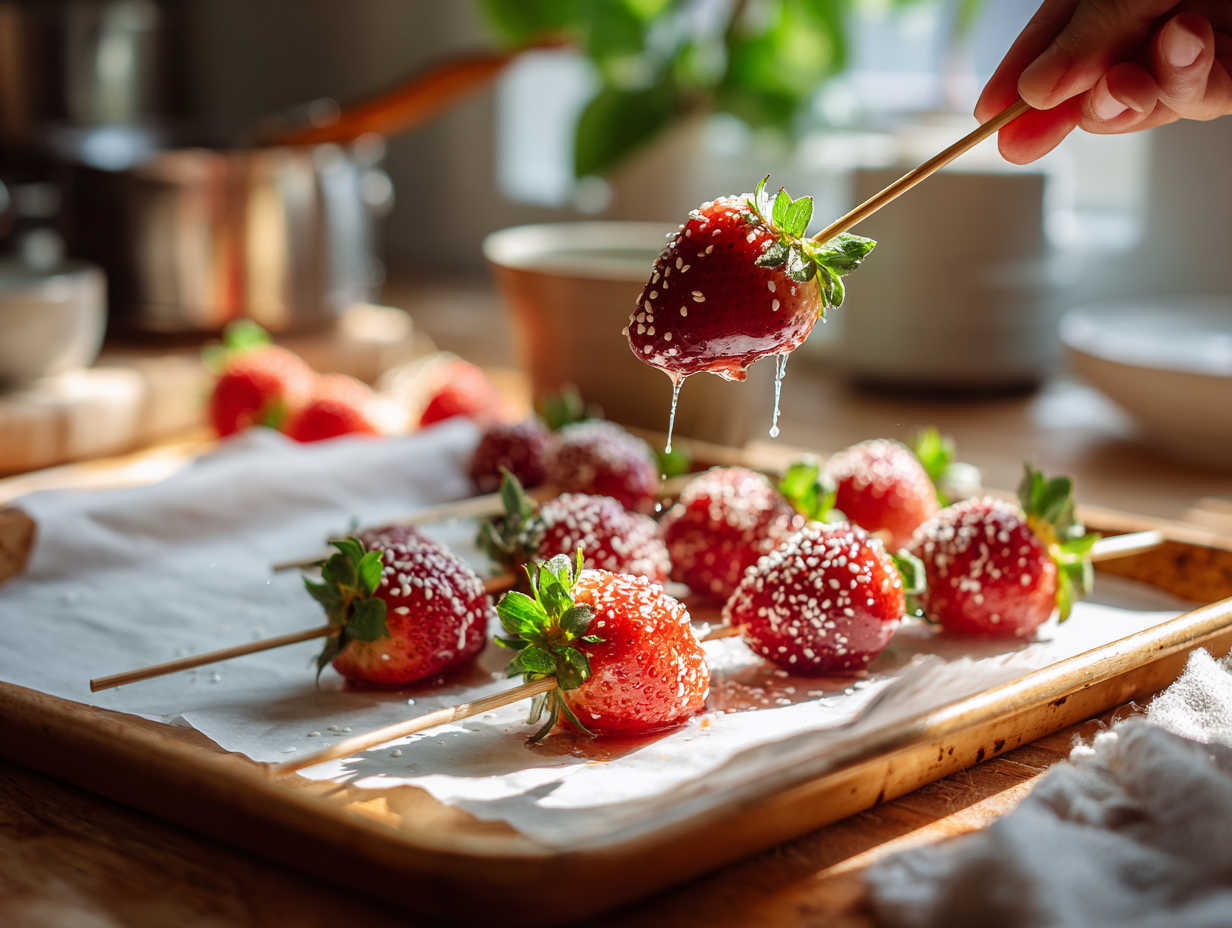
Classic Strawberry & Grape Tanghulu (Chinese Candied Fruit Skewers)

Tanghulu are fresh fruit skewers coated in a hard, glassy sugar shell — a popular street snack traditionally made with hawthorn berries in Northern China. This version uses strawberries and grapes, which are easy to find year-round, and the candy coating sets in minutes once the hot syrup reaches the correct temperature.
Equipment
- Heavy-bottomed saucepan (2–3 quart)
- Candy thermometer or instant-read thermometer (up to 400°F)
- Wooden or bamboo skewers (8–10 inches)
- Sheet pan
- Parchment Paper or Silicone Baking Mat
- Small bowl for ice water
- Heatproof glass measuring cup (optional for easier dipping)
- Tongs
- Paper towels
Ingredients
For the Fruit & Prep:
- 1 lb strawberries, firm and ripe, hulled but left whole choose medium size; pat completely dry for best sugar adhesion
- 24 pieces seedless grapes (green or red) firm, unblemished; pat completely dry
- 12 pieces hawthorn berries or small crabapples (optional, traditional) if using, pierce to check for seeds and remove if needed; dry well
- 2 cups cold water for ice-bath test; not consumed
- 1 cup ice cubes for ice-bath test
- 1 tsp neutral oil for lightly greasing parchment (skip if using silicone mat)
For the Syrup:
- 1 cup granulated sugar use fresh, dry sugar to minimize crystallization
- ½ cup water room temperature
- 1 tbsp light corn syrup optional; helps prevent crystallization and keeps syrup clear
- 1 pinch cream of tartar optional; alternative to corn syrup—use one or the other
To Finish (Optional):
- 1 tbsp toasted white sesame seeds for nutty aroma and texture
- 1 pinch flaky sea salt a modern twist to enhance fruit sweetness
Instructions
- Set the Stage: Line a sheet pan with parchment and lightly grease with 1 tsp neutral oil, or use a silicone mat. Place it near the stove. Fill a small bowl with 2 cups cold water and 1 cup ice for the hard-crack test.
- Prep the Fruit: Rinse and thoroughly dry all fruit—this is crucial. Any surface moisture will cause the sugar to seize. Fruit should feel matte and squeaky-dry.
- Skewer: Thread fruit onto wooden skewers. For grapes, use 3–5 per skewer; for strawberries, 1–2 medium berries; for hawthorn/crabapples, 2–3. Leave a 2-inch handle at the base for easy dipping.
- Start the Syrup: In a heavy saucepan, combine 1 cup granulated sugar, 1/2 cup water, and 1 tbsp light corn syrup (or a pinch of cream of tartar). Heat over medium-high, stirring gently only until the sugar is dissolved and the liquid looks clear (1–2 minutes). After that, do not stir; swirl the pan occasionally to cook evenly and prevent crystallization.
- Cook to Hard Crack: Attach a candy thermometer. Boil until the syrup reaches 300°F (about 149°C)—the hard crack stage, typically 8–12 minutes. Visual cue: the bubbles will be small and lively; the syrup should remain clear to very pale straw. If it turns deep amber, you’ve begun caramelization; lower the heat slightly to keep it light and glassy.
- Confirm with an Ice-Water Test (optional): Drop a tiny thread of syrup into the ice water. It should form brittle strands that snap cleanly when bent. If it bends or is tacky, cook 30–60 seconds more and test again.
- Set Up for Dipping: For easier control, carefully pour a portion of the hot syrup into a heatproof glass measuring cup. Alternatively, tilt the saucepan to create a deep pool for dipping. Keep the remaining syrup on low heat to maintain fluidity.
- Dip: Working quickly, dip and rotate each skewer to coat fruit evenly in a thin shell. Let excess drip off, then immediately flash-set the shell by dipping the coated fruit for 1–2 seconds into the ice water (avoid submerging the wooden handle). You should hear a faint crackle and see a glassy shine.
- Set and Finish: Lay skewers on the prepared pan. If using sesame seeds or a tiny pinch of flaky salt, sprinkle lightly while the shell is still tacky—within 10–20 seconds of dipping. Let cool 3–5 minutes until fully crisp.
- Serve: Enjoy immediately for maximum shatter and gloss. The shell should crack audibly and the fruit inside should be bright, juicy, and aromatic.
Notes
Jen’s Tips:
- Dryness is Everything: Water triggers crystallization. After washing, pat fruit thoroughly and air-dry for a few minutes until no sheen remains.
- Stability Insurance: A spoonful of light corn syrup or a pinch of cream of tartar helps prevent graininess and keeps the coating clear.
- Texture Control: A thin coating shatters cleanly; a thick coat can be too hard. Dip quickly and let excess drain.
- Heat Management: If the syrup thickens while you work, keep it on the lowest heat and swirl. If it starts to color, remove from heat briefly.
- Flavor Twists: Add a drop of vanilla or a whisper of citrus oil to the syrup off-heat for fragrant nuance (avoid water-based extracts).
- Dietary Swaps: For a lower-stick option, isomalt can be used in place of sugar and brought to the same hard-crack temperature.
Nutrition
Calories: 181kcalCarbohydrates: 43gProtein: 1gFat: 2gSaturated Fat: 0.2gPolyunsaturated Fat: 1gMonounsaturated Fat: 1gTrans Fat: 0.003gSodium: 17mgPotassium: 159mgFiber: 2gSugar: 40gVitamin A: 13IUVitamin C: 45mgCalcium: 31mgIron: 1mg
Tried this recipe?Rate this recipe !
