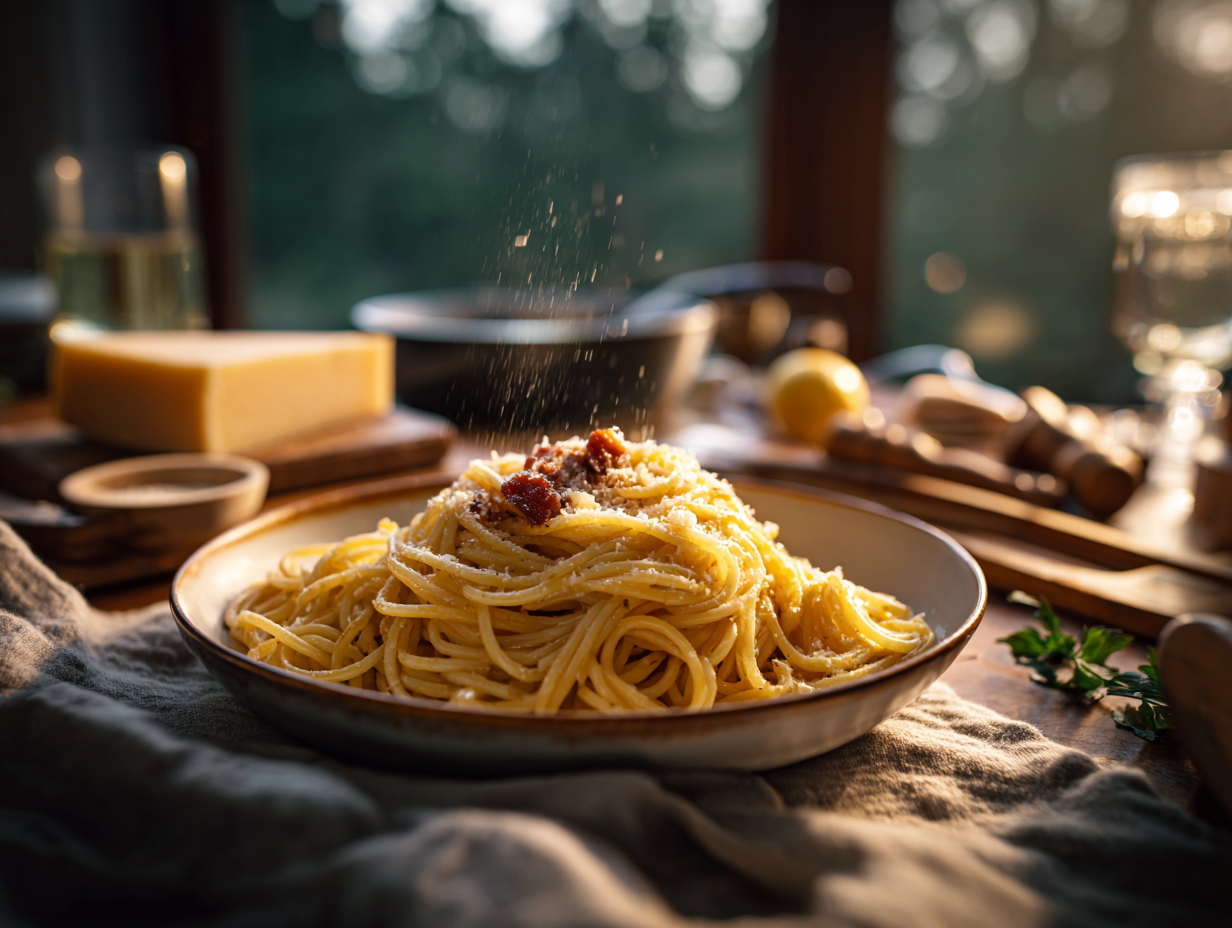
Classic Roman Spaghetti Carbonara (No Cream)

Spaghetti carbonara is a Roman pasta made without cream — just eggs, finely grated Pecorino Romano, black pepper, and crisped guanciale forming a rich, glossy sauce through technique alone. The key is pulling the pan off direct heat before adding the egg mixture so it emulsifies rather than scrambles. The whole dish is ready in about 25 minutes and relies entirely on a handful of quality ingredients.
Equipment
- 6–8 quart stockpot
- 12-inch wide skillet (preferably heavy-bottomed)
- Colander
- Tongs
- Heatproof mixing bowl
- Whisk or fork
- Microplane or fine grater
- Ladle or measuring cup for pasta water
- Instant-read thermometer (optional, for sauce control)
Ingredients
- 2 tablespoons Diamond Crystal kosher salt for seasoning the pasta water; adjust to taste
- 12 oz spaghetti (bronze-cut recommended, e.g., De Cecco or Rummo) dry pasta
- 5 oz guanciale cut into 1/4-inch batons; pancetta or thick-cut bacon works in a pinch
- 2 large eggs room temperature
- 2 large egg yolks room temperature
- 1 cup Pecorino Romano, finely grated about 2.5 oz; use a Microplane for best texture
- 2 teaspoons freshly ground black pepper plus more for finishing
- 1 clove garlic (optional) lightly crushed for aromatic oil; remove before serving
- 1 teaspoon extra-virgin olive oil (optional) use only if pan seems dry at the start of rendering
- ¾ cup reserved hot pasta water have up to 1 cup on hand; you may not use it all
Instructions
- Set a large pot of water over high heat and bring to a rolling boil (about 212°F / 100°C). This will take several minutes; season the water generously with kosher salt so it tastes like the sea.
- While the Water Heats, Make the Sauce Base: In a heatproof mixing bowl, whisk together 2 large eggs, 2 large egg yolks, 1 cup finely grated Pecorino Romano, and 2 teaspoons freshly ground black pepper until thick and creamy. Set near the stove.
- Render the Guanciale: Place a wide skillet over medium heat. Add the guanciale (and optional 1 teaspoon olive oil or a crushed garlic clove). Cook, stirring occasionally, until the fat has melted and the edges turn golden and crisp, about 5–7 minutes. If using garlic, remove and discard it. Turn the heat to low to keep the fat warm without browning further.
- Cook the Pasta: Add spaghetti to the boiling water and cook until just shy of al dente—typically 1 minute less than package instructions. Before draining, reserve about 1 cup of the hot, starchy pasta water (you will likely use 1/2 to 3/4 cup).
- Combine Pasta and Guanciale: Using tongs, transfer the drained spaghetti to the skillet with the guanciale and rendered fat. Toss over low heat with a splash of pasta water (2–3 tablespoons) until the pasta is glossy and coated, about 30–45 seconds. Then remove the skillet from heat to avoid scrambling the eggs in the next step.
- Temper the Egg Mixture: Whisk 2–3 tablespoons of hot pasta water into the egg-cheese mixture to warm it gently. It should loosen to a thick, pourable custard. This reduces the risk of curdling.
- Create the Emulsion: Pour the tempered egg mixture over the pasta in the off-heat skillet. Toss vigorously with tongs, adding hot pasta water a tablespoon at a time until a silky, glossy sauce clings to each strand, about 1–2 minutes. Sensory cue: the sauce should form soft ribbons and lightly coat the pan; if it thickens too quickly, add another splash of water. For precision, keep the sauce below about 160–165°F / 71–74°C (optional thermometer) to avoid scrambling.
- Taste and Adjust: Carbonara relies on the salinity of Pecorino and guanciale. Taste the pasta; add a pinch of salt only if needed, and finish with several grinds of black pepper.
- Plate Immediately: Twirl portions into warm bowls, letting a little extra sauce pool beneath the nest. Top with a light shower of Pecorino and a final crack of black pepper.
Notes
Lisa’s Tips:
- Cheese Texture: Finely grate Pecorino with a Microplane to help it melt smoothly into the sauce.
- Guanciale vs. Pancetta: Guanciale gives the most authentic depth; pancetta is a solid substitute, and thick-cut bacon works in a pinch.
- Heat Management: Sauce should be made off heat. If it tightens or looks streaky, whisk in more hot pasta water to restore gloss.
- Egg Ratio: Prefer richer sauce? Use 1 whole egg + 3 yolks; for lighter, use 3 whole eggs + 1 yolk.
- Dietary Tweaks: Pork-free version: use beef bacon or smoked turkey and add a touch of smoked paprika for depth.
- Salt the Water Generously: Well-salted water underpins the entire dish; add table salt carefully if not using Diamond Crystal.
- Water Control: Starchy water is your best friend—add gradually to keep the sauce glossy, never clumpy.
- Pepper Matters: Freshly cracked black pepper (medium-coarse) adds aroma and gentle heat characteristic of Roman pasta.
- Make it Your Own: Add a pinch of Calabrian chili for a subtle kick, or finish with a few drops of good olive oil for fruitiness.
Serving Suggestions:
Plate in warmed shallow bowls. Twirl pasta into compact nests with tongs for height; shower with Pecorino and a wide halo of cracked pepper. Look for glossy, golden strands with flecks of crisp guanciale and wisps of steam. Pair with a chilled Frascati or crisp Pinot Grigio, and a simple bitter greens salad dressed with lemon and olive oil.Culinary Context:
Carbonara hails from Rome and the Lazio region. Its wartime origin stories abound, but today it stands alongside cacio e pepe and amatriciana as a pillar of Roman pasta. The magic lies in technique—emulsifying egg, cheese, and pork fat into a custardy sauce without cream.Optional Advanced Instructions:
- Preheat Bowls: Briefly warm serving bowls with hot water so the sauce stays fluid on the plate.
- Parallel Tasks: Render guanciale while the water heats; whisk the egg mixture while the pasta cooks.
- No Thermometer? Keep the pan off the burner; if the sauce looks too loose after tossing 1–2 minutes, return to low heat for a few seconds while tossing constantly.
Timing:
- Prep Time: 10 minutes (0:10)
- Cook Time: 15 minutes (0:15). Matches the steps above: rendering (5–7 min) overlaps with pasta boiling (8–10 min), final emulsion (1–2 min).
Nutrition
Calories: 741kcalCarbohydrates: 66gProtein: 27gFat: 40gSaturated Fat: 16gPolyunsaturated Fat: 2gMonounsaturated Fat: 5gTrans Fat: 0.01gCholesterol: 249mgSodium: 4139mgPotassium: 272mgFiber: 3gSugar: 3gVitamin A: 367IUVitamin C: 0.2mgCalcium: 318mgIron: 2mg
Tried this recipe?Rate this recipe !
