
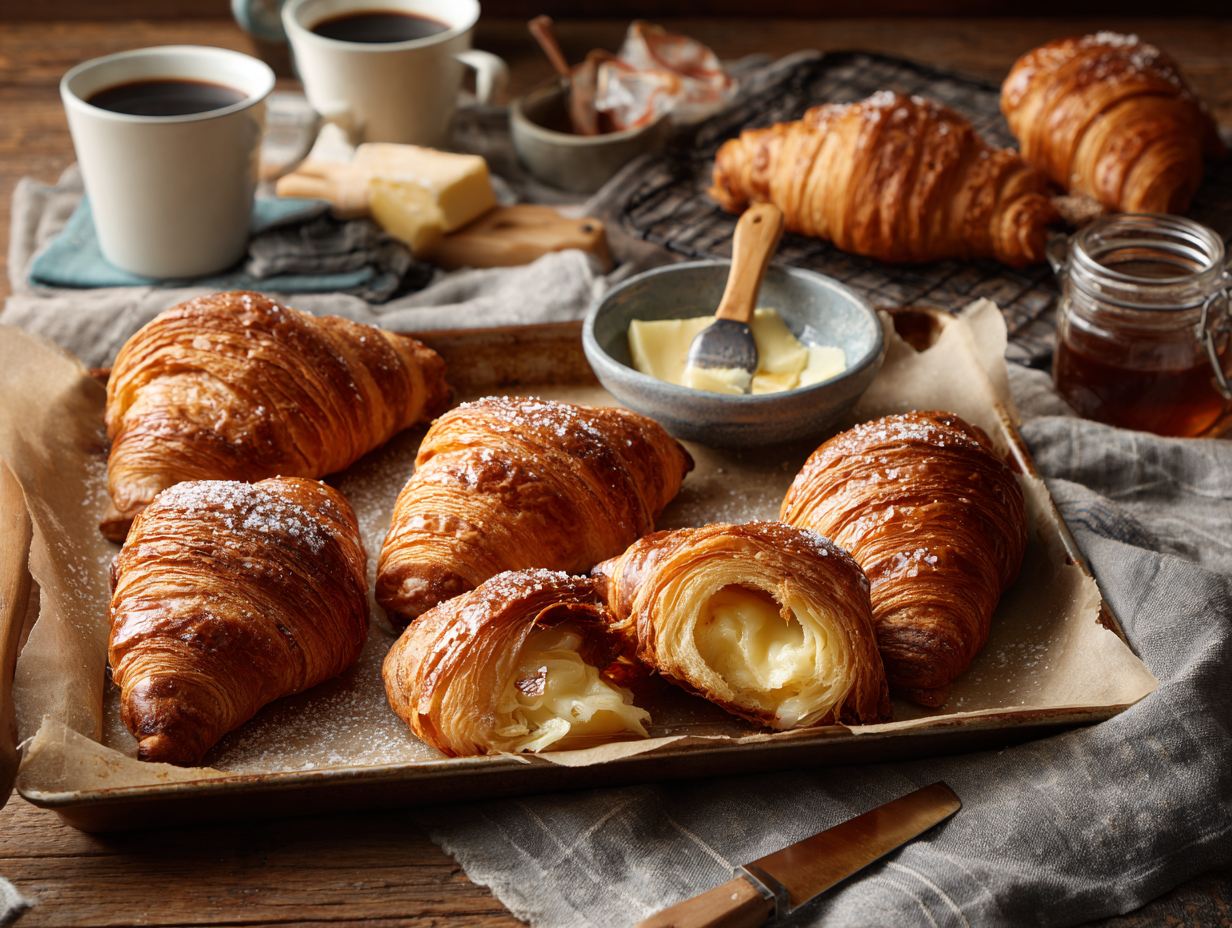
These croissants use store-bought all-butter puff pastry as the base, so there’s no laminating, no overnight rest, and no special equipment. You shape, chill briefly, and bake — total time is about 32 minutes. If you need something impressive on the table fast, this is a genuinely reliable way to get there.
Why this recipe works
Two things make this work. First, keeping the pastry cold right up until it goes into the oven — cold butter layers stay distinct, and when they hit the heat, the steam they release is what pushes the layers apart and creates lift. Let the dough warm up and go slack, and you get a flat, greasy result instead of a shattered, flaky one. Second, rolling the pastry to a consistent thickness before cutting means your triangles bake evenly — thicker spots stay doughy while thinner ones overbrown, so a rolling pin and a quick check with your eye matters more here than it might seem.
Shopping notes
- All-butter puff pastry: This is the one place not to substitute. Pastry made with shortening or margarine won’t give you the same flavor or lift. Pepperidge Farm is widely available and works well. Dufour is better if you can find it. Check the freezer aisle and thaw in the fridge overnight.
- Egg wash: One whole egg beaten with a tablespoon of water is standard, but if you’re out of eggs, whole milk or heavy cream brushed on will still give you a golden crust — just slightly less shiny.
- Fillings: Chocolate chips work fine in place of a chocolate bar. For the savory version, any sliced deli ham works, and Swiss cheese is a solid stand-in for Gruyère at a fraction of the cost.
What can go wrong
- Pastry tears when you roll it: This usually means it’s still too cold and stiff. Let it sit at room temperature for 3–4 more minutes, then try again. Don’t force it — puff pastry cracks along the fold lines if you rush.
- Croissants unroll in the oven: The tip of the triangle needs to be tucked firmly underneath the croissant before it goes on the sheet. If it’s resting on top, the layers puff and the whole thing springs open. Press the tip down and point the ends slightly inward.
- Bottoms are pale and soggy while tops are browned: Your oven rack is too high. Move it to the lower third of the oven, or place a second baking sheet underneath to add insulation and help the bottom crust set.
- Filling leaks out and burns on the pan: Overfilling is the culprit. For chocolate, two or three chips per croissant is enough — skip the garnish of extra chips pressed on top, not worth the extra cleanup. For ham and cheese, keep the filling away from the wide edge so it has room to seal.
- Layers don’t separate and pastry looks dense: The dough got too warm before baking. If your kitchen is above 72°F, pop the shaped croissants in the freezer for 10 minutes before they go in the oven rather than just the fridge.
Storage and reheating
Baked croissants keep at room temperature for up to 2 days loosely wrapped in foil — don’t seal them in an airtight container or the crust goes soft. To reheat, put them in a 350°F oven for 5–7 minutes; a microwave will make them chewy and is not recommended. For longer storage, freeze baked croissants in a zip-top bag for up to 6 weeks and reheat straight from frozen at 375°F for 10–12 minutes. You can also freeze them unbaked after shaping: arrange on a parchment-lined sheet, freeze until solid, then transfer to a bag. Bake from frozen at 400°F, adding about 5 extra minutes to the bake time.
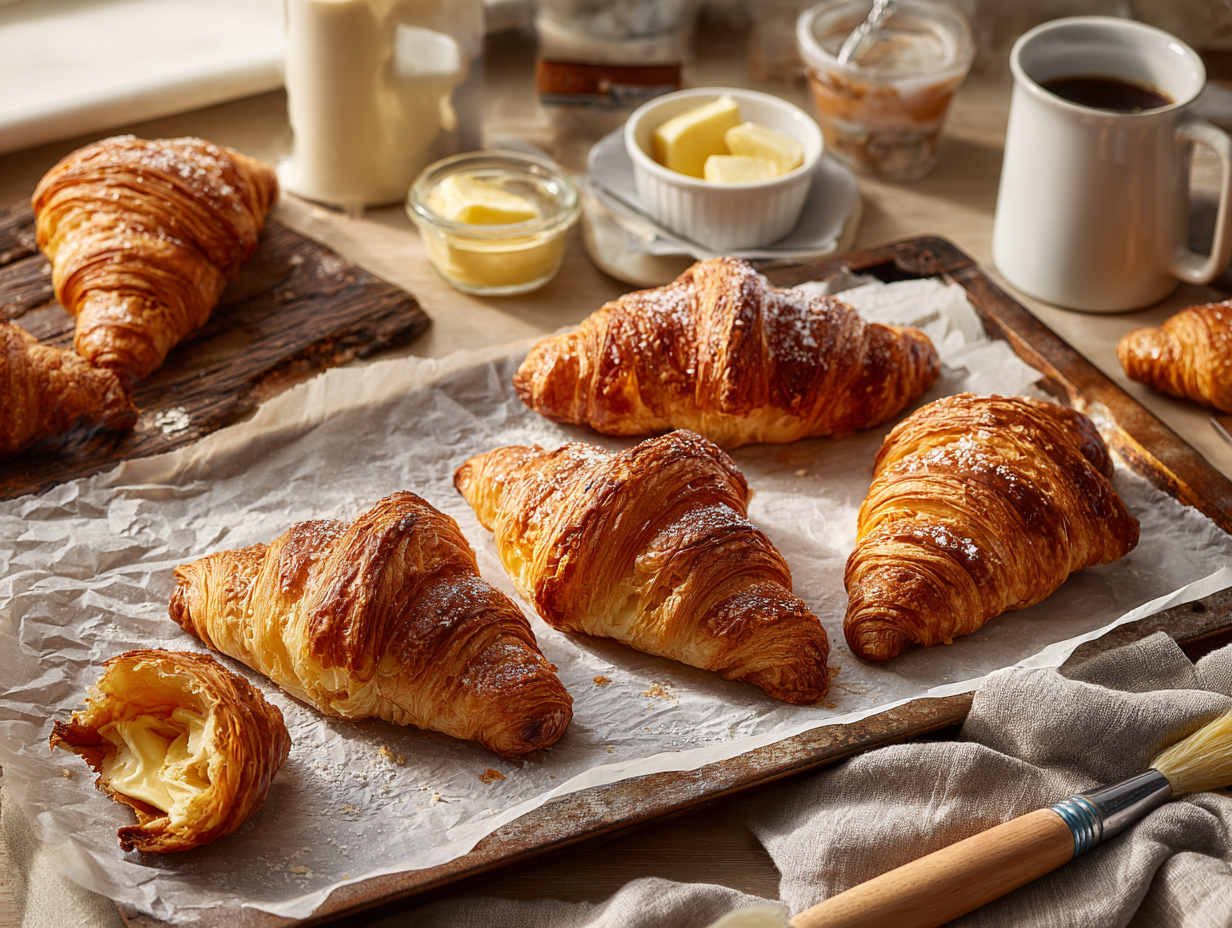
30-Minute Shortcut Croissants (All-Butter Puff Pastry)

Equipment
- Conventional oven (or convection)
- Rimmed baking sheet
- Parchment Paper or Silicone Baking Mat
- Rolling Pin
- Sharp chef’s knife or pizza wheel
- Pastry Brush
- Small mixing bowl
- Cooling rack
- Measuring cups and spoons
Ingredients
- 1 sheet all-butter puff pastry (10 to 12 oz), thawed but still cold brands like Dufour or Trader Joe’s all-butter puff pastry give best flavor and lift
- 1 tbsp all-purpose flour for dusting the work surface
- 1 large egg for egg wash
- 1 tbsp whole milk or water to loosen the egg wash
- 2 oz dark chocolate batons or chopped chocolate optional, for sweet filling
- 0.5 cup finely shredded Gruyère cheese optional, for savory variation
- 3 oz thinly sliced ham optional, for savory variation
- 1 tsp turbinado sugar optional, for sweet topping
- 1 pinch flaky sea salt optional, for savory topping
- 2 tbsp unsalted butter, melted optional, for glossy finish
- 1 tbsp warm honey optional, for serving
Instructions
- Preheat the oven to 400°F (205°C). Set a rack in the center and line a rimmed baking sheet with parchment paper or a silicone mat.
- Make the Egg Wash: In a small bowl, whisk 1 large egg with 1 tablespoon whole milk (or water) until smooth and glossy. Keep a pastry brush ready.
- Roll the Pastry: Lightly flour your work surface. Unfold 1 sheet of cold all-butter puff pastry and dust the top with a whisper of flour. Roll into a neat 10×12-inch rectangle. If the dough softens or feels sticky, slide it onto the baking sheet and chill it for 5 minutes to re-firm.
- Cut Triangles: Using a sharp knife or pizza wheel, cut the rectangle lengthwise into two 5×12-inch strips. Cut each strip into 4 long triangles by slicing diagonally at even intervals to yield 8 isosceles triangles with a 5-inch base. Make a 1/2-inch slit in the center of each base to help the crescent curve.
- Fill and Shape: Gently stretch the base of a triangle to widen it slightly. If using, add about 1 teaspoon chopped chocolate (or a baton) for sweet; or a small strip of ham plus a pinch of Gruyère for savory. Roll from the base to the tip, keeping light tension so the layers stay snug. Curve the ends toward each other into a crescent and place seam-side down on the lined sheet. Repeat with remaining triangles, spacing them about 2 inches apart.
- Glaze: Lightly brush each croissant with egg wash, avoiding puddles on the sheet. For sweet, sprinkle a little turbinado sugar; for savory, add a tiny pinch of flaky sea salt.
- Bake: Bake for about 20 minutes, rotating the pan halfway through, until the croissants are deeply golden, dramatically puffed, and crisp at the tips. The kitchen should smell buttery and toasty.
- Finish and Cool: Transfer croissants to a cooling rack. While hot, brush lightly with melted butter for extra sheen, or drizzle with warm honey for a sweet finish. Cool 5 minutes so the layers set, then serve warm.
Notes
Lisa’s Tips:
- Keep it Cold: Warm pastry smears butter and reduces lift. If the dough turns soft, chill 5–10 minutes and resume.
- Brand Matters: All-butter puff pastry delivers superior flavor and crispness. Avoid oil-based doughs for this recipe.
- Egg-Wash Finesse: A 1 egg : 1 tablespoon milk ratio gives shine without excessive browning. Add a pinch of salt to break the proteins for a smoother brush.
- Convection Option: Bake at 375°F (190°C) on convection for similar browning. Start checking at 16 minutes.
- No Puff Pastry? Use refrigerated crescent-roll dough as an ultra-quick alternative; bake per package at 375°F (190°C) for 12–14 minutes. Texture will be breadier than flaky.
- Chocolate Baton Hack: Stack a few chocolate chips end-to-end to mimic a baton for even, melty pockets.
- For Extra Lamination Vibe: After rolling to 10×12 inches, fold like a letter (tri-fold), chill 5 minutes, then roll back to 10×12. This mini-fold adds a touch more layering.
- Work swiftly and lightly—puff pastry likes cool rooms and confident hands.
- If you plan to make both sweet and savory, divide the batch and use separate pastry brushes for egg wash to avoid cross-flavoring.
- For the most dramatic layers, avoid pressing down on the rolls; tension should come from gentle stretching as you roll.
Serving Suggestions:
- Plate on a warm, light-colored platter to showcase the deep golden hue. Let the crescents face outward in a spiral for an elegant presentation.
- Garnish with a light snowfall of powdered sugar for sweet versions, or a few chives for savory.
- Serve with small pots of good jam, cultured butter, or Dijon and cornichons (for ham & Gruyère).
- Pair with a bright, aromatic coffee or a citrusy mimosa; the acidity cuts the richness beautifully.
Culinary Context:
Traditional French croissants are a triumph of lamination—yeast-leavened dough wrapped around a sheet of butter and folded repeatedly over hours or days. This modern shortcut swaps in quality all-butter puff pastry to approximate that flaky architecture in a fraction of the time. You still get layers, aroma, and that irresistible shatter, perfect for a quick brunch or pastry basket.Optional Advanced Instructions:
- Prep Ahead: Shape croissants, freeze on the tray until firm, then store in a zip-top bag up to 1 month. Bake from frozen at 400°F (205°C), adding 2–4 minutes.
- Par-Bake for Events: Bake 12–14 minutes until just pale golden, cool, then finish to deep gold for 6–8 minutes before serving.
- Beginner Alternative Shaping: Cut the pastry into rectangles, roll around fillings, and bake seam-side down—clean look, zero fuss.
Timing:
Prep Time: 0 hours 12 minutesCook Time: 0 hours 20 minutes
Total Time: 0 hours 32 minutes
Course:
BreakfastOrigin:
FrenchNutrition
FAQ
Can I use puff pastry that has shortening instead of butter?
You can, but the results will be noticeably different — less flavor and less flakiness. All-butter puff pastry is the one ingredient worth buying specifically for this recipe; everything else has a workable substitute.
My puff pastry is still frozen. Can I thaw it quickly on the counter?
Yes, 30–40 minutes at room temperature is usually enough to make it pliable without it getting too warm. Check it every 10 minutes — you want it flexible but still cold to the touch, not soft or greasy.
Do I have to use parchment paper, or can I grease the pan?
Greasing the pan works fine. Butter or a light spray of cooking oil will prevent sticking just as well. Parchment makes cleanup faster, but it’s not required.
Can I make these ahead the night before?
Yes — shape the croissants, place them on the lined baking sheet, cover loosely with plastic wrap, and refrigerate overnight. Pull them out while the oven preheats and bake as directed; they may need an extra 2 minutes since they’re starting colder.
Why are my croissants not browning evenly?
Uneven browning usually means the egg wash wasn’t applied consistently, or the oven has hot spots. Rotate the baking sheet halfway through the bake time and make sure the egg wash covers the full surface without pooling in the folds.
Can I skip the egg wash entirely?
Yes, though the crust will be paler and matte rather than golden and glossy. Brushing with milk or cream is a reasonable middle ground if you’re out of eggs and still want some color.
What to cook next
- Quick French Cream Puffs
- Quick No-Yeast Beignets
- Easy Classic French Crêpes
- Quick Vanilla Cinnamon French Toast