
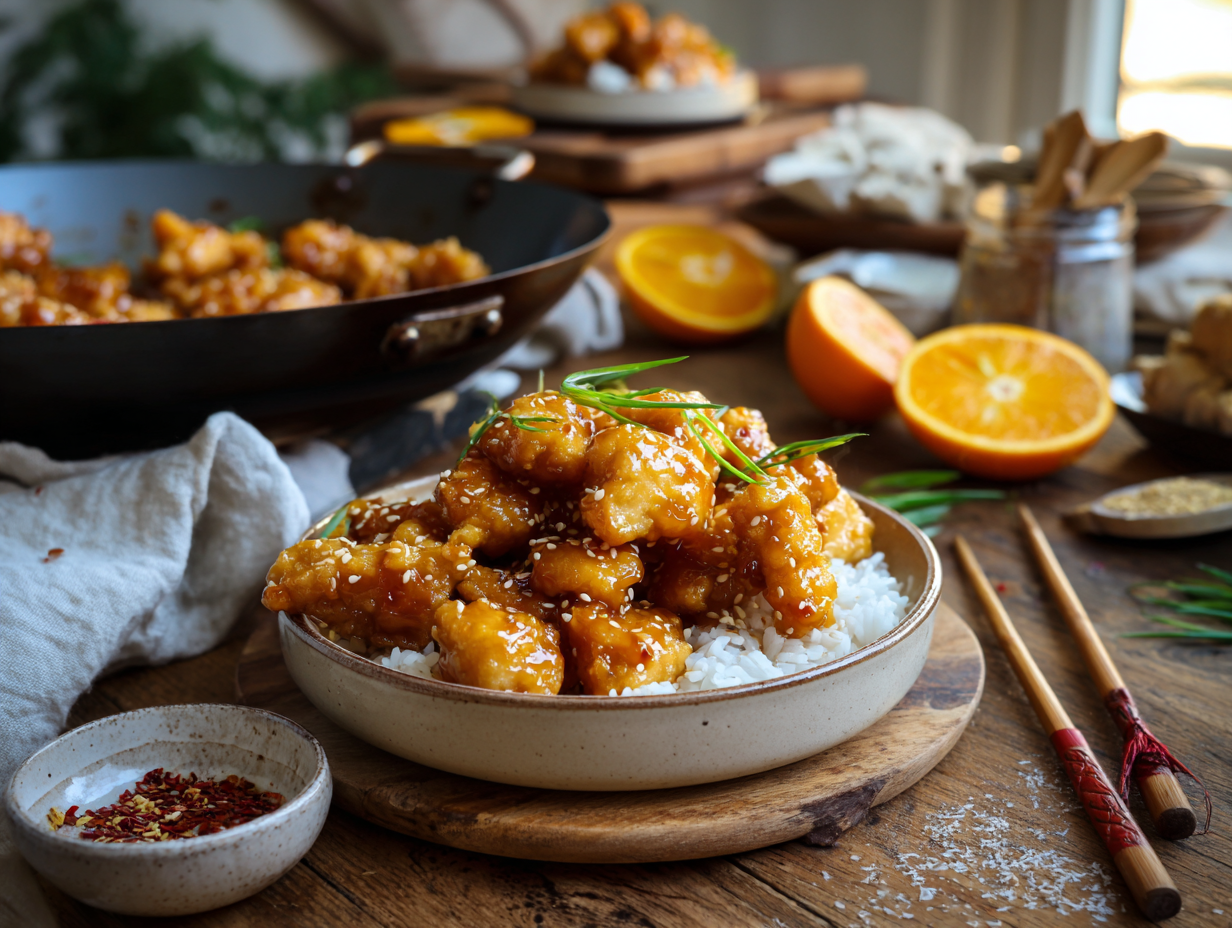
This is a skillet orange chicken built around fresh orange zest and juice, with chicken thighs fried in small batches so every piece stays genuinely crispy. It comes together in 28 minutes and uses ingredients you likely already have. If your usual takeout order includes orange chicken, this is worth making on a Tuesday.
Why this recipe works
Two things actually drive the result here. First, coating the chicken in egg and cornstarch before frying creates a shell that stays crisp even after you toss it in sauce — skip that step and you get soggy chicken in a puddle. Second, using chicken thighs instead of breast meat gives you a real margin for error: thighs tolerate the high heat of shallow-frying without drying out, so even if your oil temperature dips slightly between batches, the meat stays juicy. Those two decisions together are why this recipe holds up when you’re cooking for a crowd and the timing gets imperfect.
If something goes sideways
- The coating falls off during frying: The chicken was probably too wet before it hit the oil. Pat each piece completely dry before dredging, and let the coated pieces rest on a wire rack for two minutes before they go in the pan.
- The sauce won’t thicken: Your slurry ratio or heat may be off. Make sure the sauce is at a full simmer before adding the slurry, and stir constantly for 60 seconds after adding it. If it’s still thin, mix a fresh teaspoon of cornstarch with a teaspoon of cold water and stir it in.
- The sauce tastes flat or one-dimensional: Fresh orange juice varies a lot in sweetness and acidity. Taste the sauce before adding the chicken and adjust — a small splash of rice vinegar sharpens it, a pinch more brown sugar rounds it out.
- Cooking for a larger group and the chicken turns soggy while you finish batches: Keep finished batches on a wire rack in a 250°F oven. Don’t stack the pieces and don’t cover them — trapped steam is what kills the crust. Toss everything in the sauce right before serving, not before.
- The oil smokes before the chicken is cooked through: Your pan is too hot or too thin. Pull it off the heat for 30 seconds, reduce to medium-high, and continue. An instant-read thermometer takes the guesswork out — chicken is done at 165°F internally.
Ingredient notes
- Orange marmalade (optional): It thickens the sauce and deepens the citrus flavor without adding more liquid. A low-sugar variety works fine. If you skip it, the sauce is slightly thinner but still good.
- Rice vinegar: Don’t substitute white distilled vinegar — it’s too sharp. Apple cider vinegar is a reasonable backup in a pinch.
- Low-sodium soy sauce: Regular soy sauce will make the finished dish noticeably saltier. If that’s all you have, start with two tablespoons and taste before adding more.
- Fresh navel oranges: Bottled orange juice lacks the aromatic oils from the zest, which do real work in the sauce. Zest first, then juice — it’s much easier than the other way around.
Leftovers and make-ahead
Leftovers keep in an airtight container in the fridge for up to three days. The coating softens overnight — that’s unavoidable — but the flavor is still good. Reheat in a dry skillet over medium heat for four to five minutes rather than the microwave, which makes the chicken rubbery. Skip the garnish on reheated leftovers; not worth the extra dish. If you’re planning ahead for guests, you can mix and refrigerate the sauce up to two days in advance and dredge the chicken up to an hour ahead, keeping the pieces on a rack uncovered in the fridge. Fry and sauce everything right before you eat. The chicken does not freeze well once sauced — the coating turns mushy on thawing.
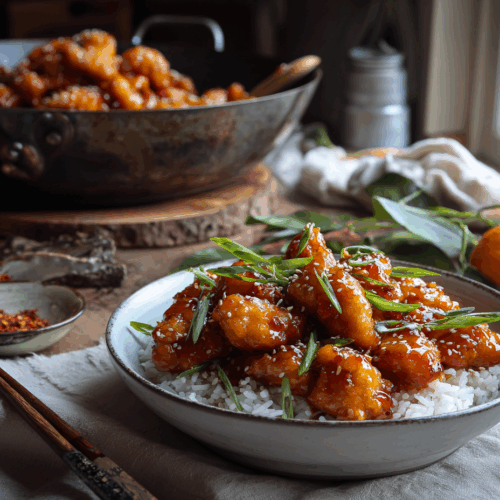
30-Minute Crispy Orange Chicken (Wok-Style)

Equipment
- Wok or large 12-inch skillet
- Medium mixing bowl
- Small bowl (for slurry)
- Whisk
- Tongs or chopsticks
- Microplane zester
- Citrus juicer
- Measuring cups and spoons
- Instant-read thermometer (optional)
- Wire rack set over a sheet pan or plate lined with paper towels
Ingredients
For the orange sauce
- 2 medium fresh navel oranges You’ll need 1 tbsp zest and 3/4 cup juice
- ⅓ cup light brown sugar, packed Adjust to taste for sweetness
- 3 tbsp low-sodium soy sauce Keeps saltiness balanced; use tamari for gluten-free
- 2 tbsp unseasoned rice vinegar Adds bright tang; adjust to taste at the end if needed
- 1 tbsp orange marmalade (optional) Boosts citrusy body and sheen in the glaze
- ¼ cup chicken broth Low-sodium preferred; water works in a pinch
- 3 cloves garlic, minced Freshly minced for best aroma
- 1 tbsp fresh ginger, finely minced Sharpens the citrus and adds warmth
- ½ tsp red pepper flakes (optional) For gentle heat; add more to taste
- 1 tbsp cornstarch For slurry to thicken the sauce
- 1 ½ tbsp water To make the cornstarch slurry
For the chicken
- 1.5 lb boneless skinless chicken thighs, cut into 1-inch pieces Thighs stay juicy; chicken breast works but cook carefully
- 1 tbsp soy sauce For seasoning the chicken before coating
- 1 tbsp Shaoxing wine (or dry sherry) Adds depth; optional but recommended
- ½ tsp garlic powder Savory backbone in the coating
- ¼ tsp white pepper Classic gentle heat and aroma; black pepper works in a pinch
- 1 large egg Helps the cornstarch cling for extra crispness
- ½ cup cornstarch For coating; potato starch works beautifully too
- ½ cup neutral oil, for frying Canola, peanut, or vegetable oil; add more as needed to create a 1/4-inch layer
To finish & serve
- 1 tsp toasted sesame oil Finish for aroma—use sparingly
- 2 scallions (green onions), thinly sliced Green parts preferred for color and freshness
- 1 tsp toasted sesame seeds For a nutty finish and texture
Instructions
Equipment
- Wok or large 12-inch skillet
- Mixing bowls (medium and small)
- Whisk, tongs or chopsticks
- Microplane zester and citrus juicer
- Measuring cups and spoons
- Instant-read thermometer (optional)
- Wire rack over sheet pan or paper towels
Ingredients List (At a Glance)
See the full measured list above—organized for workflow: blend sauce first, prep slurry, coat chicken, fry, then glaze and finish.Preparation Instructions
- Make the orange sauce base: Zest the oranges to get 1 tbsp zest, then juice to yield 3/4 cup. In a bowl, whisk the orange juice and zest with brown sugar, low-sodium soy sauce, rice vinegar, orange marmalade (optional), chicken broth, garlic, ginger, and red pepper flakes. It should smell bright and floral with a warm ginger lift.
- Mix the slurry: In a small bowl, whisk 1 tbsp cornstarch with 1 1/2 tbsp water until smooth. Reserve.
- Season and coat the chicken: Pat chicken dry. In a medium bowl, whisk 1 tbsp soy sauce, Shaoxing wine, garlic powder, white pepper, and the egg. Add chicken and toss. Sprinkle in 1/2 cup cornstarch, tossing until every piece is evenly coated and slightly clumpy. Rest 5 minutes—this helps the crust set.
- Heat the oil: Add enough neutral oil to your wok or skillet to reach about 1/4 inch depth. Heat over medium-high until the oil reaches 350°F (175°C). If you don’t have a thermometer, a wooden chopstick will bubble steadily on contact when ready.
- Fry in batches: Add half the chicken in a single layer. Fry 3–4 minutes, turning as needed, until deep golden and crisp and the centers read 165°F (74°C). Transfer to a rack or paper towels. Repeat with remaining chicken. Carefully pour off excess oil, leaving about 1 tbsp in the pan.
Air-fryer alternative: Preheat to 400°F (205°C). Lightly oil the basket. Air-fry coated chicken in a single layer 12–14 minutes, shaking halfway, until 165°F (74°C) and golden. - Build and thicken the sauce: Return pan to medium heat. Whisk the sauce base briefly and pour it in. Bring to a lively simmer (about 1 minute), then whisk in the slurry. Cook 30–60 seconds until the bubbles look thicker and the sauce turns glossy and syrupy—enough to coat a spoon.
- Glaze the chicken: Add the fried chicken, tossing for 30–60 seconds until every piece is lacquered. Drizzle in sesame oil and add most of the sliced scallions; toss to combine.
- Taste and adjust: For more brightness, add a splash of rice vinegar; for more sweetness, a teaspoon of brown sugar; for more heat, a pinch of red pepper flakes.
- Serve: Transfer to a warm platter or bowls. Sprinkle with sesame seeds and remaining scallions. See Serving Suggestions below for plating ideas.
Chef’s Tips
- Extra crisp: After coating, lightly dust with a bit more cornstarch just before frying for a craggier crust.
- Starch swap: Potato starch fries up even crisper than cornstarch—use it 1:1.
- Citrus control: Taste your oranges; if very sweet, reduce brown sugar by 1–2 tsp. If tart, keep as written.
- Tender chicken: Thighs are forgiving. If using breast, cut slightly larger (1 1/4-inch) and don’t overcook.
- Gluten-free: Use tamari instead of soy sauce and confirm marmalade and vinegar are GF.
- No wok? A heavy 12-inch skillet works. For best sear, avoid overcrowding.
- Cleaner glaze: Strain the sauce base before heating if you prefer a silky finish without bits of garlic/ginger.
Serving Suggestions
- Plate: Spoon over steamed jasmine rice or fluffy short-grain rice. Pile the chicken high for drama and let the glaze cascade.
- Garnish: Finish with scallions, sesame seeds, and a few thin strips of fresh orange zest for a fragrant pop of color.
- Sides: Blistered snap peas or steamed broccoli with a squeeze of lemon complement the sauce.
- Pairings: Lightly off-dry Riesling, chilled jasmine tea, or a crisp wheat beer.
- Doneness cues: The sauce should be glossy and cling in a thin, glassy sheet; chicken should stay crisp with a juicy center.
Notes
Nutrition
FAQ
Can I double this recipe to feed a larger group?
Yes, doubling works well — just don’t change your frying approach. Keep frying in small batches of four to six pieces regardless of how much chicken you’re making, and hold finished batches on a wire rack in a 250°F oven while you work through the rest. Crowding the pan is the one thing that will ruin a doubled batch, because it drops the oil temperature and steams the chicken instead of frying it.
Can I use an air fryer instead of pan-frying?
You can, though the crust will be slightly less shatteringly crisp than the pan-fried version. Cook at 400°F for 12 to 14 minutes, flipping halfway, then toss in the sauce made separately on the stovetop. It’s a reasonable trade-off if you’re trying to reduce the oil.
My family doesn’t like spicy food — can I leave out the red pepper flakes?
Absolutely, the dish works fine without them. The flakes add a background warmth rather than real heat, but the orange, ginger, and garlic carry the flavor on their own.
What should I serve this with to round out the meal?
Steamed jasmine rice is the most practical choice because it soaks up the extra sauce. If you want a vegetable on the same plate without making a separate dish, blanched broccoli or snap peas tossed into the sauce for the last 30 seconds works well and keeps the whole meal under 30 minutes.
Try these next
- Quick Ginger Scallion Wontons
- Quick Korean Bibimbap Bowls
- Citrus Mojo Rice and Beans
- Spicy Korean Rice Cakes