
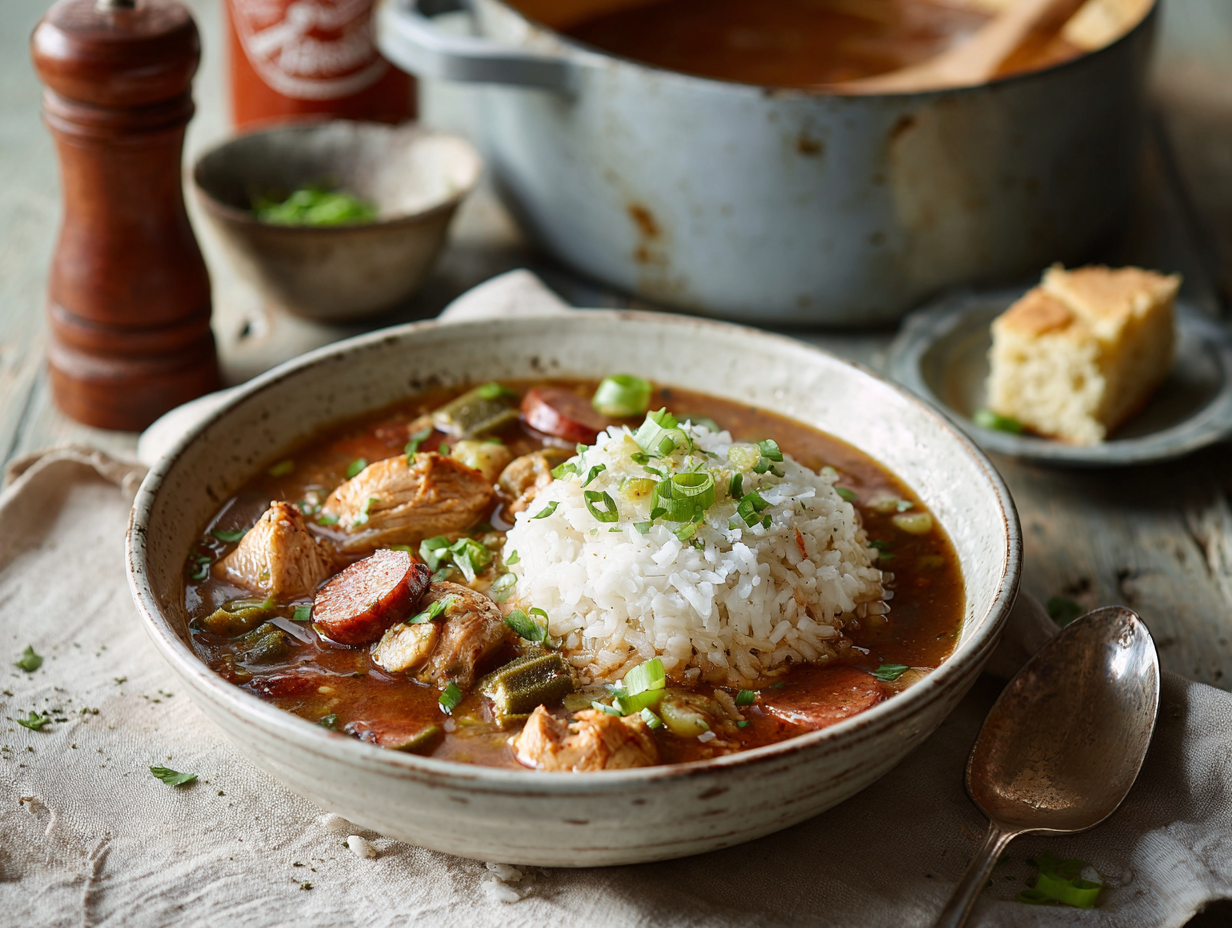
This is a chicken and andouille gumbo built for a Tuesday night — one pot, about 35 minutes, and a result that actually tastes like gumbo rather than a watered-down stew. The roux is cooked fast over higher heat to a peanut-butter color, the andouille does real work building the base, and the whole thing comes together without any special equipment or hard-to-find ingredients. If you want a bowl of something smoky, thick, and satisfying without clearing your whole evening, this is the recipe.
Why this recipe works
Two things carry this recipe. First, the roux is cooked hot and fast — 6 to 8 minutes of constant stirring over medium-high heat gets you a nutty, toasted base that gives the broth its body and depth. Most weeknight shortcuts skip the roux entirely and the result tastes flat; this one doesn’t. Second, warm stock goes into the hot roux rather than cold. That temperature match is what prevents lumps and gives you a silky broth from the first stir instead of something you have to whisk out later. Get those two steps right and the rest of the recipe is straightforward.
What can go wrong
- The roux burns before it’s ready. If it smells bitter or turns dark brown with black flecks, it’s gone — a burned roux makes the whole pot taste acrid and there’s no fixing it. Start over with fresh fat and flour, and drop the heat slightly. Keep the spoon moving the entire time.
- The broth turns out thin. Okra releases its thickening properties as it cooks, so if your gumbo looks thin at the 15-minute mark, don’t panic. Give it the full simmer time before adjusting. If it’s still too loose at the end, a short uncovered simmer of 3 to 5 extra minutes will tighten it up.
- The andouille makes the whole dish too salty. Andouille varies a lot by brand — some are aggressively seasoned. Taste the broth before adding any extra salt, and hold off on seasoning until everything has simmered together for at least 10 minutes.
- The chicken is rubbery. This usually means it was cut too large or added too early and then overcooked. Small, even pieces — about 1-inch chunks — will cook through in the simmer time without tightening up. Thighs are more forgiving than breast here, but size still matters.
- Filé powder clumps or turns stringy. Never add filé to a boiling pot. Stir it in off the heat or into individual bowls. A little goes a long way — start with a small pinch and taste before adding more.
Make-ahead notes
Gumbo keeps well and is often better the next day once the flavors have had time to settle. Store it in an airtight container in the fridge for up to 4 days — keep the rice separate so it doesn’t absorb all the broth overnight. For freezing, skip the okra before freezing if you can (it softens considerably on reheating) and freeze the gumbo base in portions for up to 3 months. Reheat gently on the stovetop over medium-low, adding a splash of chicken stock or water to loosen it back up, since the roux will cause it to thicken considerably when cold. Skip the garnish — not worth the extra dish when you’re reheating leftovers on a Wednesday.
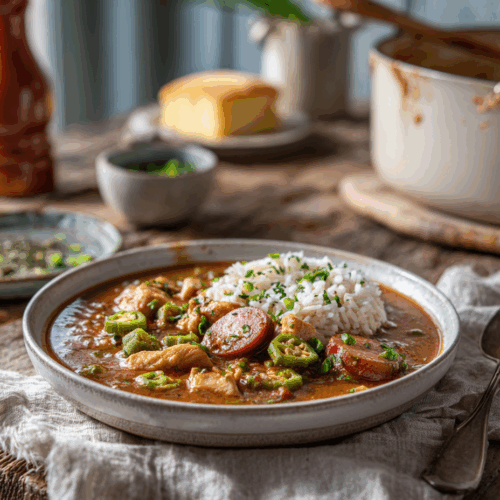
30-Minute Weeknight Chicken & Andouille Gumbo

Equipment
- 5- to 6-quart heavy-bottomed pot or Dutch oven
- Wooden spoon or flat-edged spatula
- Whisk
- Chefs Knife
- Cutting board
- Measuring cups and spoons
- Ladle
- Instant-read thermometer (optional)
- Rice cooker or medium saucepan with lid (for rice)
Ingredients
For the Gumbo:
- 2 tbsp neutral oil (canola or peanut) peanut oil handles higher heat for roux; canola works well too
- 8 oz andouille sausage, sliced 1/4-inch thick look for a smoky, coarse-grind andouille; Aidells or a local Cajun brand are great
- 12 oz boneless skinless chicken thighs, cut into 1/2-inch pieces thighs stay juicier than breast in quick simmers
- 3 tbsp all-purpose flour for a fast, medium roux
- 1.5 cups yellow onion, diced from 1 medium onion; fresh, firm onions are best
- 1 cup green bell pepper, diced from 1 medium pepper; choose glossy, heavy peppers
- 0.75 cup celery, diced from 2 ribs; crisp, pale-green ribs are sweetest
- 1 tbsp garlic, minced about 3 cloves; avoid pre-minced for best aroma
- 1 tbsp tomato paste (optional) adds subtle sweetness and color
- 0.5 tsp smoked paprika deepens smokiness alongside the andouille
- 0.25 tsp cayenne pepper adjust to heat preference
- 0.5 tsp freshly ground black pepper
- 1 tsp kosher salt, divided use Diamond Crystal; reduce by 1/3 if using Morton
- 4 cups low-sodium chicken stock homemade if possible; store-bought like Swanson works well
- 1 piece bay leaf fresh-dried (under 1 year) has brighter aroma
- 0.5 tsp dried thyme rub between fingers to awaken oils
- 1 tsp Worcestershire sauce adds savory depth
- 1 tsp hot sauce Crystal or Tabasco recommended
- 1 cup okra, sliced (fresh or thawed frozen) adds body; slice 1/2-inch thick
- 2 tbsp flat-leaf parsley, chopped reserve some for garnish
- 2 pieces scallions, thinly sliced green and pale parts
To Finish & Serve:
- 4 cups cooked long-grain white rice, warm use Louisiana long-grain or jasmine for fragrance
- 1 tsp filé powder (sassafras), optional stir in off heat for classic aroma and a little body
- 1 pinch Kosher salt to taste, for final seasoning
- 1 pinch black pepper to taste, for final seasoning
Instructions
- Preheat and Prep (2 minutes): Set a 5–6 qt Dutch oven over medium heat. Have all ingredients measured and the trinity (onion, bell pepper, celery) diced. Warm your stock in a small pot or microwave-safe jug—warm stock blends more smoothly with roux.
- Brown the Andouille (3 minutes): Add the sliced andouille to the dry pot and cook, stirring, until lightly browned and some fat renders, about 2–3 minutes. The sausage should smell smoky and sizzle. Transfer to a bowl; keep the flavorful fat in the pot.
- Season and Sear Chicken (3–4 minutes): Toss chicken with half the salt, half the black pepper, the smoked paprika, and cayenne. Add 1 tbsp oil to the pot and sear chicken just until opaque on the outside, 2–3 minutes; do not fully cook. Transfer to the bowl with the andouille.
- Make a Quick Medium Roux (6–8 minutes): Add remaining 1 tbsp oil to the pot. Sprinkle in the flour and stir constantly with a flat-edged spatula, scraping the corners. Cook over medium to medium-high until the roux turns the color of peanut butter to light milk chocolate—glossy and nutty, 6–8 minutes. If using a thermometer, keep surface temperature around 325–350°F (165–175°C). If it smells sharp or scorches, lower heat and keep stirring.
- Cook the Trinity (3–4 minutes): Stir in onion, bell pepper, and celery with the remaining salt. Sauté in the roux until slightly softened and edges look glossy, 3–4 minutes. Aromas should be sweet and toasty.
- Add Aromatics (1 minute): Add garlic and tomato paste; cook 30–60 seconds until fragrant and the paste darkens slightly. Avoid burning the garlic.
- Build the Gumbo (1–2 minutes): Whisk in warm chicken stock gradually to avoid lumps. Add bay leaf, thyme, Worcestershire, and hot sauce. Return andouille and chicken (along with any juices) to the pot.
- Simmer to Thicken (8–10 minutes): Bring to a gentle simmer, about 185–195°F (85–90°C). Add okra and cook, stirring occasionally, until chicken is just cooked through and the broth is lightly silky, 8–10 minutes. Skim any excess fat if desired.
- Finish and Balance (1–2 minutes): Remove bay leaf. Stir in most of the parsley and scallions, reserving some for garnish. Taste and adjust salt, pepper, and heat. If using filé powder, remove from heat first, then stir in filé to avoid stringiness—do not boil after adding filé.
- Serve: Spoon warm rice into bowls and ladle gumbo over top. Garnish with remaining parsley and scallions. Serve with extra hot sauce on the side.
Notes
Jen’s Tips:
- Faster Roux: Use a wide pot for more surface area and steady stirring. Peanut oil tolerates higher heat for quicker browning without burning.
- Okra vs. Filé: Okra adds body during the simmer; filé (sassafras) thickens off heat and adds a classic aroma. You can use one or both, but never boil filé.
- Gluten-Free: Swap flour for 1:1 gluten-free all-purpose blend, or skip roux and thicken lightly with 1–2 tsp filé off heat.
- Protein Swaps: Use rotisserie chicken (added at Step 8) to save time, or sub shrimp (add in last 3 minutes) for a seafood twist.
- Heat Control: Layer heat with cayenne and hot sauce; finish with a few drops at the table to keep spice bright.
- Stock Quality: Better stock = better gumbo. If using store-bought, a dash of fish sauce (1/2 tsp) can boost savory depth.
Serving Suggestions:
- Plating: Mound rice slightly off-center; ladle gumbo around so rice peeks through. Finish with a confetti of scallions and parsley.
- Visual Cues: Broth should be glossy and lightly thick, with a warm mahogany hue and flecks of herbs.
- Sides & Drinks: Serve with warm cornbread or crusty French bread, and a crisp pilsner or iced tea with lemon.
Culinary Context:
Gumbo is a beloved dish of Louisiana with African, French, and Indigenous roots—the name likely linked to the West African word for okra. Styles vary: Cajun gumbos often skip tomatoes and lean on roux; Creole versions may include tomatoes. This version keeps it weeknight-friendly while respecting the flavor pillars: roux, the trinity, and soulful seasoning.Optional Advanced Instructions:
- Make-Ahead: Dice trinity up to 2 days ahead. Roux can be made in advance and refrigerated for 1 week; warm gently before use.
- Parallel Prep: Start rice first (12–18 minutes) so it’s ready as the gumbo finishes. Warm stock while browning sausage to streamline Step 7.
- Beginner Alternative: If roux makes you nervous, start with medium heat and cook a shade lighter; you’ll trade a touch of depth for more control.
Timing:
- Prep Time: 10 minutes
- Cook Time: 25 minutes
Course & Origin:
- Course: Dinner, MainCourse
- Origin/Cuisine: Cajun-Creole, American-Southern (Louisiana)
Nutrition
Frequently asked questions
Can I use chicken breast instead of thighs?
You can, but thighs are the better choice for this recipe. Breast meat cooks faster and dries out quickly in a simmering broth, so if you use it, cut the pieces smaller and check them at the 8-minute mark rather than waiting for the full simmer time.
I’ve never made a roux before — how do I know when it’s done?
You’re looking for the color and smell to change: it should go from pale and floury to a warm tan that looks like peanut butter, with a toasty, nutty aroma. If it still smells raw or looks white, keep stirring — it needs more time. The whole process takes 6 to 8 minutes over medium-high heat with constant movement.
Can I leave out the okra?
Yes — the roux already thickens the broth, so the gumbo will still have body without it. If you skip the okra and want a little extra thickness, a pinch of filé powder stirred in off the heat at the end will do the job.
More quick recipes to try
- Quick Cajun Dirty Rice
- Quick Smoky Weeknight Chili
- Quick White Chicken Chili
- Quick Chicken Noodle Soup