
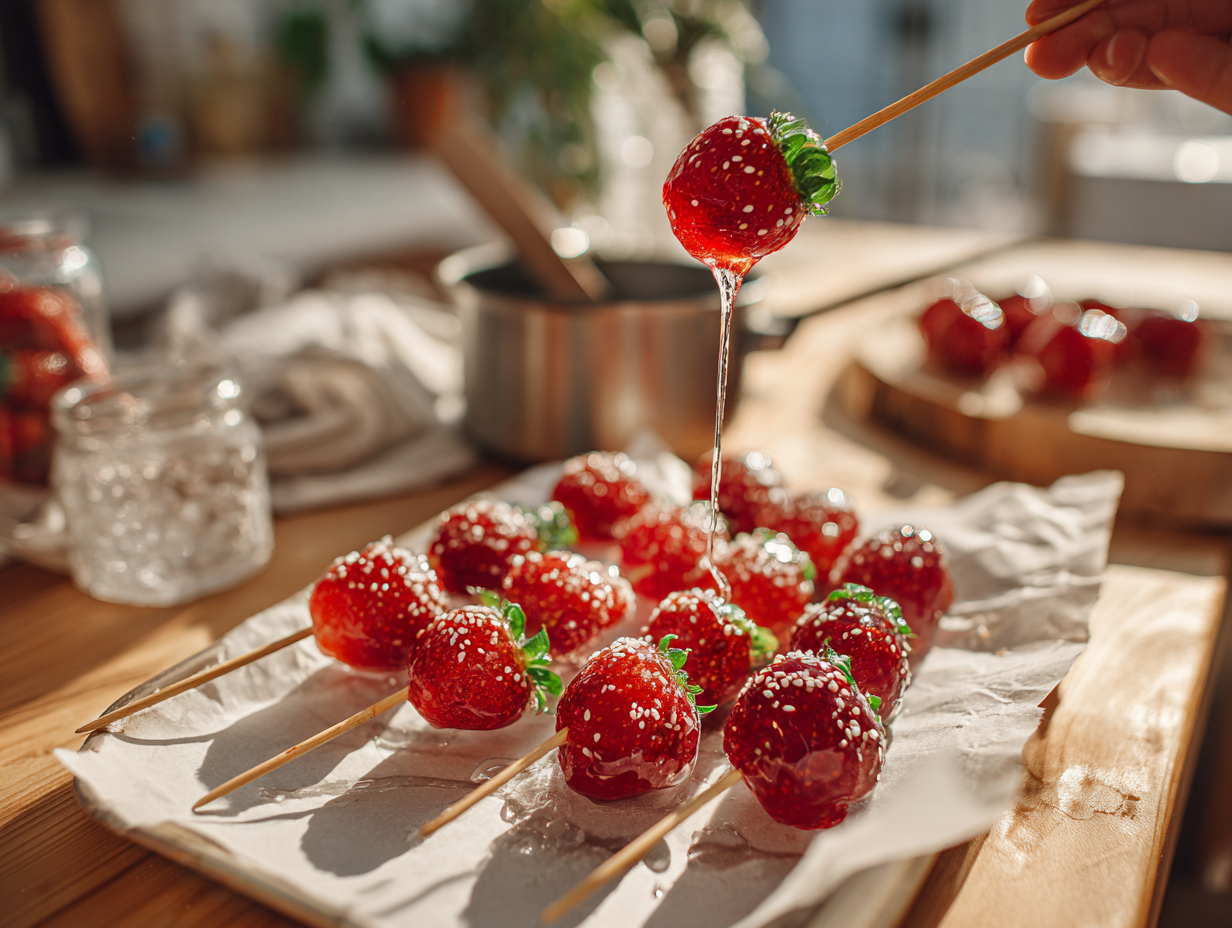
Tanghulu are fresh fruit skewers dipped in hard-crack sugar syrup — the coating sets glassy and brittle in seconds, and the whole thing takes 25 minutes start to finish. This version uses strawberries and grapes because they’re cheap, available year-round, and don’t need any prep beyond drying. If you’ve got a candy thermometer and a bag of sugar, you can make these tonight.
About the ingredients
- Granulated sugar: Standard white granulated sugar is exactly what you want. Do not substitute brown sugar, honey, or powdered sugar — they won’t reach hard-crack cleanly and will stay sticky.
- Corn syrup: A small amount prevents the sugar from crystallizing as it cooks. If you don’t have it, cream of tartar (about 1/8 teaspoon per cup of sugar) works as a substitute. Plain water alone will crystallize more easily, so don’t skip one of these two options.
- Fruit choices: Strawberries and grapes are the most forgiving. Avoid high-water fruits like watermelon or citrus segments — they release too much moisture and the coating won’t stick. Cherry tomatoes actually work well if that’s what you have.
- Skewers: Bamboo skewers from the dollar store are fine. Soak them in water for a few minutes first so the fruit doesn’t slide.
The short version of why this works
Two things matter here and nothing else does. First, the fruit must be completely dry before it goes anywhere near the syrup — even a thin film of moisture will prevent the sugar from bonding and you’ll end up with a coating that slides right off. Pat each piece with paper towels and let them air for a few minutes. Second, the syrup has to hit 300°F (hard-crack stage) before you dip. Below that temperature the coating stays soft and tacky instead of setting into a shell. Skip the garnish — not worth the extra dish. Once the coating is on and set, the skewers look exactly as good plain.
Troubleshooting
- Coating is sticky and won’t harden: The syrup didn’t reach 300°F, or the fruit had surface moisture. Next batch, clip the thermometer so the tip isn’t touching the pan bottom, and re-dry your fruit thoroughly before dipping.
- Sugar crystallized and turned grainy in the pot: Sugar crystals from the sides of the pan fell in. Brush the inside walls of the saucepan with a wet pastry brush while the syrup cooks, or cover the pot for the first two minutes to let steam wash the sides down.
- Coating slid off the fruit: Almost always a moisture problem. Even refrigerated fruit sweats — bring it to room temperature and dry it again right before dipping.
- Syrup hardened in the pot before you finished dipping: Work faster, or set the pot over the lowest possible heat while you dip. Don’t add water to thin it — that drops the temperature and ruins the batch.
- Coating cracked and fell off after setting: The layer was too thick from dipping too slowly. One smooth, quick dip and rotate is enough. Lingering in the syrup builds up excess that contracts unevenly as it cools.
Storage and reheating
Tanghulu is best eaten within two hours of making it. The sugar shell starts absorbing moisture from the fruit and from the air after that, turning soft and sticky — there’s no way around this. Do not refrigerate finished skewers; the humidity inside a fridge accelerates the breakdown and you’ll have a sticky mess within 30 minutes. If you need to hold them briefly, stand the skewers upright in a glass at room temperature and serve within the hour. There is no good way to reheat or restore a softened coating, so make only as many as you’ll eat right away.
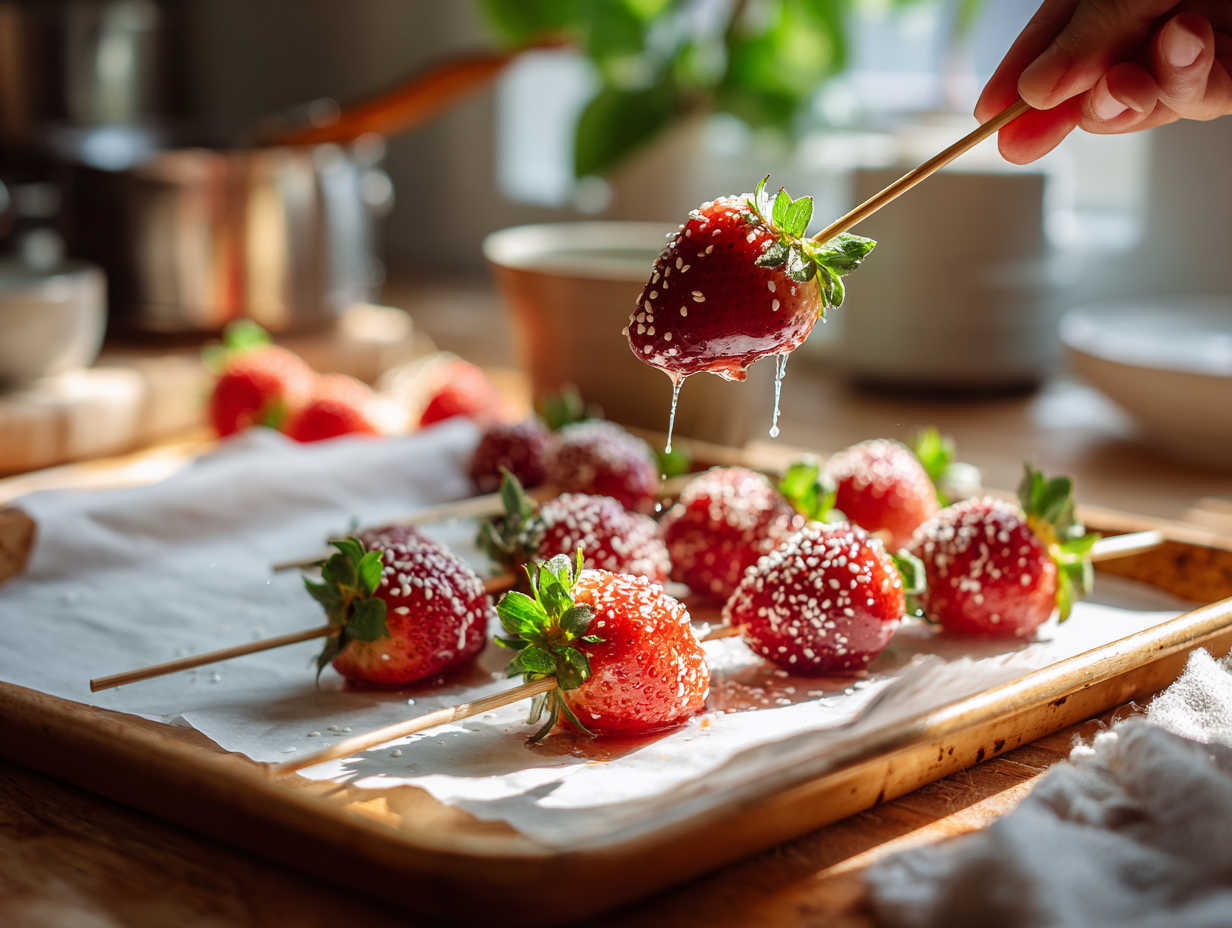
Classic Strawberry & Grape Tanghulu (Chinese Candied Fruit Skewers)

Equipment
- Heavy-bottomed saucepan (2–3 quart)
- Candy thermometer or instant-read thermometer (up to 400°F)
- Wooden or bamboo skewers (8–10 inches)
- Sheet pan
- Parchment Paper or Silicone Baking Mat
- Small bowl for ice water
- Heatproof glass measuring cup (optional for easier dipping)
- Tongs
- Paper towels
Ingredients
For the Fruit & Prep:
- 1 lb strawberries, firm and ripe, hulled but left whole choose medium size; pat completely dry for best sugar adhesion
- 24 pieces seedless grapes (green or red) firm, unblemished; pat completely dry
- 12 pieces hawthorn berries or small crabapples (optional, traditional) if using, pierce to check for seeds and remove if needed; dry well
- 2 cups cold water for ice-bath test; not consumed
- 1 cup ice cubes for ice-bath test
- 1 tsp neutral oil for lightly greasing parchment (skip if using silicone mat)
For the Syrup:
- 1 cup granulated sugar use fresh, dry sugar to minimize crystallization
- ½ cup water room temperature
- 1 tbsp light corn syrup optional; helps prevent crystallization and keeps syrup clear
- 1 pinch cream of tartar optional; alternative to corn syrup—use one or the other
To Finish (Optional):
- 1 tbsp toasted white sesame seeds for nutty aroma and texture
- 1 pinch flaky sea salt a modern twist to enhance fruit sweetness
Instructions
- Set the Stage: Line a sheet pan with parchment and lightly grease with 1 tsp neutral oil, or use a silicone mat. Place it near the stove. Fill a small bowl with 2 cups cold water and 1 cup ice for the hard-crack test.
- Prep the Fruit: Rinse and thoroughly dry all fruit—this is crucial. Any surface moisture will cause the sugar to seize. Fruit should feel matte and squeaky-dry.
- Skewer: Thread fruit onto wooden skewers. For grapes, use 3–5 per skewer; for strawberries, 1–2 medium berries; for hawthorn/crabapples, 2–3. Leave a 2-inch handle at the base for easy dipping.
- Start the Syrup: In a heavy saucepan, combine 1 cup granulated sugar, 1/2 cup water, and 1 tbsp light corn syrup (or a pinch of cream of tartar). Heat over medium-high, stirring gently only until the sugar is dissolved and the liquid looks clear (1–2 minutes). After that, do not stir; swirl the pan occasionally to cook evenly and prevent crystallization.
- Cook to Hard Crack: Attach a candy thermometer. Boil until the syrup reaches 300°F (about 149°C)—the hard crack stage, typically 8–12 minutes. Visual cue: the bubbles will be small and lively; the syrup should remain clear to very pale straw. If it turns deep amber, you’ve begun caramelization; lower the heat slightly to keep it light and glassy.
- Confirm with an Ice-Water Test (optional): Drop a tiny thread of syrup into the ice water. It should form brittle strands that snap cleanly when bent. If it bends or is tacky, cook 30–60 seconds more and test again.
- Set Up for Dipping: For easier control, carefully pour a portion of the hot syrup into a heatproof glass measuring cup. Alternatively, tilt the saucepan to create a deep pool for dipping. Keep the remaining syrup on low heat to maintain fluidity.
- Dip: Working quickly, dip and rotate each skewer to coat fruit evenly in a thin shell. Let excess drip off, then immediately flash-set the shell by dipping the coated fruit for 1–2 seconds into the ice water (avoid submerging the wooden handle). You should hear a faint crackle and see a glassy shine.
- Set and Finish: Lay skewers on the prepared pan. If using sesame seeds or a tiny pinch of flaky salt, sprinkle lightly while the shell is still tacky—within 10–20 seconds of dipping. Let cool 3–5 minutes until fully crisp.
- Serve: Enjoy immediately for maximum shatter and gloss. The shell should crack audibly and the fruit inside should be bright, juicy, and aromatic.
Notes
Jen’s Tips:
- Dryness is Everything: Water triggers crystallization. After washing, pat fruit thoroughly and air-dry for a few minutes until no sheen remains.
- Stability Insurance: A spoonful of light corn syrup or a pinch of cream of tartar helps prevent graininess and keeps the coating clear.
- Texture Control: A thin coating shatters cleanly; a thick coat can be too hard. Dip quickly and let excess drain.
- Heat Management: If the syrup thickens while you work, keep it on the lowest heat and swirl. If it starts to color, remove from heat briefly.
- Flavor Twists: Add a drop of vanilla or a whisper of citrus oil to the syrup off-heat for fragrant nuance (avoid water-based extracts).
- Dietary Swaps: For a lower-stick option, isomalt can be used in place of sugar and brought to the same hard-crack temperature.
Nutrition
Your questions, answered
Can I make tanghulu without a candy thermometer?
It’s risky but possible using the cold-water test — drop a small amount of syrup into ice water and it should form a hard, brittle thread that snaps. A thermometer is genuinely worth buying for this recipe; a basic candy thermometer costs about $8 and removes all the guesswork.
Why does my sugar keep crystallizing before it reaches temperature?
A stray sugar crystal on the side of the pan is usually the culprit — it triggers a chain reaction that turns the whole batch grainy. Brush the inner walls of the pan with a wet pastry brush as the syrup heats, and make sure your pan and utensils are completely clean before you start.
Can I use frozen fruit?
No. Frozen fruit releases water as it thaws, and surface moisture is the main reason coatings fail to set. Use fresh fruit and dry it very well.
What other fruits can I use if I don’t have strawberries or grapes?
Cherry tomatoes, blueberries, mandarin orange segments (patted very dry), and firm chunks of apple all work. Avoid anything with high water content or a very soft texture — the fruit needs to hold its shape on the skewer and stay dry enough for the coating to grip.
The syrup turned yellow or amber — did I ruin it?
A very pale yellow is fine and won’t affect flavor. Once it turns amber, the sugar is beginning to caramelize and will taste slightly bitter — that batch is past its window. Pull the pan off the heat the moment you hit 300°F and dip immediately.
What to cook next
- Quick Double Chocolate Cookies
- Perfect English Toffee Recipe
- Spicy Korean Rice Cakes
- Quick Ginger Scallion Wontons