
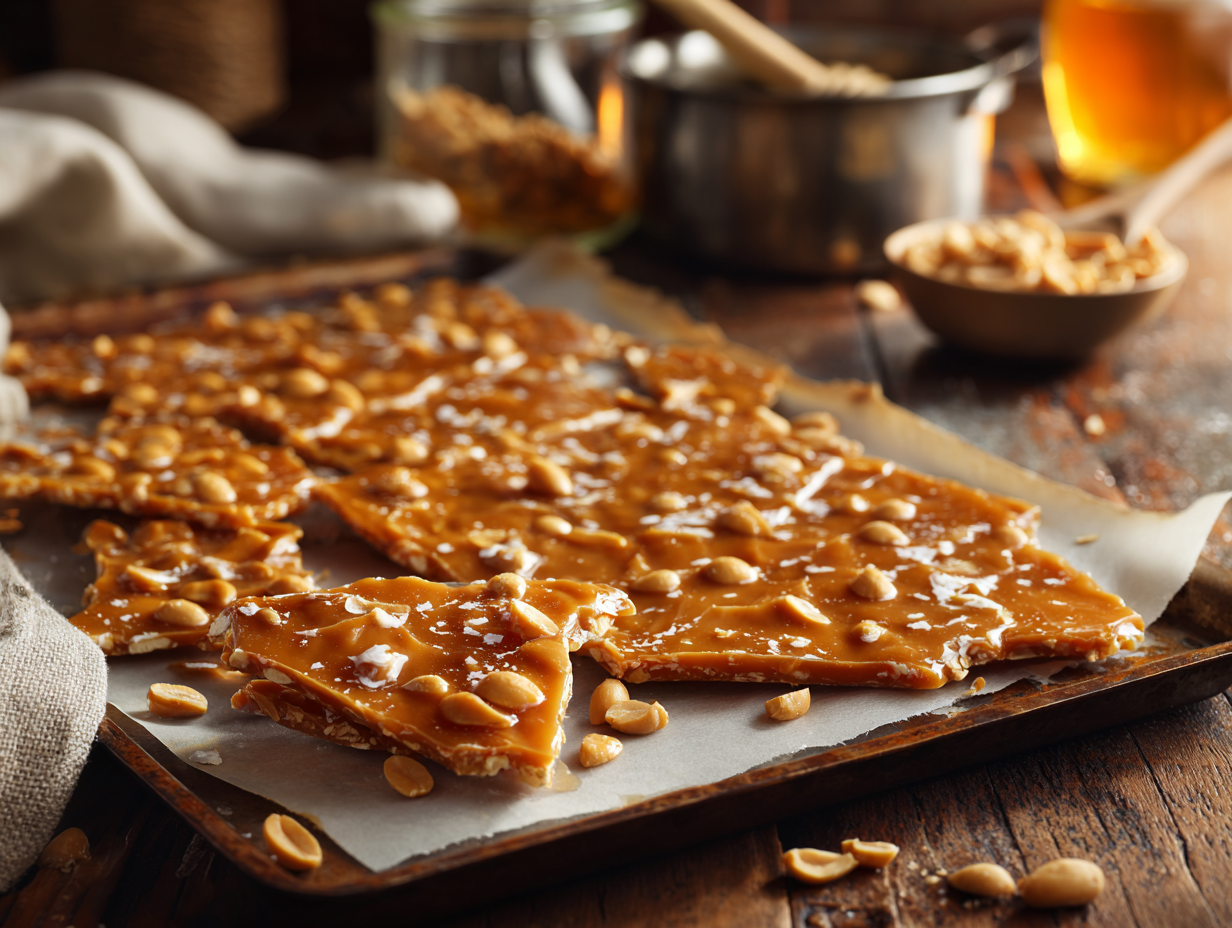
This peanut brittle comes together in about 30 minutes on the stovetop using sugar, corn syrup, butter, roasted peanuts, and baking soda. The baking soda is what makes it light and snappable rather than dense and tooth-breaking. If you need a make-ahead treat that holds up well and scales easily for a crowd, this is a reliable choice.
Substitutions that actually work
- Corn syrup: Don’t skip it or swap it for honey. Corn syrup prevents the sugar from crystallizing and going grainy — there’s no good substitute that behaves the same way at high heat.
- Roasted vs. raw peanuts: Raw peanuts work if you’re cooking them long enough to reach hard-crack temperature, but dry-roasted peanuts give you more consistent flavor without relying on the cook time to do the roasting. Salted roasted peanuts are fine — just hold back any added salt in the recipe.
- Butter: Unsalted is standard, but salted butter works. Skip margarine; the water content is different and can cause splattering.
- Vanilla: Pure or imitation both work here. The candy cooks hot enough that the difference is minimal.
What makes this version work
Two things matter most. First, medium heat — not low, not high. Low heat drags the cook time past 45 minutes and makes it harder to catch the right temperature window. High heat scorches the sugar before the center of the pot catches up. Medium heat gives you control and keeps the 30-minute timeline realistic. Second, the baking soda goes in fast and gets stirred quickly but not obsessively. It reacts immediately with the hot caramel to create tiny air bubbles throughout the mass. Those bubbles are what give brittle its characteristic lightness. Stir just enough to distribute it — about 5 to 10 seconds — then pour immediately. Overworking it after the soda goes in deflates those bubbles and leaves you with a denser, harder slab.
Troubleshooting
- Brittle is chewy or sticky after cooling: The sugar didn’t reach hard-crack stage (300–310°F). Humidity can also be a factor — avoid making brittle on a rainy day if possible, since sugar absorbs moisture from the air and stays tacky.
- Sugar seized into a grainy clump early in cooking: Undissolved sugar crystals on the sides of the pan fell back into the syrup. Use a wet pastry brush to wash down the sides before the syrup starts boiling, and don’t stir once it’s bubbling.
- Brittle cracked into uneven, too-thick chunks: The mixture wasn’t spread thin enough fast enough. Have your greased or lined baking sheet right next to the stove before you start. Once the soda goes in, you have maybe 20 seconds to pour and spread before it sets.
- Doubling the batch — sugar scorched on the bottom: A larger volume takes longer to heat through, so the bottom layer can burn before the top is ready. When scaling up for guests, make two separate batches rather than doubling in one pot. It takes only 30 minutes per batch and the results are far more consistent.
- Peanuts sank to the bottom of the pan: They were added too early, before the syrup thickened enough to hold them in suspension. Add peanuts only after the syrup reaches around 280°F so they stay distributed throughout the finished brittle.
Make-ahead notes
Peanut brittle is one of the better make-ahead candies. Once fully cooled and broken into pieces, store it in an airtight container at room temperature with parchment or wax paper between layers — it keeps well for up to two weeks. Don’t refrigerate it; the moisture in a fridge makes it sticky and soft. Freezing works for up to two months in a sealed freezer bag with the air pressed out, but bring it fully to room temperature before opening the bag, otherwise condensation will form on the surface and make it tacky. Skip the flaky salt garnish if you’re making this more than a day ahead — it dissolves into the surface and isn’t worth the extra step.
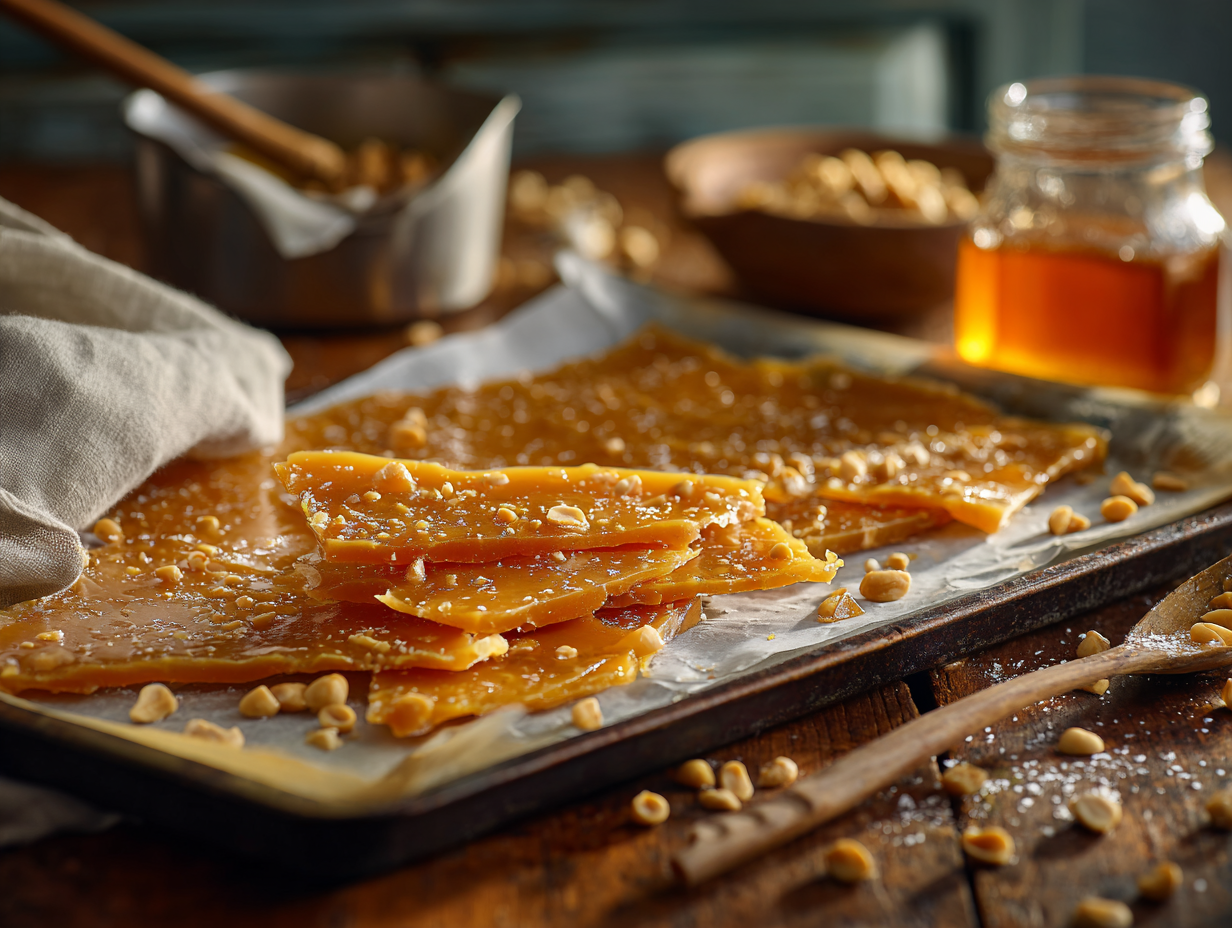
Classic Peanut Brittle (30-Minute)

Equipment
- Heavy-bottomed 3-quart saucepan
- Candy thermometer or instant-read thermometer (up to 400°F)
- Heatproof silicone spatula or wooden spoon
- Rimmed baking sheet
- Parchment Paper or Silicone Baking Mat
- Pastry Brush (optional, for dissolving sugar crystals)
- Measuring cups and spoons
- Small heatproof bowl
- Oven mitts
Ingredients
- 1 teaspoon neutral oil or unsalted butter for greasing parchment or mat
- 1 cup granulated sugar use fresh, free-flowing sugar for even melting
- ½ cup light corn syrup Karo or similar; ensures a smooth, glassy brittle
- ¼ cup water just enough to help the sugar dissolve evenly
- 2 tablespoons unsalted butter softened; adds flavor and reduces stickiness
- 1 cup unsalted roasted peanuts or raw Spanish peanuts; unsalted keeps sweetness balanced
- 1 teaspoon pure vanilla extract adds roundness to the caramel
- ¾ teaspoon baking soda aerates the brittle for a lighter, crisp snap
- ½ teaspoon fine sea salt balances sweetness; can reduce to 1/4 tsp if using salted peanuts
- 1 pinch flaky sea salt optional, for finishing
Instructions
- Prepare the Pan: Line a rimmed baking sheet with parchment or a silicone baking mat and lightly grease with 1 teaspoon neutral oil or butter. Keep the pan close to the stove for quick pouring.
- Stage Your Finishers: In a small bowl, combine the baking soda and fine sea salt so they’re ready to add together. Measure vanilla and set butter and peanuts within arm’s reach. This mise en place keeps the endgame smooth.
- Start the Syrup: In a heavy 3-quart saucepan, add sugar, corn syrup, and water. Stir just until the sugar is evenly moistened—no dry pockets. Attach a candy thermometer. Set over medium heat and cook without stirring. If crystals form on the sides, brush with a little water using a pastry brush.
- Cook to Light Amber: Let the syrup bubble steadily, occasionally swirling the pan for even heating. After about 8–10 minutes, the thermometer should read around 280°F (138°C) and the color will be pale gold with a gentle caramel aroma.
- Add Butter and Peanuts: Stir in the 2 tablespoons butter and 1 cup peanuts. Continue cooking, stirring occasionally to prevent hotspots, until the syrup reaches 300°F (149°C)—the hard-crack stage—about 3–5 minutes more. The mixture will be deep amber and the peanuts smell toasty.
- Aerate and Flavor: Remove from heat. Immediately stir in the vanilla, then the baking soda–salt mixture. The candy will foam and lighten—this creates tiny bubbles for an ultra-crisp, easy-to-bite texture. Stir just 5–10 seconds until evenly combined.
- Pour and Spread: Quickly pour the foamy candy onto the prepared pan. Tilt the pan and use a lightly oiled spatula to coax it into a thin sheet (about 1/8 inch). Work fast—30–45 seconds—then stop to preserve bubbles and avoid overworking.
- Finish and Cool: Sprinkle with a pinch of flaky sea salt (optional). Let cool until glassy and firm, about 5–8 minutes. Snap into shards—listen for that crisp, clean crack.
- Store Smartly: Keep brittle in an airtight container at cool room temperature with parchment between layers. It stays snappy for up to 2 weeks.
Notes
Lisa’s Tips:
- No Thermometer? Use the cold-water test: drizzle a little syrup into cold water—if it forms brittle, thread-thin strands that snap, it’s at hard-crack (approximately 300°F/149°C).
- Crystallization Insurance: Avoid stirring early; swirl instead. A tablespoon of corn syrup already helps, but brushing down the pan with water dissolves stray crystals.
- Nut Swaps: Try cashews, almonds, or pistachios (unsalted). For mixed nut brittle, keep total nuts to 1 cup.
- Dairy-Free: Replace butter with 2 tablespoons neutral oil or coconut oil for a dairy-free version.
- Flavor Twists: Add 1/4 teaspoon ground cinnamon or cardamom with the baking soda; or zest of 1/2 orange stirred in with vanilla for a bright aroma.
- Humidity Warning: Candy hates humidity. On damp days, work quickly and store airtight as soon as cool.
Nutrition
Your questions, answered
Do I really need a candy thermometer?
A thermometer is the most reliable way to hit hard-crack stage consistently. If you don’t have one, the cold-water test works — drop a small amount of syrup into ice water and it should form brittle, snapping threads — but a thermometer removes the guesswork, especially when you’re making multiple batches for guests.
Can I use a nonstick pan instead of a heavy-bottomed saucepan?
No. Most nonstick coatings are not rated for the temperatures required for hard-crack candy (300°F+), and thin nonstick pans develop hot spots that scorch the sugar. Use a heavy-bottomed stainless or enameled pot.
Why did my brittle turn out dark brown instead of golden?
The sugar cooked past the target temperature and started to burn. This usually happens when the heat is too high in the final minutes. Once the thermometer reads around 280°F, watch it closely — the temperature climbs fast from there and the difference between golden and burnt is less than a minute.
Can I make this without corn syrup?
Not successfully. Corn syrup is what prevents sugar crystallization at high heat — without it, you’re likely to end up with a grainy, fudge-like texture instead of glassy brittle. It’s a functional ingredient, not just a sweetener.
How do I break the brittle into even pieces for gifting?
Let it cool completely — at least 20 minutes — then lift the whole sheet off the pan and break it by hand or with the back of a wooden spoon. Scoring it lightly with a knife while it’s still warm (but set) gives you more control over the size of pieces if uniformity matters.
Can I double this recipe if I’m making it for a party?
Make two separate batches instead of doubling in one pot. A larger volume of sugar syrup heats unevenly in a standard home saucepan, which increases the risk of scorching on the bottom before the top is ready. Two back-to-back 30-minute batches give you twice the brittle with far less risk.
If you liked this one
- Perfect English Toffee Recipe
- Chinese Candied Fruit Tanghulu
- Quick Double Chocolate Cookies
- Classic Midwestern Scotcharoos Recipe