
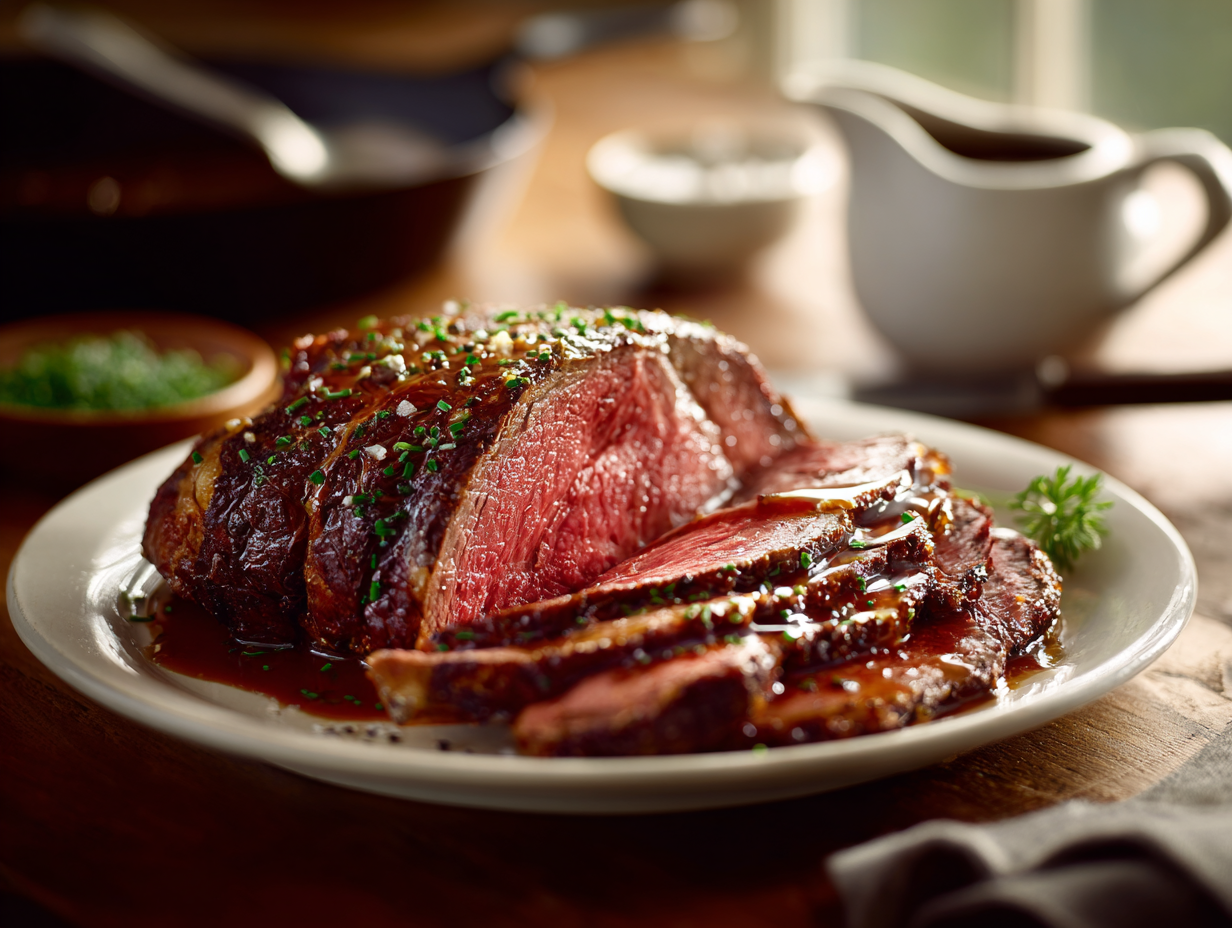
This is a 2-pound boneless ribeye roast cooked entirely on the stovetop and in the oven in about 40 minutes — no overnight dry-brine, no special rig, no half-day babysitting. It serves two to three people and finishes with a quick pan jus made from the drippings. If you want prime rib on a weeknight without committing your entire evening, this is the honest way to do it.
The short version of why this works
Two things carry this recipe. First, a screaming-hot skillet sear before the roast ever sees the oven — this builds the dark, savory crust that normally takes hours of dry-roasting to develop. Second, pulling the roast at 118–120°F internally and letting it rest under foil. The internal temperature will climb another 5–7 degrees during the rest, landing you at medium-rare without any guesswork. Both steps depend on each other: skip the hard sear and the crust is pale; skip the early pull and the rest won’t save you from overcooking. A 2-pound roast has very little thermal buffer, so the thermometer is doing real work here, not just confirming what you already know.
About the ingredients
- Boneless ribeye roast: Ask the butcher counter specifically for a “boneless ribeye roast” or “boneless prime rib” — it’s the same muscle as individual ribeye steaks, just left as one piece. A 2-pound piece typically equals two to three thick steaks still attached. Butcher’s twine keeps the shape even so it cooks uniformly; ask them to tie it if they haven’t already.
- Kosher salt (Diamond Crystal vs. Morton): These two brands have different crystal sizes, which is why the recipe specifies reducing Morton by half. Using the wrong amount is one of the most common reasons a roast comes out over-salted — worth paying attention to the label.
- Avocado or grapeseed oil: Regular olive oil will smoke aggressively at the temperature needed for searing. Either of these neutral high-heat oils handles it without filling your kitchen with smoke.
- Sherry for the jus: Dry sherry is ideal but a splash of dry vermouth or even low-sodium beef broth alone works fine. Skip the cooking sherry sold near vinegars — it’s heavily salted and throws off the balance.
Storage and reheating
Leftover roast keeps well in an airtight container in the refrigerator for up to 3 days. For reheating, slice the meat first — thin slices warm through in about 60 seconds in a covered skillet over low heat with a small splash of the reserved jus or beef broth. Avoid the microwave if you can; it tends to push the center past medium-rare quickly. The jus stores separately in the fridge for the same 3 days and reheats in a small saucepan over medium-low in about 2 minutes. Freezing is possible — wrap slices tightly in plastic, then foil, and freeze for up to 6 weeks — but the texture softens slightly after thawing, so it’s better used in sandwiches or hash than served as a standalone roast.
Mistakes to avoid
- Skipping the pat-dry step: Surface moisture is the enemy of a good sear. Even a minute of extra moisture on the roast will steam the exterior instead of browning it. Use paper towels and press firmly on all sides right before the oil goes in the pan.
- Starting with a cold skillet: The pan needs to be genuinely hot before the roast goes in — not warm, not medium-high for 30 seconds. Give cast iron at least 2 full minutes over high heat. A drop of water should evaporate instantly on contact.
- Opening the oven repeatedly to check: Every time the oven door opens, the temperature drops and the cooking time shifts. Insert the thermometer probe once and check it without opening the door, or use an oven-safe probe thermometer if you have one.
- Cutting into the roast immediately after it comes out: The juices redistribute during the rest. Slice too soon and they run straight onto the cutting board instead of staying in the meat. Ten minutes under loose foil is the minimum — skip the garnish on the plate while you wait, not worth the extra dish.
- Using a skillet that’s too small: A roast crowded in a 10-inch pan traps steam around the sides and prevents even browning. A 12-inch skillet gives the roast room to sear properly on all surfaces.
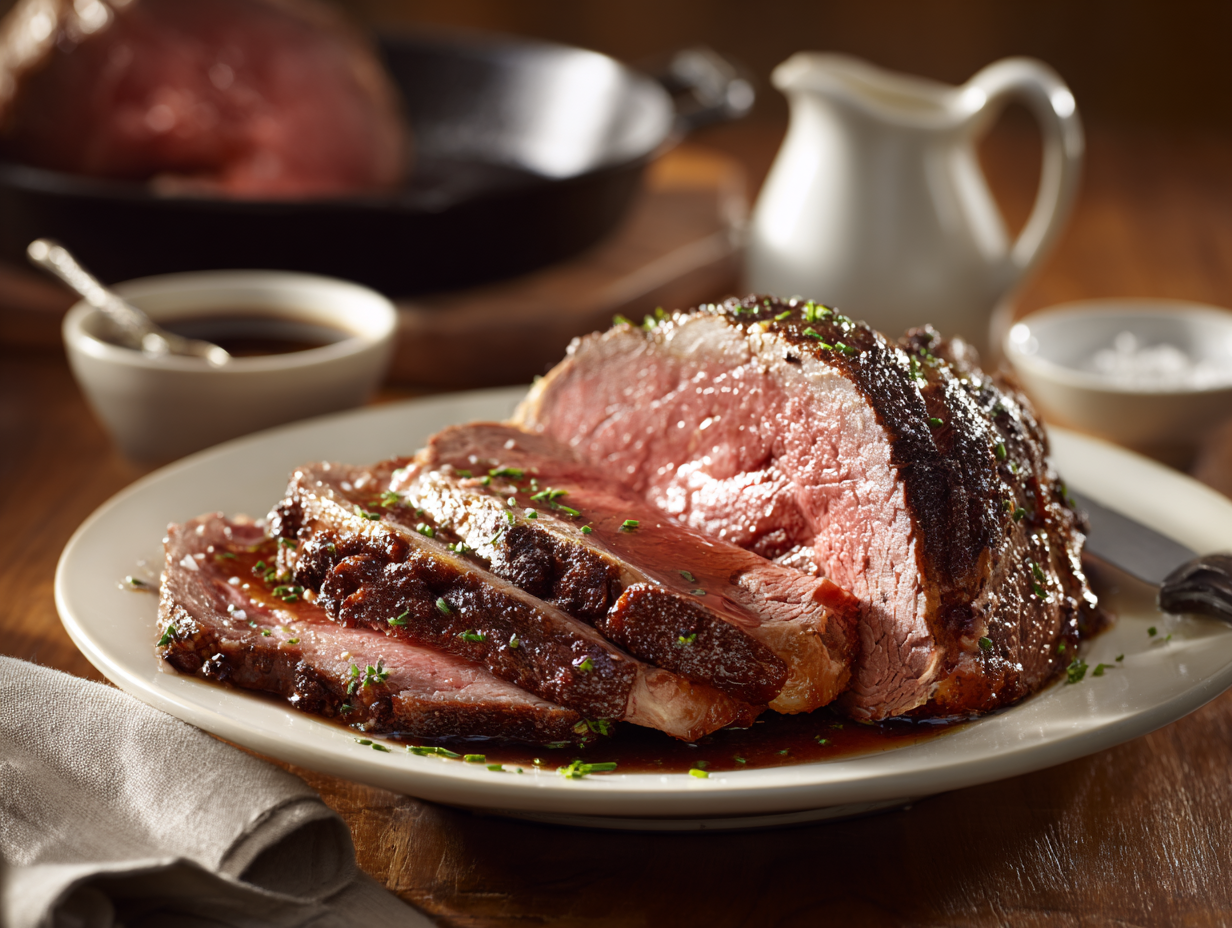
Turbo Prime Rib Roast for Two (High-Heat, 40-Minute Method)

Equipment
- 12-inch oven-safe skillet (cast iron preferred)
- Instant-read thermometer
- Tongs
- Small saucepan (or use the skillet for the jus)
- Cutting board
- Sharp carving knife
- Aluminum Foil
- Paper towels
Ingredients
- 2 lb boneless prime rib (ribeye) roast preferably USDA Choice or Prime; have it tied with butcher’s twine
- 2 tsp kosher salt Diamond Crystal preferred; reduce by 1/2 if using Morton
- 1 ½ tsp freshly ground black pepper medium-coarse grind for better crust
- 1 tbsp neutral high-heat oil avocado or grapeseed oil
- 2 tbsp unsalted butter room temperature if possible
- 3 cloves garlic finely minced (about 1 tbsp)
- 1 tbsp fresh rosemary finely chopped
- 1 tsp fresh thyme leaves chopped
- ½ cup low-sodium beef broth good quality store-bought or homemade
- 2 tbsp dry sherry or dry white wine optional, for deglazing
- 1 tsp Worcestershire sauce adds depth to the jus
- 1 tsp Dijon mustard balances richness of the jus
- 1 pinch flaky sea salt for finishing slices
- 1 tbsp fresh parsley or chives finely chopped, for garnish
Instructions
- Preheat and Prep (about 10 minutes total): Preheat your oven to 500°F (260°C), rack in the middle. Pat the 2 lb boneless prime rib roast very dry with paper towels—dry meat browns faster and deeper. If not already, tie with butcher’s twine every 1 1/2 inches for an even cylinder. Season all over with 2 tsp kosher salt and 1 1/2 tsp black pepper, pressing to adhere. In a small bowl, combine 2 tbsp softened butter, 3 minced garlic cloves, 1 tbsp chopped rosemary, and 1 tsp chopped thyme; set aside.
- Sear for a Bold Crust (6 minutes): Heat a 12-inch oven-safe skillet over high heat. Add 1 tbsp neutral oil; when it shimmers and a wisp of smoke appears, lay in the roast. Sear 2 minutes per broad side (4 minutes total), then 1 minute on each end (2 minutes) until deep brown and fragrant—listen for a lively sizzle; it should not be spitting aggressively.
- Baste and Roast (16 minutes at 500°F/260°C): Reduce heat to medium; smear the herb-garlic butter over the top and sides and baste for 30 seconds as it foams and turns nutty-aromatic. Insert an instant-read thermometer horizontally into the center. Transfer the skillet to the oven and roast 16 minutes, or until the thermometer reads 118–120°F (48–49°C) for medium-rare. For medium, go to 125°F (52°C). Visual cue: the butter will have browned and the edges will be sizzling.
- Rest and Make the Pan Jus (10 minutes rest; jus 4 minutes during rest): Move the roast to a cutting board, tent loosely with foil, and rest 10 minutes—this evens the juices. While it rests, pour off excess fat from the skillet, set over medium heat, and deglaze with 2 tbsp dry sherry or white wine (optional), scraping up browned bits for 1–2 minutes. Add 1/2 cup beef broth, 1 tsp Worcestershire, and 1 tsp Dijon; simmer 2 minutes to reduce slightly. Taste and adjust salt and pepper. If you like, swirl in a teaspoon of butter off heat for gloss.
- Carve and Finish (2 minutes): Remove twine. Slice into 1/2-inch slices across the grain. Sprinkle with a pinch of flaky sea salt and shower with chopped parsley or chives. Serve immediately with warm jus.
- Safety and Technique Notes: If you don’t have a cast-iron skillet, any heavy, oven-safe pan works; just ensure it’s preheated well for the sear. If you lack an instant-read thermometer, the center should feel springy (not firm) for medium-rare; however, a thermometer is strongly recommended for precision.
Notes
Jen’s Tips:
- Buy Right: A small, well-marbled, center-cut boneless ribeye roast (about 2 lb) is ideal for this fast method.
- Dry Brine Option: Salt the roast up to 24 hours ahead and refrigerate uncovered for even deeper seasoning and better crust.
- No Wine? Skip the sherry and add a splash of water or extra broth plus a few drops of Worcestershire.
- Herb Swaps: Use 1 tsp dried rosemary and 1/2 tsp dried thyme if fresh aren’t available; crumble finely.
- Dairy-Free: Replace butter with 2 tbsp olive oil; the jus will still be silky.
- Alternative Method for Thicker Pieces: If your roast is over 2 1/2 lb, consider a quick reverse-sear: roast at 275°F (135°C) to 115°F internal, rest 10 minutes, then sear 1–2 minutes per side in a ripping-hot pan.
- For best results, rely on temperature over time. Pull at 118–120°F (48–49°C) for medium-rare and let carryover heat finish the job during the 10-minute rest. Ovens and pan materials vary; adjust a minute or two as needed.
Nutrition
Frequently asked questions
Do I really need an instant-read thermometer, or can I use the finger-poke test?
Yes, you genuinely need a thermometer for this recipe. A 2-pound roast is small enough that the difference between medium-rare and overcooked is only a few degrees and a couple of minutes — the finger test doesn’t give you that precision.
Can I use a bone-in prime rib roast instead of boneless?
You can, but the cooking time will increase and the searing step becomes harder because the bone creates an uneven surface in the skillet. Boneless is strongly recommended for this specific method.
What if my roast is closer to 3 pounds — does the timing change?
Yes, plan on an additional 8–12 minutes of oven time and start checking the internal temperature earlier than you think you need to. The target pull temperature of 118–120°F stays the same regardless of size.
Is USDA Prime worth the extra cost here, or is Choice fine?
USDA Choice works well and is what most grocery stores carry. Prime has more marbling and will be slightly richer, but the high-heat method produces a good result with either grade — don’t stress if Prime isn’t available.
My skillet isn’t oven-safe. Can I transfer the roast to a baking dish for the oven portion?
Yes — sear in whatever pan you have, then move the roast to a small baking dish or rimmed sheet pan for the oven. You’ll make the jus in a separate small saucepan using the drippings you pour off from the searing pan.
Can I season the roast ahead of time, or does it need to go straight into the pan?
Seasoning 30–60 minutes ahead and letting it sit uncovered at room temperature is fine and helps the salt penetrate slightly. Don’t season it and then refrigerate it overnight without a full dry-brine setup — the surface moisture that draws out won’t have time to reabsorb and will interfere with the sear.
What to cook next
- Perfect Bistro French Fries
- Easy Silky Brown Gravy
- Speedy Twice-Baked Potato Casserole
- Bright Poppy Seed Broccoli